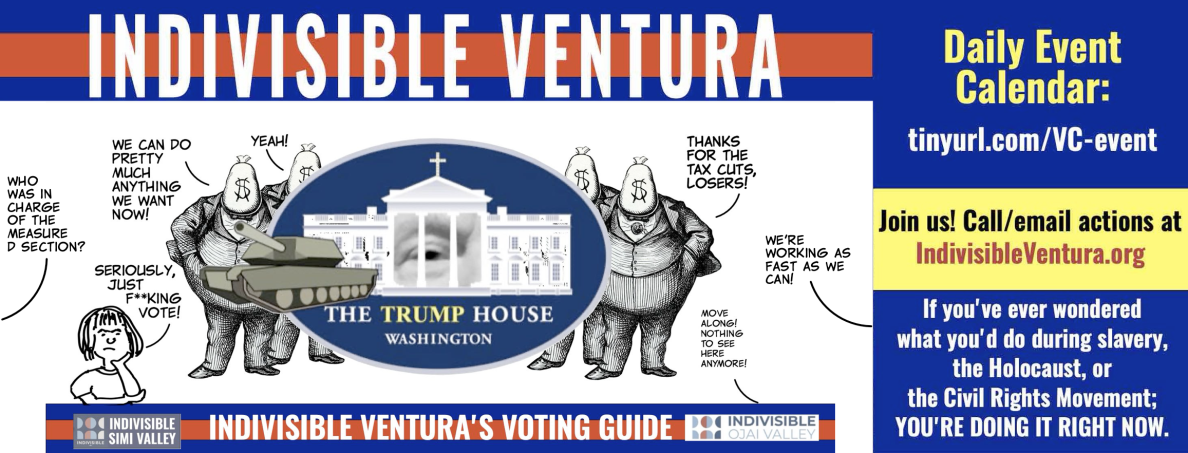
Note: this post will be periodically updated! (10/22/2026)
VOTER GUIDE – QUICK LINKS:
- HOME: Quick Voting Guide
FEDERAL LEGISLATORS: 24th Congressional Dist. * 26th Congressional Dist. * 32nd Congressional Dist. - STATE LEGISLATORS: Assembly, 38th Dist. * Assembly, 42nd Dist. * Assembly, 46th Dist.
- STATE OFFICES: Governor * Lt. Governor * Secretary of State * Controller * Treasurer * Attorney General * Insurance Commissioner * State Board of Equalization * Superintendent of Public Instruction
- JUDICIAL: Judicial Offices
- COUNTY EDUCATION: Superintendent of Schools * Ventura County Board of Education Trustees (* Ventura County Community College District Trustees *
- CITY SCHOOL DISTRICTS: Fillmore USD * Las Virgenes USD * Moorpark USD * Oxnard USD * Pleasant Valley School District * Rio School District * Santa Paula USD * Simi Valley USD * Ventura USD
- CITY COUNCILS: Camarillo * Moorpark * Ojai * Oxnard * Port Hueneme * Santa Paula * Simi Valley * Thousand Oaks * Ventura
- SPECIAL DISTRICTS: Antelope Valley -East Kern Water Agency * Bell Canyon Community Service Dist. * Camarillo Health Care District * Conejo Rec. & Park District * Fillmore-Piru Memorial District * Oxnard Harbor District * Pleasant Valley Rec. & Park District * Rancho Simi Rec. & Park District * Santa Clarita Valley Water Agency * United Water Conservation District
- PROPOSITIONS: TLDR * Prop. 1 * Prop. 2 * Prop. 3 * Prop. 4 * Prop. 5 * Prop. 37 * Prop. 38 * Prop. 39 * Prop. 40 * Prop. 41 * Prop. 42 * Prop. 43 * Prop. 44 * Prop. 45
- LOCAL MEAURES: Measures
- VOTING:
Voting Fast Facts!

- The League of Women Voters has a great informational page on all aspects of voting here. (https://my.lwv.org/california/ventura-county)
- Returning your ballot: Not sure about the post office right now? You can return your ballot securely at ballot boxes and and voting centers. Find the closest option here: https://indivisibleventura.org/ballot-box-and-voting-center-locations/
- Registration: Information page to do the following:
- Check your voter status,
- register online,
- pre-register if you’re 16 or 17
- Make changes – changed your address, name or political party preference?
- Questions? Call the Ventura Co. Elections Division at(805) 654-2664
- Hotline: 1-800-500-3555
- Election Observation information: Information page
- Sign up for “Track my Ballot”: https://california.ballottrax.net/voter/
- Report it. Call the Election Protection hotline to report any type of voter intimidation.
- Contact the Election Protection hotline, available in multiple languages, using the following phone numbers:
- English: 1–866-OUR-VOTE
- Spanish or English: 1–888-VE-Y-VOTA
- Asian languages or English: 1–888-API-VOTE including Mandarin, Cantonese, Korean, Vietnamese, Tagalog, Urdu, Hindi, Bengali/Bangla, and Punjabi
- Arabic or English: 1–844-YALLA-US
- Contact the Election Protection hotline, available in multiple languages, using the following phone numbers:
New Postmark Rule Change Affects Your Ballot!

Register to become a Neighborhood Poll Protector with Epic 805!
We all know that this isn’t a normal election…
We know that our own president is threatening to subvert our elections. We have no idea how far he will go, but he’s already started an ICE surge on the central coast to frighten some of our neighbors from exercising their right to vote as American citizens.
(More on this below the graphic.)
If you were wondering what you could do besides voting early to protect our democracy, here it is.

Join a movement that’s happening across California!
Our county needs over a hundred volunteers to watch the polls in their communities, Poll protectors will safely document and report incidents to legal experts, and make sure every voter knows their rights to cast a ballot without fear or intimidation.
Sign up for one of (5) 90-minute training session to learn how you can look out for your neighbors, your block, and your local polling place. Spanish interpretation is available.
(tinyurl.com/cipc-training)
– Monday, Oct. 19 (6pm)
-,Monday, Oct. 26 (6pm)
(tinyurl.com/Train-for-CA)
– Wednesday Oct, 14 (6pm)
– Wednesday Oct, 21 (6pm)
– Saturday, Oct. 24 (10 am)
Why is this important for us all to pitch in?
If you haven’t read it yet, this article from the Santa Barbara Independent discusses the surge in ICE operations here on the central coast.
“According to a report published by the Washington Examiner, the ICE activity across the region is believed to be part of a 45-day surge known internally as “Operation Safe California.” Government sources revealed to the Examiner that ICE officers have allegedly been told to arrest all undocumented immigrants they encounter, regardless of criminal history.
Governor Gavin Newsom issued a statement in response to the alleged operation, saying that “Donald Trump is using fear and panic as a weapon, putting families at risk, undermining our economy.”
Gubernatorial Candidate Xavier Becerra issued a similar response, saying the 45-day ICE sweep across California is “timed right up to the midterms, targeting people with no criminal history.”
“Donald Trump is trying to rig the November election by intimidating voters and suppressing the vote,” Becerra continued. “Vote by mail before November 3rd, and send him and his MAGA candidates a message that California won’t be intimidated by his threats and thugs.”
For your friends in SLO or SB County, please have them go here.
Before Voting, know your rights.

The Trump administration has repeatedly refused to rule out sending federal agents to polling locations this fall. Voters may be worried about this unlawful threat. The fear is understandable. The threat is meant to discourage eligible Americans from exercising their right to vote. This administration knows that voters have the power and will to exercise their rights. Voters should know that the law is on their side.
Federal law prohibits federal officers from interfering in elections. Deploying troops or armed federal agents to anywhere an election is held is illegal under federal law. And federal and state laws bar everyone, including federal agents, from intimidating voters.
If the Trump administration carries out this unlawful threat, however, voters, community organizations, and election officials can go to court to protect voters’ rights. Courts have processes for responding quickly to prevent election disruptions, including voter intimidation.
Additionally, voters can prepare by knowing their rights and making a plan to vote. Here is what you can do to protect your vote and your community’s voice if federal agents show up at your polling place. (More on Voter Suppression )
- It is illegal for the government to send armed federal agents to the polls. Voters have the right to vote free from fear and intimidation. State and federal laws prohibit sending ICE or other armed federal agents to the polls. Voter intimidation — including by federal, state, and local officials — is illegal under federal laws such as:
- 18 U.S.C. § 592, prohibiting federal officials from deploying “armed men at any place where a general or special election is held”;
- 18 U.S.C. § 593, prohibiting the armed forces from using “force, threat, intimidation, advice, or otherwise” to prevent someone from voting, and from interfering “in any manner with an election officer’s discharge of his duties”;
- 18 U.S.C. § 594, prohibiting intimidation, threats, or coercion of any person “for the purpose of interfering with the right . . . to vote”; and
- 18 U.S.C. § 595, prohibiting government employees from using official authority in connection with federally financed activity to interfere with a federal election.
- You are not required to know how to speak, read, or write English to vote. The Voting Rights Act guarantees you the right to bring an assister or translator of your choice when voting, as long as they are not your employer or a labor union representative. Some locations must also provide language assistance for certain language-minority groups. Some locations provide additional language assistance beyond what is federally required. Contact your local election office for more information.
- You may need to present identification to vote, depending on where you live.
Make a plan to vote.
- Check your voter registration status now. Call the Election Protection hotline below or visit vote.org for help.
- Make a plan to vote ahead of time. Voters can take advantage of alternative ways to vote:
- Early voting. 47 states (including CA) allow any voter to cast a ballot in person before Election Day. There may be less activity at the polls at the beginning of the early voting period.
- Voting by mail ballot. 36 states (including CA) permit any voter to vote by mail ballot, and the remaining states allow certain voters, such as those who have disabilities or will be outside the county on Election Day, to do so. Mail ballots can be returned in secure ballot drop boxes if provided in your area, at an election official’s office, or by mail. Contact your local election office or call the Election Protection hotline for help requesting a mail ballot.
- Vote with others. Consider going to the polls with a trusted person or a group of loved ones or neighbors. A person does not need to be a registered voter or a U.S. citizen to accompany voters, though noncitizens may choose not to make the trip. Remember to check state law limitations on transportation to the polls; photography and video at polls; and compensation for voting, such as food or prizes.
During Voting, if you witness federal agents at your polling place . . .
- Report it. Call the Election Protection hotline to report any type of voter intimidation.
- Contact the Election Protection hotline, available in multiple languages, using the following phone numbers:
- English: 1–866-OUR-VOTE
- Spanish or English: 1–888-VE-Y-VOTA
- Asian languages or English: 1–888-API-VOTE including Mandarin, Cantonese, Korean, Vietnamese, Tagalog, Urdu, Hindi, Bengali/Bangla, and Punjabi
- Arabic or English: 1–844-YALLA-US
- Consider additional steps. Voters can alert election workers to the presence of federal agents or contact their local election official. Find contact information at usvotefoundation.org.
- Voters may want to document federal agent activity at the polls. Some states don’t allow filming at or near polling locations. Voters should be mindful that filming law enforcement may escalate the situation, and they should consider keeping distance while taking photos or videos. If in doubt about the legality or safety of filming an interaction, voters can consider recording only audio, taking written notes, or recording a voice memo with your observations. The following information is of use to the Election Protection hotline and election workers:
- Size: How many agents/officers were present?
- Activity: What were the agents doing? Were there voters present?
- Location: Where in or around the polling place were the agents?
- Uniform: What letters, details, or patches were visible on the agents’ clothing?
- Time: When precisely did you witness the agents?
- Equipment: What did the agents have with them? Were they armed?
- Voters may want to document federal agent activity at the polls. Some states don’t allow filming at or near polling locations. Voters should be mindful that filming law enforcement may escalate the situation, and they should consider keeping distance while taking photos or videos. If in doubt about the legality or safety of filming an interaction, voters can consider recording only audio, taking written notes, or recording a voice memo with your observations. The following information is of use to the Election Protection hotline and election workers:
- Use caution before sharing information about agents’ presence more broadly, including on social media. You may not be able to identify whether officials are federal agents, immigration agents, or local law enforcement. Some jurisdictions require local law enforcement to be at the polls or allow their presence if requested by election officials or in response to an emergency. False reports of federal agents or ICE at a polling place can cause undue panic and discourage people from voting.
If you are stopped or questioned by federal agents or law enforcement while voting . . .
- Ask whether you are free to go. If agents say “yes,” voters can walk away. Officials generally cannot detain voters without reasonable suspicion that they are committing a crime or, in the case of federal immigration agents, have violated immigration law. Walking away calmly instead of running can help avoid giving officials a reason to stop a voter.
- Know what information you are required to give. Voters can exercise their right to remain silent and ask for a lawyer, even if they are detained. Voters can clearly say, “I want to remain silent” or “I want a lawyer.” Voters are not required to answer law enforcement or federal agents’ questions. They may only be required to state their name and show ID when stopped for traffic, pedestrian, and certain other state offenses.
- Voters do not have to unlock their cell phones for law enforcement without a warrant. Voters have the right to object to a search of their belongings by clearly saying, “I do not consent to a search,” while not obstructing access. Officials may have legal authority to conduct the search regardless.
The election protection and pro-democracy bill package Newsom just signed!
- AB 282 (Pellerin) – Makes it a felony 1) to seize or cause or assist in the seizure of ballots, election records, or certified voting technology before election results are certified by the elections official and 2) for any person with authority to direct another person subject to their supervision or authority to seize ballots, election records, or certified voting technology before election results are certified.
- SB 259 (Wahab) – Makes it a felony for a person with authority to direct a person subject to their supervision or authority to interfere with the delivery or return of a vote by mail (VBM) ballot. This bill also makes it a misdemeanor for a person who has charge of a VBM ballot to interfere with its delivery to a voter.
- AB 2103 (Irwin) – Establishes the Engaged California Program within the Office of Data and Innovation inside the Government Operations Agency.
- AB 502 (Pellerin) – Makes modifications to provisions of law that prohibit anyone, with malice, from knowingly distributing a campaign advertisement or other election communication containing materially deceptive content unless certain conditions are met.
- AB 686 (Berman) – Extends the sunset date, from January 1, 2027, to January 1, 2031, on the prohibition on distributing materially deceptive audio or visual media (i.e., “deepfakes”) with actual malice with the intent to injure a candidate’s reputation or to deceive a voter into voting for or against a candidate, unless the media includes a disclosure that it has been manipulated.
- AB 1130 (Berman) – Allows administrative, civil, or criminal penalties to be imposed against a person who is paid by a campaign committee to post online political content in support of or in opposition to a candidate or measure if the person fails to include the required disclaimer that the person is being paid.
- AB 1664 (Jackson) – Requires a local agency, political subdivision, or elections official to provide notice to the Secretary of State and the California Attorney General immediately, but no later than one calendar day, after becoming aware of any warrant, subpoena, or active law enforcement investigation pertaining to the search, seizure, or retention of any election records or certified voting technology.
- AB 2281 (Berman) – Requires the Secretary of State to assess whether additional state resources are needed to replace election cybersecurity resources previously provided by the federal government and permits the Office of Elections Cybersecurity to consult with academic researchers to develop best practices for protecting against threats to election cybersecurity.
- SB 1164 (Cervantes) – Revises and expands the California Voting Rights Act of 2001 to further protect voters from voter suppression and vote dilution.
- SB 1360 (Cervantes) – Increases language access services and the types of translated election-related materials for voters.
- SB 884 (Umberg) – Extends the time vote by mail drop off locations are open and modifies the type and range of prohibited activities near a polling location for elections held or proclaimed in 2026, 2027, 2028, and 2029.
- SB 1418 (Cervantes) – Makes it a crime to take election materials or voting technology from the custody of election officials and expands the types of materials required for preservation if an election contest or criminal proceeding is ongoing.
- SB 1420 (Richardson) – Requires the Secretary of State to promulgate regulations establishing uniform procedures for election officials that allow a voter to vote their VBM ballot at a polling location without the VBM ballot’s identification envelope; and 2) requires information to be included in the state voter information guide about early in-person voting opportunities.
This bill package builds on the Governor’s continued protection from potential federal or other state interference. Earlier today, the Governor signed SB 1354 (Archuleta), which draws a clear line around state-to-state military deployments and preserves California’s sovereignty over military forces operating within its borders.