
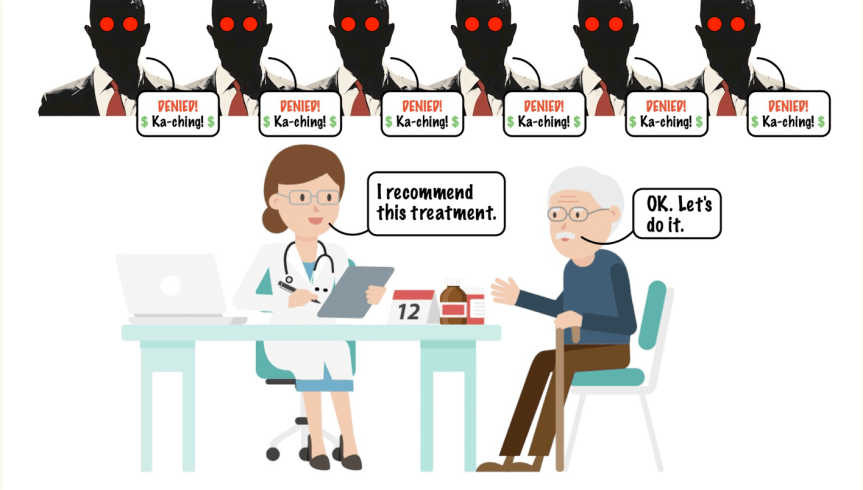
CMS’s WISeR “test” is just another way for Trump’s equity-pirate donors to gorge on our Medicare dollars. Call your legislators!
The corruption here is bizarrely obvious. But that doesn’t mean it will go away without a fight.
(https://youtube.com/shorts/ir-XY39VTVI?si=j4OWWjb1fKbz-v5w)
Minimal script for House Reps: I’m calling from [zip code] and I want (Rep._____) to stop the CMS (Centers for Medicare and Medicaid Services) WISeR model. Who thought it would be a good idea to let private, for-profit contractors and their AI tools decide whether or not seniors get treatments their doctors recommend? And what genius thought these guys should get paid on HOW MUCH CARE THEY DENY?! I expect [him/her] to cosponsor H.R.6361 – Ban AI Denials in Medicare Act. Stop 3rd party profiteering in our health care.
- H.R.6361 cosponsors: Neither Reps. Brownley or Carbajall are cosponsors.
Minimal script for Senators: I’m calling from [zip code] and I want (Sen._____) to stop the CMS (Centers for Medicare and Medicaid Services) WISeR model. Who thought it would be a good idea to let private, for-profit contractors and their AI tools decide whether or not seniors get treatments their doctors recommend? And what genius thought these guys should get paid on HOW MUCH CARE THEY DENY?! I expect [him/her] to cosponsor S.3480 – Seniors Deserve SMARTER Care Act of 2025. Stop 3rd party profiteering in our health care.
- S.3480 cosponsors: Neither Sens. Schiff or Padilla are cosponsors.
More script if you want it: Already another CMS “experiment” to allow corporate donors access to our Medicare dollars, Medicare-Take-Advantage, is starting to crash and burn. While they are costing us taxpayers an extra $83 billion annually, 22% more than traditional Medicare, hospitals and health systems nationwide are dropping some or all of their Medicare Advantage contracts due to excessive denial rates and slow payments from insurers.
Deeper Dive into the Scam!
(Wendell Potter, Aug 12) “Lawmakers urge CMS to scrap a model they say will deny necessary treatment as bipartisan calls for MA reform grows.”
A few weeks ago, Rachel Madley, PhD, director of policy and advocacy for the Center for Health & Democracy, laid out why the Centers for Medicare and Medicaid Services’ new Wasteful and Inappropriate Service Reduction (WISeR) Model is bad news for patients in Traditional Medicare. She warned that it would import one of the worst aspects of Medicare Advantage — aggressive prior authorization run by private, profit-driven contractors — into a program that has long prided itself on letting doctors, not algorithms, decide what’s medically necessary.
The article written by Rachel Madley, PhD, director of policy and advocacy for the Center for Health & Democracy, laying out why the WISeR model is bad for patients in Traditional Medicare.
Madley’s piece explained why WISeR is dangerous:
- It hands prior authorization in Traditional Medicare to private companies that profit by denying care — exactly as they do in MA.
- It uses AI and “technology-enhanced” reviews that have been shown to spike denial rates.
- It offers companies a cut of the “savings” they generate, creating a built-in incentive to say no.
- It paves the way for more and more services to be put behind prior authorization walls.
- And now, there’s a sign that her warning is resonating and that momentum is building against CMS’s latest experiment.
MORE RESOURCES
- (pnhp) Murray pushes to halt federal pilot adding AI to Medicare approvals
- (pnhp) Consensus Statement on Expanding Prior Authorization in Traditional Medicare
- (healthcareuncovered) Note: this is a great substack on healthcare.

“As we previously published in HEALTH CARE un-covered, the WISeR model is more than just some small administrative update. The new model dramatically shifts how traditional Medicare patients will access care. Under this demonstration program, the Centers for Medicare and Medicaid Services (CMS) will let private, for-profit contractors and their AI tools decide whether seniors get treatments their doctors recommend – and those contractors will be paid based on how much care they deny.
After months of speculation and anticipation, CMS this week announced the private companies selected to participate in the model beginning January 1, 2026. The six companies selected are Cohere Health, Inc., Genzeon Corporation, Humata Health, Inc., Innovaccer Inc., Virtix Health LLC, and Zyter Inc..
Those six companies now have the ability to decide if seniors or people with disabilities in traditional Medicare get the care recommended by their doctors for 17 medical procedures that previously did not require prior authorization. This is a lot of trust to put in private companies, so we dug more into the ones chosen by CMMI to participate in the model.
We previously described how insurers and affiliated venture capital firms use their influence and leverage to “self-deal”, in effect creating opportunities to boost their profits. The WISeR program and the participants selected appear to follow the same playbook.
Most of the companies CMS selected are backed by insurer-linked venture funds or staffed by former insurance industry executives, including from Elevance, Optum, Kaiser, Highmark, and HCSC. For example, Humata Health lists four venture capital firms backed by insurance companies as key investors: Blue Venture Fund (backed by Blue Cross Blue Shield), Optum Ventures (backed by UnitedHealth Group), LRV Health (backed by over 30 health systems and insurers), and Highmark Ventures (backed by Blue Cross Blue Shield insurer Highmark Health). These concerning ties are replicated in other model participants including Cohere Health, which is funded through venture capital and contract ties to Humana, and Innovaccer, which is funded by Kaiser Permanente and Banner.
Several already operate in Medicare Advantage, in which private insurers routinely use prior authorization to delay or deny coverage for needed care. Between the lines: WISeR effectively imports the same harmful machinery into traditional Medicare for the first time in the program’s history. Amplifying this concern is that several are pure technology companies without any medical oversight or leadership. This raises serious questions about how they will comply with state and federal regulations requiring licensed clinical personnel to oversee utilization decisions (for good reason).
Precious little is known about other participants. The website of one of the participants, Virtix Health, doesn’t disclose any executives or board members. It doesn’t even list a physical address or phone number, and the last time the company uploaded a news story was in 2021. These are hardly things that inspire the public’s confidence about its legitimacy, let alone entrusting it to oversee the care of Medicare beneficiaries.
What is known about Virtix Health is that it offers risk adjustment coding services, such as chart reviews, to MA plans. These chart reviews are used by MA insurers to add medical codes to an enrollee’s chart, making them appear sicker than they are in order to receive a higher payment from the government. Overpayments, driven largely by coding intensity, means MA plans will be paid $84 billion more than traditional Medicare in 2025; cumulative overpayments between 2025-2034 could reach $1.2 trillion. CMS Administrator Mehmet Oz pledged in his confirmation hearing to go after excessive coding by insurers, which is at odds with his agency giving a contract for the WISeR model to a company that enables this practice as its main line of business.
All this begs the question: How were these companies chosen? It’s an important one, especially given the strong ties between current and past leadership at CMMI and the health insurance and venture capital industries that will profit from this program. We have previously called for the disclosure of financial conflicts of interest in the selection of vendors by health insurers (and in this case CMS, which controls billions of our tax dollars), including any underlying financial relationships with the vendor and/or related investors. CMMI has not disclosed whether or how they managed these potential conflicts of interest in the selection process. The American public deserves to know.
A coalition of lawmakers have introduced the Seniors Deserve SMARTER Care Act to stop WISeR before it launches. The lawmakers warn that the model “creates a dangerous incentive to put profits ahead of patients’ health” — and they’re right.
At the same time, public confidence in insurers’ use of AI has cratered amid lawsuitsand reports of algorithms overriding physicians’ judgment. Even President Trump has blasted insurers as “BIG,” “BAD,” and “money-sucking.” Yet WISeR hands many of these same corporate players a new federal revenue stream — and unprecedented authority over seniors’ care in traditional Medicare, which has historically been a safe haven from Big Insurance meddling in coverage.”
Q: What is the CMS WISeR Model?
A: “Under the Wasteful and Inappropriate Service Reduction (WISeR) Model the CMS Innovation Center will contract with technology companies to process prior authorization requests from providers in six selected states for a specified list of services furnished to traditional Medicare beneficiaries. These companies will be paid a part of the savings realized from denying claims that do not satisfy applicable national or local coverage determinations.” (pyapc.com)
Q: Which states are involved in the WISeR rollout?
A: Arizona, Ohio, Oklahoma, New Jersey, Texas, and Washington will roll out WISeR.
Q: How will companies handling prior authorization requests be paid under WISeR?
A: These companies will receive a percentage of cost savings resulting from denied or avoided claims.
Q: Is WISeR a voluntary program?
A: The CMS Innovation Center considers WISeR a voluntary program, insofar as technology companies must apply to be selected to process prior authorization requests. For providers in the six selected states, however, the program is mandatory: they will not receive payment for any of the specified services without prior authorization or pre-payment review.
Q: What services will require prior authorization under WISeR?
A: The Request for Applications for the technology companies includes the list of services subject to prior authorization. [The list is in our article]
Q: Why are providers concerned about the WISeR model?
A: Providers are raising several red flags:
- Improper incentives for technology companies whose payment will be based on the number of prior authorization requests denied.
- Administrative burden from prior authorization requirements
- Risk of care delays and compromised patient outcomes
Q: How is WISeR different from prior authorization programs in Medicare Advantage?
A: The CMS Innovation Center encourages companies that currently work with Medicare Advantage on processing prior authorization requests to apply for WISeR. If prior authorization is denied, a provider will be able to appeal in the same way a provider can appeal denial of a claim by a Medicare Administrative Contractor.
Q: What does WISeR signal about CMS’s strategy going forward?
A: WISeR may mark a philosophical shift toward regulatory enforcement over innovation. The model suggests CMS is more willing to impose mandatory restrictions on providers in an effort to contain costs—potentially previewing more aggressive models under the current administration.
KEY TAKEAWAYS
- WISeR is the Trump administration’s first CMS Innovation Center model.
- The model financially rewards companies that use AI and algorithms to reduce improper payments through prior authorization.
- Initially launching in six states and covering a specific list of services, WISeR likely will be expanded to more states and services.
- Providers will face additional administrative burdens similar to those under Medicare Advantage.
PYA is committed to helping physicians and hospitals understand and manage regulatory changes. Stay informed with our Washington Updates and contact us for assistance.
 INDIVISIBLE VENTURA