Let’s see…who else in history made it their priority to go after gay and transgender people, those without citizenship (Jews), unions, political opponents and disabled people?
(DREDF.org) “The Department of Energy (DOE) is trying to get rid of important rules of Section 504! DOE is trying to change the rules that new buildings must be accessible to people with disabilities. They are also trying to get rid of other rules that help disability accessibility. Please make your voice heard and say “no” to these changes. You can send in a comment as part of an organization. You can also send a comment on your own. The deadline to send in comments is Monday, June 16, 2025, [by 11:59 pm EDT]”
How to make that “significant adverse comment” by June 16, 8:59 PDT:
- The first rule of Comment Club is that your comment MUST BE ORIGINAL! Templates are dangerous in that people using them don’t realize that all exact copies will be not be counted. No matter how many were submitted, they will only be counted as one submission.
- You do not need to be a professional of any kind to comment. Legalistic or technical jargon is not required.
- Tell your story about who you are, and why you care about accessibility and that you vehemently disagree with them messing with Section 504. (We’ve defined this law under “Deeper Dive” below.).
- Assume that this is their fishing trip to see if anyone notices this slippery rule-change. If it passes unnoticed, it will spread like a virus to other federal departments. The Department of Energy may not be a big issue for you, but your comment can touch on how this concept could affect you when you interact with other departments.
- Don’t forget to mention that making life harder for those who are disabled is extremely f***** up and immoral. Use your own words. Profanity is not allowed.
- DREF has provided two templates in the form of letters that can be attached to a comment. Read them. They are filled with facts and ideas you can recycle into your own comment, but absolutely do not copy them verbatim.
- There is no minimum length of comment, but there is a maximum character limit. Groups with long letters attach them.
To fight this particular piece of slippery bureaucratic corruption, you will need to copy your exact same comment into two separate comment pages.
- Comment #1: https://www.regulations.gov/document/DOE-HQ-2025-0015-0001
- Comment #2: https://www.regulations.gov/document/DOE-HQ-2025-0024-0001
Once you figure out what you want to tell these yahoos, it’s actually pretty easy:
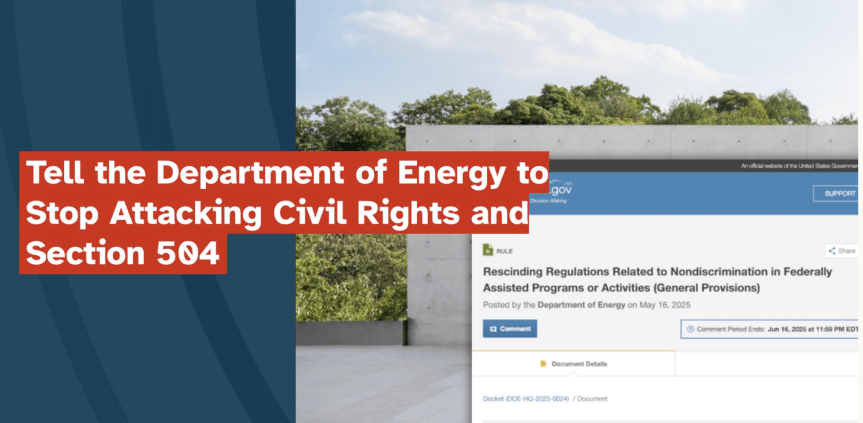
This is what the first form looks like. (https://www.regulations.gov/document/DOE-HQ-2025-0015-0001) You can read their jargony nonsense about why it’s OK to screw over disabled people, or you can just hit the blue comment button and get on with it. There should also be a clear button for reviewing other people’s comment, but we can’t find it for this rule.

The comment button will take you here. You can write your comment right in the comment field if it’s less than 5,000 characters. You can also write your comments in a document like a Word or PDF file and attach the file with your comments. (DON’T FORGET TO COPY YOUR COMMENT TO USE ON THE SECOND RULE SITE!) You can then define yourself as an individual, an organization or as an anonymous commenter. Complete the reCAPTCHA, select the blue “Submit Comment” button. Then rinse and repeat here (https://www.regulations.gov/document/DOE-HQ-2025-0024-0001), then go get a well-deserved coffee and a nosh while you simmer over what they’re trying to pull over on us.

Deeper Dive!
(For those who’d rather just read the transcript, go here.)
Definition – What is the difference between Section 504 and ADA?
What is ADA and Section 504?
(augustaga.gov) The Rehabilitation Act of 1973: Broader than any disability law that came before it, Section 504 of the Rehabilitation Act made it illegal for the federal government, federal contractors, and any entity receiving federal financial assistance to discriminate on the basis of disability. Section 504 obligates state and local governments to ensure that persons with disabilities have equal access to any programs, services, or activities receiving federal financial assistance.
Specifically, 34 C.F.R.§104 states: “No otherwise qualified individual with a disability in the United States… shall, solely by reason of her or his disability, be excluded from participation in, be denied the benefits of, or be subjected to discrimination under any program or activity receiving Federal financial assistance.”
The Rehabilitation Act of 1973 is found in its entirety at https://www.eeoc.gov/rehabilitation-act-1973-original-text.
The Americans with Disabilities Act of 1990
The ADA is built upon the foundation laid by Section 504 of the Rehabilitation Act. It uses as its model Section 504’s definition of disability and then goes further. While Section 504 applies only to entities receiving federal financial assistance, the ADA covers all state and local governments, including those that receive no federal financial assistance. The ADA also applies to private businesses that meet the ADA’s definition of “public accommodation” (restaurants, hotels, movie theaters, and doctors’ offices are just a few examples), commercial facilities (such as office buildings, factories, and warehouses), and many private employers.
While the ADA has five separate titles, Title II is the section specifically applicable to “public entities” (state and local governments) and the programs, services, and activities they deliver.
They didn’t want anybody to notice this corruption of disability rights!
(Mother Jones) The Department of Energy Is Quietly Slashing Disability Rights – “If we don’t put a line in the sand here, other agencies will try and do the same.”
The agency “is prioritizing private convenience over the civil rights of disabled people,” said law professor Robyn Powell.
“In May, the Department of Energy quietly introduced a proposal to eliminate its longstanding requirement that new buildings receiving funds from the agency be accessible to disabled people—a rule in effect across the federal government since 1980, thanks to Section 504 of the Rehabilitation Act.
“Disability rights,” professor Jasmine Harris said, “are not uncontroversial as the Department of Energy claims.”
According to a document published in the Federal Register, the final rule will become effective July 15—unless it receives “significant adverse comments” before Tuesday, a month after the rule was proposed.
“By labeling these long-established protections as ‘unnecessary and unduly burdensome,’” Powell said, the Department of Energy “is prioritizing private convenience over the civil rights of disabled people” in its rulemaking. (The agency did not respond to Mother Jones’ questions.)
More than 3,000 comments have been submitted so far, many after the launch of a campaign by the Disability Rights Education and Defense Fund (DREDF). “From our point of view, they cannot lawfully do this, because the regulations were reviewed by Congress,” said Claudia Center, the organization’s legal director. Beyond its mandated inclusion in the Federal Register, Center added, “There was no announcement, no press release that we saw” regarding the proposal—allowing it to largely slip under the radar.
The proposed rule, according to Center, “really just disrupts this whole idea of Section 504, and the regulations—which is that, over time, we’re going to have a more accessible society.” Attacks on Section 504’s disability protections through federal rulemaking are unprecedented, Center said.
Center’s wider concern: DOE’s move could be a blueprint for other Trump administration federal agencies to follow, extending it to a much wider range of buildings and institutions—a kind of trial balloon at a federal agency which draws less public attention, and controversy, than the departments of Health and Human Services and Education, for instance.
They trying to do this through an unusual and expedited method – “direct final rule”
(Disabilityscoop) Effort To Roll Back Federal Disability Rights Protections Alarms Advocates
The Trump administration is quietly working to fast-track changes to a key disability rights law by circumventing typical procedures, advocates are warning.
The U.S. Department of Energy posted a notice last month announcing plans to rescind requirements under Section 504 of the Rehabilitation Act that specify what standards newly constructed and altered buildings must meet in order to be considered accessible.
The change would do away with a mandate that’s been on the books for decades, advocates say, sowing widespread confusion. More than that, it’s the way that the agency is going about the update that’s setting off alarm bells.
Typically, in order to modify regulations, federal agencies go through a process known as “notice and comment,” where the public is given notice, offered a period of time to comment and then the agency considers any comments before issuing a final rule. Those steps can take years to complete.
In this case, however, the Energy Department is using a far more expedited approach known as a “direct final rule.” As a result, the notice indicates that the change will take effect July 15 unless “significant adverse comments” are received by next week.
The move is highly unusual, according to Claudia Center, legal director at the Disability Rights Education & Defense Fund.
“A ‘direct final rule’ is supposed to be for something routine or noncontroversial,” she said. “One example I heard was changing the name of a department. I’ve never seen it before in my career, and most of my colleagues report the same.”
Center said she’s concerned that if the Trump administration is successful, they could use this same approach to make other big changes.
“This action could be a ‘trial balloon’ for other agencies,” she said. “There are more than 80 sets of Section 504 regulations across the federal government. This could be the first of many.”
If adopted, the change put forth by the Energy Department could affect thousands of buildings that receive funding from the agency, including those that are part of state and local governments, many universities and other private entities, advocates say.
Under existing regulations, facilities constructed or altered after June 13, 1980 that receive federal financial assistance must be “readily accessible to and useable by handicapped persons.” Buildings are considered to meet that standard if they comply with what are known as Uniform Federal Accessibility Standards.
But now the Energy Department is calling this requirement “unnecessary and unduly burdensome.”
“It is DOE’s policy to give private entities flexibility to comply with the law in the manner they deem most efficient. One-size-fits-all rules are rarely the best option. Accordingly, DOE finds good reason to eliminate this regulatory provision,” reads the agency’s new rule.
The Energy Department did not respond to questions from Disability Scoop about what prompted the changes and why the agency is using an expedited process to implement them.
Amy Robertson, a civil rights attorney who specializes in disability rights litigation, said this is the first time in 57 years that a federal agency has tried to delete the building requirement and doing so would yield significant consequences.
“This would inevitably lead to the construction of less accessible or even inaccessible facilities,” she said. “It would also create havoc (for) the entities that receive funding from the Department of Energy, as they would no longer have to follow the (Uniform Federal Accessibility Standards), but would still be open to liability under general non-discrimination requirements.”
In addition, Robertson noted that many entities that receive funding from the Energy Department are also subject to the existing building standard under Title II of the Americans with Disabilities Act as well as regulations from other federal agencies.
In comments that the Disability Rights Education & Defense Fund plans to submit to the Energy Department, the group argues that the proposed rule is “unlawful.”
“The changes cannot be adopted as ‘direct final rules’ as they are neither routine nor noncontroversial. Nor can the changes be adopted through ordinary rulemaking,” according to the comments. “The proposed rescissions contradict the foundational principles of Section 504 of the Rehabilitation Act.”
Above and beyond the specifics of the regulatory change, advocates are leery that the Energy Department’s rushed approach could set a dangerous precedent.
“The regulations implementing Section 504 of the Rehabilitation Act are foundational to prohibiting discrimination against people with disabilities in federally funded programs. Any changes to Section 504 should be approached cautiously and with extensive consideration and collaboration with impacted stakeholders,” said Lydia Dawson, vice president of government relations at the American Network of Community Options and Resources, or ANCOR, which represents disability service providers across the nation. “Any rulemaking which implicates regulations fundamental to the rights of people with disabilities should be afforded the time and consideration necessary to protect against the potential for any unintended consequences which may infringe on those rights.”
The Energy Department is accepting comments through June 16.
THIS MEANS THAT ALL STATE AND LOCAL BUILDINGS BUILT WITH FEDERAL FUNDS WILL ALSO NOT BE ACCESSIBLE!
The Department of Energy (DOE) has issued a “direct final rule” that will eliminate a long-standing requirement of Section 504 which requires new buildings constructed with federal funds to be accessible to people with disabilities. According to the submitted dockets at www.Regulations.gov, the final rule will be effective on July 15, 2025 unless significant adverse comments are received by June 16, 2025. The two dockets for this issue are linked below and are available for public comment:
Docket #1 – Go to DOE-HQ-2025-0015 and click “Comment”: https://bit.ly/4kuX2R2
Docket #2 – Go to DOE-HQ-2025-0024 and click “Comment” : https://bit.ly/4mGKgjY
People, we have seen these past six months that if there is enough pushback by the public, IT WORKS. So PUSH BACK!
 INDIVISIBLE VENTURA