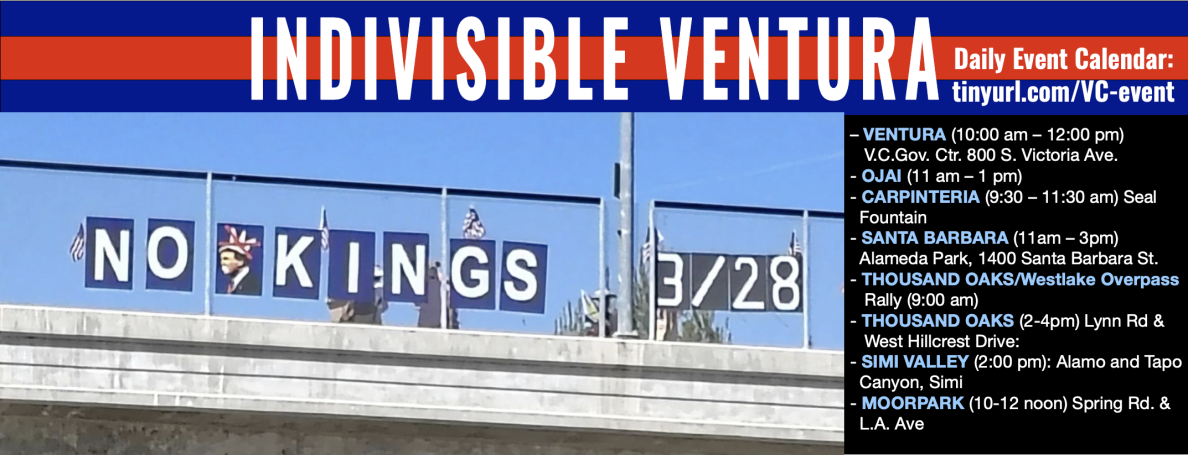

…Meaning that our Postal Service does not belong to rich assholes.



“The Postal Service shall have as its basic function the obligation to provide postal services to bind the Nation together through the personal, educational, literary, and business correspondence of the people.” – 39 U.S. Code § 101(a)
Action: Tell your legislators to protect our postal service from Musk, Trump, and all the equity pirates circling it like sharks!

Minimal script for representatives: I’m calling from [___] and want to thank Representative [Brownley/Carbajal] for voting for House Resolution 70. I am absolutely against any privatization of our postal service and firings of postal workers. I would also like them to support Rep. Chris Pappas and Rep. Jared Golden‘s “Protect Postal Performance Act,” which prevents further degradation of services to underserved areas.
- Did your representative endorse H.Res.70?: Check here.
- H.Res.70: “Expressing the sense of the House of Representatives that Congress should take all appropriate measures to ensure that the United States Postal Service remains an independent establishment of the Federal Government and is not subject to privatization.”

Minimal script for senators: I’m calling from [___] and want Senator [___] to stand firmly against any attempts to privatize the Postal Service or fire workers, such as stated in the House Resolution 70. The postal service belongs to the people, it’s in our Constitution. Trump has talking about grabbing the power to fire the postmaster general. Remind hIm that it is an independent agency and only the legally appointed Board of Governors — nominated by the President and confirmed by the Senate—can hire and fire the Postmaster General.
- Contact
Rep. Julia Brownley: email, (CA-26): DC (202) 225-5811, Oxnard (805) 379-1779, T.O. (805) 379-1779 - or Rep. Salud Carbajal: email.(CA-24): DC (202) 225-3601, SB & Ventura: (805) 730-1710 SLO (805) 546-8348
- Senator Adam Schiff: email, DC (202) 224-3121, LA (310) 914-7300, SF (415) 393-0707, SD (619) 231-9712, Fresno (559) 485-7430
- and Senator Padilla: email, DC (202) 224-3553, LA (310) 231-4494, SAC (916) 448-2787, Fresno (559) 497-5109, SF (415) 981-9369, SD (619) 239-3884
Who is my representative/senator?: https://www.usa.gov/elected-officials
More useful information for your calls and emails
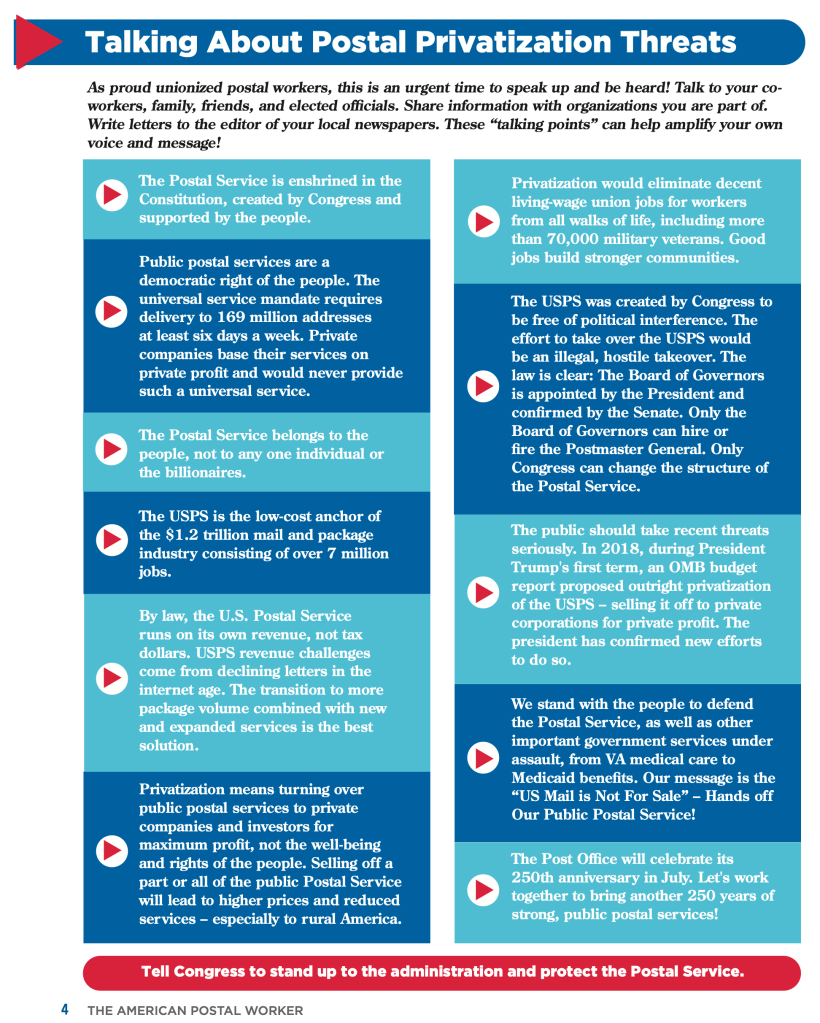
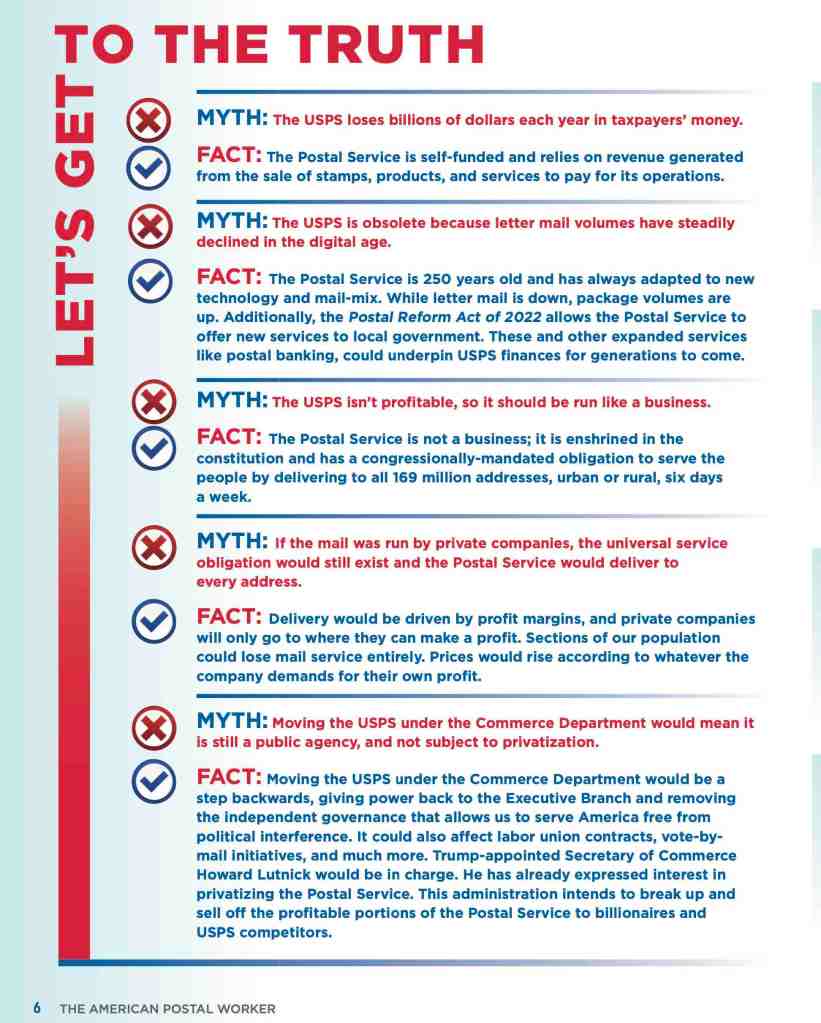

Wells Fargo Report is DOGE-esque Roadmap for Looting USPS
The Wells Fargo report, entitled “USPS Privatization: A Framework”, includes many eye-catching tidbits about what privatization could mean for customers, workers, and corporate investors. The biggest takeaways:
- Postage Prices: The report recommends carving out USPS’ parcel delivery operations to either IPO or sell to private competitors like FedEx and UPS. It states that “raising [parcel] prices would be likely” under privatization, by as much as 30 to 140% across parcel products. This would hurt millions of e-commerce sellers and small businesses who rely on USPS’ statutory commitment to affordable pricing, and have similar inflationary effects for consumers.
- Scrapping universal service: Wells Fargo describes USPS’ universal service obligation (USO) – a statutory requirement to provide a minimum level of service at reasonable prices to ALL domestic addresses – as an “restructuring issue” to be addressed. The analysts propose severing USPS’ lucrative parcel business from its less profitable letter mail delivery, selling the former to private investors and potentially leaving taxpayers on the hook for the latter. Without the USO, parcel and package delivery to regions deemed “unprofitable” (such as rural communities) could be scaled back or cease entirely, while public 6-day letter mail service could enter a death spiral.
- Selling off postal real estate: The Wells Fargo report takes note of USPS’ 8,500 properties, which include historic post offices, sorting centers, and vital rural community hubs. It notes ominously that “value can be harvested” by “unlocking” these properties via sale or lease to commercial bidders (who could include real estate developers, corporate landlords, private couriers, or retail monopolists like Amazon).
- Layoffs and Pension Obligations: Citing “recent DOGE efforts on federal cost control”, the report states that USPS’ 600,000-person workforce – 91 percent of whom are unionized – would either receive deferred buyout offers or see mass layoffs as a “required step” of privatization. The authors expect “sizable opposition” to privatization from postal workers, noting USPS’ “union dynamics and collective bargaining agreements”. Another “required step” involves shifting $400B in postal pension and healthcare liabilities to taxpayers (as the UK’s Royal Mail did), or selling off parcel operations and postal real estate to fund workers’ hard-earned retirement benefits. In other words, privatizing the profits and socializing the losses.
- Path to privatization: Wells Fargo floats scrapping the Postal Reorganization Act of 1970 (which turned USPS into an independent agency after the Great Postal Strike) by sneaking PRA repeal into the GOP’s forthcoming budget package. The report concedes that privatization would be unlikely to garner 60 Senate votes, meaning it would have to be attached to “must-pass” legislation to become law.
- “Challenges” to privatization: The report notes that USPS enjoys strong bipartisan support among the public, and that its delivery of election ballots, medicine, taxes, and government distributions and notices (e.g. Social Security checks) would make privatization politically toxic. It also observes the “particularly strong affinity” rural communities have for USPS, and its offering of financial services in unbanked or under-banked areas. Singling out those specific services is a blaring alarm that a privatized USPS would gut them.
- Wall Street’s lobbying helped bring an end to the US Postal Savings System and has helped thwart recent efforts to revive postal banking.
Deeper Dive – the “Privatize the Post Office” Pandemic – How close we came to losing the USPS during Trump’s first administration, and how is all that postal privatization working out for Europe?
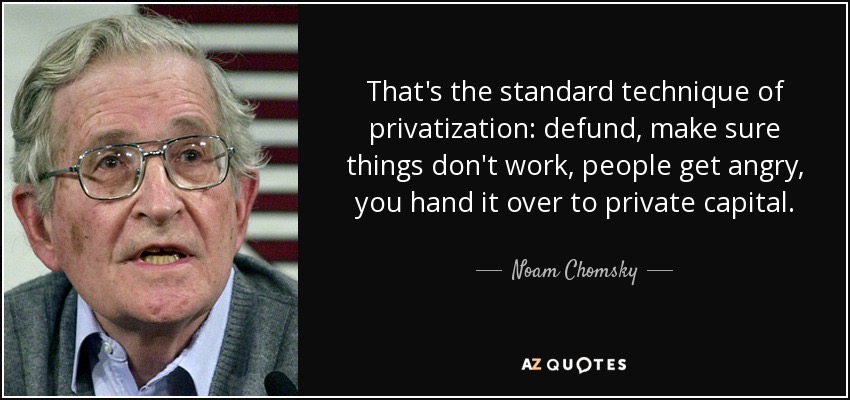
The GOP has been deadset on killing the post office for a long time.
- 1970 – Postal Reorganization Act by President Richard Nixon – set requirement that post office must be self-supporting, even if in conflict with its constitutional requirement to provide a national service.
- 2006 – Postal Accountability and Enhancement Act – limited the services that the Postal Service could offer to only those it already provided and also established a requirement for the USPS to save money for the medical benefits of future retirees, something no other businees has to do.
- 2018 – Donald Trump administration proposed turning USPS into “a private postal operator” which could save costs through measures like delivering mail fewer days per week, or delivering to central locations instead of door to door.
(LA Times) “The pro-privatization argument rests on the assumption that private enterprise is capable of providing adequate service anywhere in the U.S. at competitive prices. The argument usually doesn’t incorporate standardized flat rates, though — the idea being that any dope who “chooses” to live in a remote spot should pay the cost of getting his mail there.
This argument has many obvious flaws, but the most glaring are that not everyone has it within their power to “choose” where they live; and not everyone can live within walking distance of the Dupont Circle stop on the Washington, D.C., subway, from where a lot of these nonchalantly Darwinian pronouncements seem to emanate.
The most insidious claim heard in this debate is that mail service ought to be cost-effective. First of all, there’s no such thing. Delivery to some communities is nevergoing to be cost-effective. As economics blogger Kevin Drum points out, in some places delivery always will be unprofitable, except at prices that would make service effectively unusable.
The idea that government services such as mail delivery should be cost-effective is a conservative fetish, with no grounding in the Constitution, history or practice. If every government program were held to this standard, we would have no interstate highways. No international airports. No Internet. No levees on the Mississippi and no Hoover Dam.
These things were all designed or built precisely because private industry was unable to make a cost-effective case for the investment. In each case, however, it was understood sooner or later that, if the cost were spread out over the entire country and even over several generations, the expenditure would be plenty worthwhile.
That’s certainly true of universal postal service, which helped bind together this country when it was only a loose confederation of agricultural regions and population centers. If anything, these bonds are even more important today, when anyone can choose his or her own news slant and erect a guarded fence around the neighborhood, and when whole socioeconomic communities are at risk of falling off the map entirely.
Could commercial entities provide the equivalent service on a privatized or contract basis? It’s doubtful. Private industry always enters into such deals with earnest promises that they will provide public services without fear or favor, and more often than not they end up promoting their own parochial interests at the expense of the public interest.”
Once Again: Postal Privatization is a Bad Idea
Re: Wells Fargo’s privatization report: Corporations and think tanks like the Cato Institute, Heritage Foundation, and postal contractor Pitney Bowes have lobbied for decades to kill USPS and sell its assets to the private sector. During the first Trump administration, Treasury Secretary Steve Mnuchin led a task force that called for shrinking the Postal Service and stripping its workers of collective bargaining rights. Mnuchin later engineered the appointment of Louis DeJoy as Postmaster General, whose death-by-thousand-cuts austerity plan for the agency has left it even more vulnerable to privatization.
Make no mistake: if these privatization hawks get their way, corporate investors and shareholders will reap a windfall – while everyone else will suffer.
- Postal Privatization Harms Mail Recipients: Postal privatization would likely mean the end of the universal service obligation and 6-day delivery standard, as corporate carriers would seek to profit-maximize by conducting fewer weekly delivery trips or avoiding routes with fewer residents. This could result in millions of mail items and packages arriving late (including time-sensitive tax or legal documents, medication, government benefit checks, and election ballots) – or not at all. Rural, indigenous, and remote communities (where private couriers often rely on USPS for “last-mile delivery”) are particularly at risk of being cut off.
- Postal Privatization Harms Customers & Small Businesses: Steep postage hikes to satisfy corporate investors and shareholders (as the Wells Fargo report recommends) would raise costs on postal retail customers, including millions of small businesses and e-commerce sellers on platforms like eBay, Mercari, and Etsy. Lightweight packages (below 1lb) could see the biggest price hikes under privatization, as USPS’ current Ground Advantage offering is often significantly cheaper than similar offerings from FedEx and UPS.
- Postal Privatization Harms Workers: Privatization would likely mean mass layoffs to USPS’ 600,000-person workforce, which has historically been a road to the middle-class for non-white workers. Pay, working conditions, and benefits could also get worse for postal workers under privatization if USPS’ operations are absorbed by union-busting corporations like Amazon or FedEx. Workers’ pensions could also be at risk, either under the taxpayer-funded scenario outlined by Wells Fargo or by corporations with track records of mismanaging retirement benefits.
- Postal Privatization Harms The Public: A privatized postal service would have no obligation to prioritize or provide public services, like timely delivery of election ballots or infectious disease test-kits. Rural areas could lose more than mail service: rural post offices at risk of sale function as community hubs, while rural carriers often assist in local emergency response and national disasters. There would be few to no mechanisms to hold a privatized postal service accountable to the public, like an Inspector General or board meetings that allow public comment. (The Postal Board of Governors has recently rolled back public comment periods at its quarterly board meetings, now only allowing them once per year.)
These are not theoretical harms. The 2013 privatization of Royal Mail in the UK has already led to steep postage hikes, plummeting on-time delivery rates, job cuts, and chronic mismanagement of worker pensions.
History of the GOP’s assault on our Postal System
Our postal system is facing two determined predators.

The GOP has wanted to privatize the Postal Service for decades and they are mostly responsible for the yearly headlines that chronicle job slashing, office closing, longer lines and slower or diminished services. OK, so what exactly happened in 2006 with the HR 6407, Postal Accountability and Enhancement Act ?

They dream of selling the USPS off to the highest bidders, (possibly important donors!), in pieces if necessary, and removing the money-losing services like door-to-door deliveries in remote areas. (This video is from 2016, but it sounds like yesterday.)

The winning bidders could then break up the largest union in the US, fire workers, lower wages or just uber-ize them, remove benefits and shift that profit into private investors’ hands. Then they’d raid the USPS’ well-funded retirement account of hundreds of billions of dollars.

Just another day for the GOP – union-busting, screwing over one of the biggest employers of minorities and veterans, and transferring American tax dollars to millionaires and billionaires.

The GOP privateers’ dreams are closer to coming true than ever before, having found an ally in our president, who, during his first administration, was willing to veto the entire $2 trillion CARES Act to prevent giving the USPS, the most popular of all public agencies, any financial relief. (He wanted to give tax dollars to foreign-owned cruise lines but the Democrats nixed that.) Why?
Trump was neck-deep in his mail-fraud fantasy and his revenge plot against the Jeff Bezos, owner of both the critical Washington Post and Amazon, which delivers packages to our doorsteps with the help of the USPS. Striking a blow against Amazon would have annoyed Bezos, but it would have killed our postal system and our accessible elections. But the one thing our president is good at is killing businesses. But that’s all in the past. Bezos is now onboard, calling for a breakup of the postal service, and possibly a piece of the action.
How close we came to losing it during Trump’s first administration
A tale of two reports during Trump’s first administration
In preparation for destroying our most beloved public agency, the White House created two documents during his first administration.

SELL IT!: The first was a June 2018 OMB report – “Delivering Government Solutions in the 21st Century” which frankly detailed the steps to make the USPS attractive for sale to private investors, fattening it up by raising prices and cutting wages and benefits. However, someone in Trump’s orbit must have remembered that many GOP voters live in rural areas whose postal access has already been hard hit by their own party’s shenanigans. So the approach was softened to this…

GET IT READY FOR SALE: In December of 2018, “United States Postal Service: A Sustainable Path Forward,” a report for a task force headed by Treasure Secretary Steven Mnuchin, produced the soft-porn version of the OMB’s report, cloaking its recommendations to prepare the USPS for takeover without specifically endorsing privatization, while wasting three pages mooning over foreign privately-owned models. (pages 29-31). No surprises – the report includes eliminating collective bargaining and forbidding a repeat of the last century’s success with banking services, due to the historical power of payday lender lobbyists.

Though the National Association of Letter Carriers (NALC) supported some of the report’s recommendations – such as maintaining the geographic scope of the Universal Service Obligation (USO), reducing the burden of the prefunding mandate and exploring the addition of new services outside the current USO to help fund the agency, they felt overall it had “fundamentally misdiagnoses the operational and financial condition of the Postal Service, and as a result offered recommendations that would seriously weaken if not destroy USPS, a national treasure and vital part of our nation’s economic infrastructure.”

The NALC state that the report “would dramatically raise mailing costs for “commercial mailers” and shippers, slash the frequency and quality of delivery, and gut the standard of living of postal employees by outsourcing their jobs, stripping them of collective bargaining rights and reducing their retirement and workers’ compensation benefits. These recommendations would weaken, not strengthen the Postal Service – and threaten the most efficient and affordable universal postal system in the world.” So, not good. The entire analysis by the NALC is here.
Privatizing, American-style.

The United States has privatized what should be public resources before. As usual, it hurts rural communities and the poor and middle classes, while enriching the original investors.
However, the intent of our postal service laws are pretty clear.

“It shall provide prompt, reliable, and efficient services to patrons in all areas and shall render postal services to all communities. The costs of establishing and maintaining the Postal Service shall not be apportioned to impair the overall value of such service to the people. The Postal Service shall provide a maximum degree of effective and regular postal services to rural areas, communities, and small towns where post offices are not self-sustaining. No small post office shall be closed solely for operating at a deficit, it being the specific intent of the Congressthat effective postal services be insured to residents of both urban and rural communities.” – 39 U.S. Code § 101(a)
Privatizing the Postal Service would turn this on its head, as described by economist Rick Geddes in his mean-spirited 2004 manifesto. (Blue titles are ours!).
- Pay your own way!: First, basic economics implies that rural customers are unlikely to be without service under competition; they would simply have to pay the true cost of delivery to them, which may or may not be lower than under monopoly. (The 328 million Americans who rely on the mail foressential services, including prescription drugs will be very interested to hear this. – Private services like FedEx, add a “Delivery Area Surcharge” to harder-to-reach zip codes.)
- You chose to live there!: Second, basic notions of fairness imply that the cross-subsidy should be eliminated. To the extent that people make choices about where they live, they should assume the costs of that decision. (It delivers about 1 million lifesaving medications each year and serves as the only delivery link to Americans living in rural areas.)
- Cutthroat competition is always better!: Third, there is no reason why the government monopoly is necessary to ensure service to sparsely populated areas. The government could easily award competitive contracts to private firms for that service.
- Buy computers, you losers!: Fourth, early concerns that rural residents of the United States would somehow become isolated without federally subsidized mail delivery today are simply unfounded. … Once both sender and receiver have access to a computer, the marginal cost of sending an electronic message is close to zero. (This is untrue for 42 million Americans without access to broadband access due to location. It is unknown how many simply can’t afford it. Also, it’s still very hard to send objects by email.)
What else could be be lost with privatization…
- The GOP, and their law enforcement associates, including ICE, may also want easier access to your private communications.
- “The US mail comes equipped with legal protection.“Law enforcement can’t open your mail without a judge’s say-so, and any private individual who tries could face a long sojourn as an involuntary guest of the feds.”
- “Laws governing the sanctity of your email are in their infancy. Actually, that’s a gross overstatement: They’re positively fetal. Government agencies may not need any warrant at all to read some of your emails. Google, Yahoo, Microsoft and anyone else whose system carries your email can read your messages at whim, with no consequences.” (LA Times)
- On the other hand, the GOP wants nothing to do with two functions the USPS’ “Universal Service Obligation” facilitates – the constitutional requirement of the Census and fair and accessible vote-by-mail elections.
Privatizing, just like dear old Europe – How did that work out for them?

During Trump’s first administration, both White House’s reports referenced the privatization of post offices in foreign countries. One states – “Like many European nations, the United States could privatize its postal operator.” Mnuchin singles out two countries for their privatization efforts – Germany and New Zealand.
Our first thought was “What!?! Our government wants to do something the Europeans do? How about focusing on something else they do, like nationalizing health care?”
Our next thought was – How is that privatizing working out for them? What Mnuchin didn’t reveal is that European nations charge substantially more for mail services delivered in a much smaller area, and they regularly raise the price of delivery. One example is that the price of sending a letter in the United Kingdom has increased 80 percent over the last decade.
UK Royal Mail – “…one giant-sized con from beginning to end“
This video is from 2017.

In 2013, the Royal Mail, a 500-year old system, was privatized. “Part of the justification for this was that people’s habits were changing.” While there was a 40% drop in mail, the privatizers failed to mention the increase in packages. “…This has been by far the greatest shift in the industry since the onset of the digital revolution: the sheer number of packets we carry, a much more profitable enterprise. I can’t believe the government hadn’t predicted this when they decided to sell off the Royal Mail, or that experts in the industry weren’t already aware of it. In other words, it’s been one giant-sized con from beginning to end.” (The anti-private mail folks included this nice list of why privatizing is bad for non-millionaires.)
So what do other Europeans think?

Europe reports: Accoring to Global Research: “After fifteen years of market-opening, the balance sheet of post “liberalization” is overwhelmingly negative…In sum, post liberalization has not improved services and reduced prices as promised by the European Commission and others. Instead, liberalization has produced a few winners and many losers.(Note: “Economic liberalization refers to the reduction or elimination of government regulations or restrictions on private business and trade. It is usually promoted by advocates of free markets and free trade… Economic liberalization also often involves reductions of taxes, social security, and unemployment benefits. (It) is often associated with privatization, which is the process of transferring ownership or outsourcing of a business, enterprise, agency, public service or public property from the public sector to the private sector.”)
The winners are private shareholders of former public monopolies, post managers and large customers.

The losers include private households, especially those in rural areas, and postal sector workers who have experienced liberalization as massive deterioration of employment and working conditions…The European postal service privatization process has been, however, very successful in reducing labour costs and in turning what used to be a reservoir of stable and decent jobs, especially for low-skilled workers, into an area of precarious and low-waged work.”
Details:
- With few exceptions, the new competitors emerging from privatization never opened post offices or installed letter boxes. Instead they pick-up mail directly at the premises of their mostly large corporate customers.
- Mail delivery has typically been reduced to only two or three days a week and only in highly populated areas.
- Prices have decreased for large customers such as banks, telephone companies and online retailers because they can negotiate individual price rebates.
- Standard mail costs have increased in a number of countries.
- Corporate issues like bankruptcy still occur – i.e. 2008 insolvency of the main competitor in Germany and the recent takeover of a major competitor in the Netherlands.
- Privatization is responsible for cuts between 20-50% in employment numbers, an increase in atypical and precarious forms of employment, a reduction in wages, as well as an intensification of work and a fragmentation of industrial relations. Here’s a employment horror story from the “Dutch Model.”
- Contrary to the European Commission’s prediction, these job cuts were not offset by the resulting growth in employment among new market entrants and most new jobs created were part-time.
- In Germany, less than 20% of the workforce at the new competitors is employed on full-time contracts. Almost 25% work normal part-time, whereas a majority of almost 60 % work very short part-time, or what in Germany is called ‘mini jobs’ (jobs that pay less than €400 per month).
- Wages have been substantially reduced, often below minimum standards.
- In a German study, piece rates of between 70 and 90 cents per delivered item amount to an average hourly wage of €5.
- Self-employed deliverers in the parcel and express services partly compensate for low hourly wages by putting in extremely long working hours.
So what about New Zealand?:
Per Mnuchin’s task force report – “For example, in New Zealand, which has a fully privatized postal system, the operator has a “Deed of Understanding” with the government, ensuring the provision of the USO (Universal Service Obligation).”
The 1989 Deed required New Zealand Post to provide 6-day a week service, along with other requirements:
- provide six days a week delivery to more than 90% of delivery points and five day a week delivery to more than 99% of delivery points
- not increase the proportion of counter delivery services or community mail boxes beyond 0.85% of all delivery points;
- maintain at least 1,202,073 delivery points;
- maintain a uniform basic letter price at 40c, with certain changes allowed in line with changes in the Consumer Price Index; and
- maintain a network of at least 880 official‘ (i.e. staffed by New Zealand Post personnel) and agency‘ (i.e. not owned and operated by New Zealand Post) post offices and postal delivery centres, including at least 330 official post offices.

However, the NZPost’s core business was “cherry picked” by private mail companies not obliged under the Postal Services Act to provide a nationwide mail service. Therefore, the NZPost is required to carry DX Mail’s ‘reject’ unprofitable mail, and the country’s taxpayers are subsidising a private mail company which is privatising the core business of a state owned enterprise. “NZPost employees may be the only workers in New Zealand compelled by law to actively assist a competitor in putting themselves out of a job.”
In 2013, NZPost renegotiated it’s mandate and in 2015, mail delivery was reduced – each street address in major towns and cities would receive standard mail delivery either on Monday, Wednesday and Friday or on Tuesday, Thursday and Saturday. The new contract:
- provide a minimum basic postal service for delivery of letters which includes not less than three day per week delivery to 99.88 % of delivery points within New Zealand Post‘s network;
- include within its network a minimum of 1,910,010 delivery points (being the number of delivery points in the network as at 30 June 2012);
- not reduce the frequency of delivery under the basic postal service to those areas where New Zealand Post offered a three or two day delivery service as at 30 June 2012;
- increase the number of delivery points within its network if and to the extent there is demand for it to do so, but this undertaking will be subject to New Zealand Post‘s reasonable opinion about what is commerciallysustainable and operationally practicable; and
- maintain a network throughout the country where consumers can purchase postal services. The network will contain no fewer than 880 service points in total, including no fewer than 240 where consumers can, in addition to purchasing postal services, use such bill payment services as New Zealand Post may provide from time to time. The network may be made up of a combination of outlets owned by New Zealand Post, services hosted in other businesses and electronic self-service kiosks
Job losses included 1500 to 2000 frontline and back-office jobs.
Allow our USPS to thrive!
Add banking again:

From 1911 to 1967, (prime MAGA fantasy-time!) , the US Post Office did act as a bank, accepting deposits and paying interest for small accounts. Today’s post office already offers simple financial services like money orders and international money transfers.
“Literally the only person who is going to be against this is somebody who wants to protect payday lender profits.” – Sen. Kirsten Gillibrand (D-N.Y.)
- Re-up this legislation: In 2018, Sen. Kirsten Gillibrand (D-N.Y.) introduced legislation that would have required every U.S. post office to provide basic banking services. This bill, if passed, would have improved the lives of more than one-quarter of Americans households (34 million homes, 80 million people), who are either “unbanked” ― meaning they lack someone with a bank account altogether ― or “underbanked” ― relying on payday loans or other so-called alternative lenders to supplement the services of a traditional bank.
- Racism is part of this: Because of racial wealth and income gaps of black and Latino households, they are more likely to be both unbanked and underbanked. The unbanked rate among black households is 18.2 percent, compared with 7 percent for the population as a whole.
- Physical access to bank branches remains important but banks are fleeing low-income areas. Nationally, banks have shut 1,915 more branches in lower-income neighborhoods than they’ve opened in the four years through 2018, according to S&P Global Inc. However, the postal system’s 30,000 locations touch every community. A majority ― 59 percent ― are in “banking deserts”, or zip codes that have either no bank branches or just one. Yes, there is online banking, but according to a 2017 government study, “…some groups with higher unbanked and underbanked rates, including lower-income households, less-educated households, older households, and households in rural areas, continue to disproportionately use bank tellers as their primary—and often only—method for accessing their accounts.“
- It’s expensive to be poor – A payday loan of $375 typically costs a borrower an additional $520 in interest and triple-digit fees, according to Pew Charitable Trusts. The average underbanked household has an annual income of $25,500, and spends nearly 10 percent on alternative financial products and associated fees, according to a 2011 KPMG study. “There is a huge racial justice issue,” Gillibrand said. “The average person who gets a payday loan is a 44-year-old African American single mom. It overwhelmingly affects communities of color.”
UPDATE: Some services are now available at post offices: Money orders, cashing Treasury checks, company check cashing (available only in limited areas) .
Expand beyond:

USPS advantages! The USPS has a that network of 32,000 retail outlets (many of them historic and even works of art) that form the most extensive local presence of any business or government in America, drawing more than seven million people into them each day.
An experienced, smart, skilled, and dedicated workforce of nearly 600,000 middle-class Americans who live in the communities they serve and are brimming with ideas and energy to move the Postal Service forward — if only those at the top would listen and turn them loose

The general goodwill of the public, which sees the local post office and its employees as “theirs,” providing useful services and standing as one of their core civic institutions (in a 2009 Gallup Poll, 95 percent of Americans said it was personally important to them that the Postal Service be continued).

Go digital!: John Nichols reported in The Nation that USPS already has the world’s third-largest computer infrastructure, including 5,000 remote locations with satellite Internet service. Rather than bemoan the loss of postal business to the Internet, become an Internet hot spot in town after town for universal email, digital scanning, and forwarding of documents, etc.
- Expand that into a handy consumer service offering high-speed broadband all across the country.
- In Sweden, the Post Office will physically deliver e- mail correspondence to people who are not online.
- In Switzerland, registered users can have their physical mail received, scanned, and delivered into their email boxes
- In Germany, Duetsche Post will allow customers to communicate through secure servers

Expand the store: Vermont Senator Bernie Sanders wants to let post offices sell products and services that they’re now barred from offering (thanks to corporate opposition and Congressional meddling). Sanders suggests allowing sales of cellphones, delivery of wine, selling fishing licenses, notarizing documents, etc. This would be a boon to the people in poor neighborhoods and rural areas who don’t have convenient access to such services.

Expand, not shrink access: Instead of reducing service, be the only entity that offers reliable delivery service to every community in the country, seven days a week.
Sen. Bernie Sander’s Postal Service Protection Act proposed creating a blue ribbon commission composed of entrepreneurs, representatives of labor and small businesses to provide recommendations on how the postal service can generate new revenue to succeed in the 21st century.
 INDIVISIBLE VENTURA