AB-1984 Corporate powers: “…This bill would establish the powers of corporations, as defined, organized under the Corporations Code. The bill would revoke all powers, privileges, and capacities previously granted to corporations under state law and provide that a corporation operating under the jurisdiction of this state possesses only those powers, privileges, and capacities specifically granted in the Corporations Code. The bill would grant a corporation perpetual duration and succession in its name and every power held by an individual to do all things necessary or convenient to carry out its business and affairs, except as specified. The bill would specify that these provisions do not grant any power to a corporation to engage in ballot issue activity or election activity. The bill would declare void any act undertaken by a corporation beyond the scope of its granted powers.
This bill would make its provisions severable and would further specify the intent and preference of the Legislature that corporations hold no powers at all, rather than be vested with powers for election activity or ballot issue activity.“
(https://www.youtube.com/watch?v=K-ZlQ-iOgXI)
ACTION 1: Call our legislators and tell them we want this foundational change to stop corporate corruption NOW!
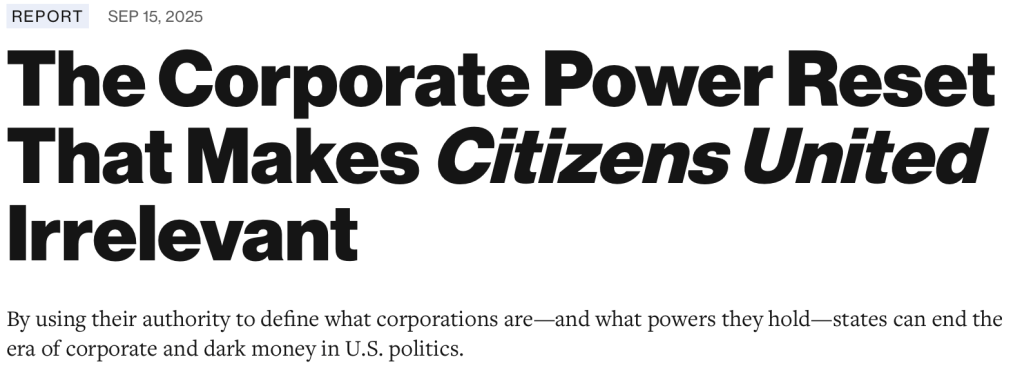
- WHAT WE DIDN’T REALIZE: “Each state creates and defines its corporations. It need not permit its creations to consume it. By using their authority to define what corporations are—and what powers they hold—states can end the era of corporate and dark money in U.S. politics.”
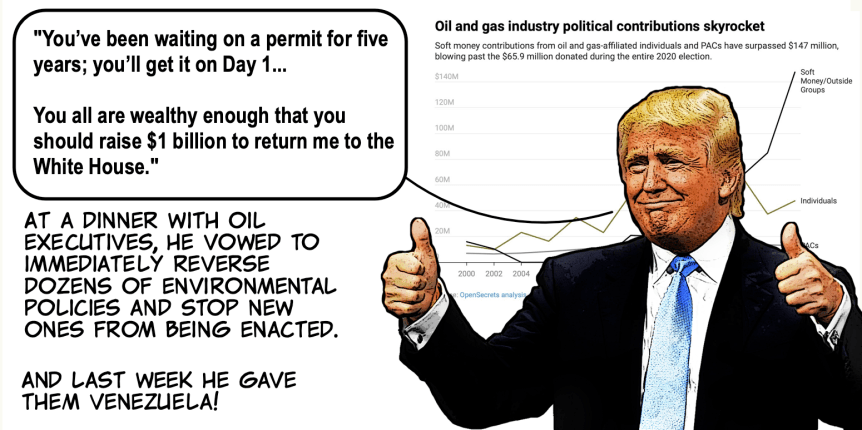
- The American public is sick of the corruption that’s now destroying laws and regulations that protect every aspect of life for the majority of Americans, in favor of deep-pocketed corporations and oligarchs, thanks to Citizens United. We invaded Venezuela and killed people in boats for oil, and now our EPA is tossing all responsibility for regulating pollution from fossil fuels.
- Instead of begging our legislators to make them to stop taking donations from corporations, where they worry that their competition will take the money if they won’t – this makes it easy for them. NOBODY GETS THE MONEY!
MINIMUM SCRIPT: I’m calling from [zip code] and I want [State Senator/Assemblymember______] to support the AB-1984 CORPORATE POWERS, also called the Corporate Power Reset, to stop corporate spending in CA politics.
MORE SCRIPT IF YOU WANT IT: The legislation, based on the Montana Plan, uses the States authority to define what powers corporations get and stops giving them the power to spend in our state and local politics. Montana can do it, and CA can too!
Contact:
- State Senator Monique Limón (SD-21): email, SAC (916) 651-4021 SB (805) 965-0862, OX (805)988-1940
- State Senator Henry Stern (SD-27):email, SAC (916) 651-4027, Calabasas (818) 876-3352
- State Assemblymember Steve Bennett: (CA-38): email, SAC (916) 319-2038, VTA (805) 485-4745
- State Assemblymember Jacqui Irwin: (CA-42): email, SAC (916) 319-2042, TO ((805) 370-0542
- Not your people? Which assemblymember/state senator is mine?: findyourrep.legislature.ca.gov.
ACTION #2 – Tell Governor Newsom we want AB-1984 to pass!
Our script – use your own voice if you can:
Dear Governor Newsom,
We believe that government should be “by the people, for the people.” Corporations are not people, yet they are allowed to exert undue influence on every election though donations to PACs and their unlimited funding of Super PACs and dark money organizations.
We also believe that only the citizens of our state should vote, yet our elections have been derailed by intense pressure campaigns from corporate interests beyond our state, and even from beyond the borders of our country.
Prop. 22, a duplicitous campaign in 2020 to rob gig workers of their newly granted employee benefits, set funding records of over $200 million from companies like Uber, which is partly owned and controlled by Saudi Arabia, and Lyft, which has significant investments from Chinese and Japanese conglomerates. Why did we allow their foreign influence to remove rights from California’s workers?
Prop. 8, an 2018 attempt to improve the care of CA’s dialysis patients, was defeated by a $110 million dollar campaign, where an industry making $3 billion in profits every year threatened patients with mass closure of clinics. The bulk of the anti-Prop. 8 financial support came from Fresenius Medical Care, a German multinational healthcare company. Why did we allow a foreign company’s influence to degrade the health care of Californians?
Citizens United has done what it set out to do by protecting the “free speech” of corporations, whether they were based in America, foreign countries or were heavily foreign-influenced. However, unlike a citizen’s right to free speech guaranteed under the 1st Amendment, a corporation’s political speech is a right that was granted to them by states, and states can take it away. It’s time to return corporations to the original conditions they had under the Corporations Code. They survived for over a 100 years without political speech. Let their actions speak for them, not their money.
Governor Newsom, please promote AB 1984, legislation that removes political speech from the corporations doing business in our state. It will keep them out of our elections, out of our legislators’ pockets and away from our ballot measures. In fact, it would be awesome parting gift to Californians and a great example to the rest of the nation if you encouraged legislators to make this an “urgency” bill, and let us have a November election free of malign corporate influence, the first since Citizens United.
Contact: https://www.gov.ca.gov/contact/
Resources
How corporations funnel money into politics now.
(Brennancenter.org) Corporations spend money on politics primarily through Political Action Committees (PACs), Super PACs, and 501(c)(4) “dark money” groups, fueled by the 2010 Citizens United ruling. While direct donations from corporate treasuries to federal candidates are banned, companies legally fund independent advertisements, lobby officials, and support state-level candidates.
- Traditional PACs are permitted to donate directly to a candidate’s official campaign, but they are also subject to contribution limits, both in terms of what they can receive from individuals and what they can give to candidates. For example, PACs are only permitted to contribute up to $5,000 per year to a candidate per election.
- Super PACS: outside groups could accept unlimited contributions from both individual donors and corporations as long as the groups don’t give directly to candidates. Additionally, while super PACs are required to disclose their donors, donors can include dark money groups, which make the original source of the donations unclear.
- Dark money: Dark money is election spending where the source is secret. Citizens United contributed to a major jump in this type of spending, which often comes from nonprofits that are not required to disclose their donors.
“Montana Plan” – style bills have been introduced in RI, HI, NY, VT, VA and NOW CA (AB 1984), and are pending in CT, NC, PA!
Yeah, the “Montana Plan” model is legal and it’s genius!
Montana has already figured out the legal argument to make Citizens United irrelevant and other states can use it too. Here are the basic parts of their plan:
- POWER TO ALTER OR REVOKE: each state’s laws state starkly and clearly that the state can alter—or revoke—its corporation law at any time, for any reason.
- UNIVERSAL APPLICATION: every change in a state’s corporation law applies to existing corporations as well as new corporations.
- OUT-OF-STATE CORPORATION PROVISIONS: The provision concerns corporations not chartered in the state, known as “foreign corporations.” This provision determines which powers a state grants to out-of-state corporations.
People on both sides want this legislation!
(issueone.org) New polling illuminates how the Supreme Court got Citizens United wrong and shows bipartisan momentum for money-in-politics reforms, including proposed Montana ballot measure

“Overall, Issue One’s new poll found that nearly 8 in 10 Americans (79%) agreed that large independent expenditures (the technical name for political ads that are not coordinated with a candidate) by wealthy donors and corporations in elections give rise to corruption or the appearance of corruption. This included 84% of Democrats, 74% of Republicans, and 79% of independents.
Relatedly, more than 3 in 4 Americans (76%) — including 84% of Democrats, 68% of Republicans, and 77% of independents — agreed that “the appearance of wealthy donors or corporations gaining influence over or access to elected officials causes me to lose faith in this democracy.”

“In Montana, Issue One’s new poll found that nearly 3 in 4 Montanans (74%) — including 84% of Democrats, 69% of Republicans, and 64% of independents — would vote in favor of this proposed ballot measure to eliminate corporate and dark money spending in elections by amending state law governing corporate charters, compared to only 11% opposed.

Nationally, Issue One’s poll tested a comparable proposal — asking voters how they would respond if a similar measure were considered in their own state. Support was nearly as strong, with 72% of Americans said they would support such a reform, compared to only 12% opposed, after respondents were exposed to messaging from both supporters and opponents. That included support from 81% of Democrats, 64% of Republicans, and 60% of independents.
These high levels of support persisted even when voters were reminded that proposed reforms to curb corporate and dark money spending in elections could apply to their own preferred groups, or raise free speech concerns.
- 77% of Americans — including 84% of Democrats, 70% of Republicans, and 78% of independents — agreed that anti-corruption rules strengthen our democracy and constitutional rights by ensuring everyone has equal political representation, regardless of money.
- 75% of Americans — including 84% of Democrats, 65% of Republicans, and 73% of independents — said unlimited spending in elections makes our democracy weaker because it gives wealthy special interests too much influence over elected officials. Only 13% of Americans said unlimited spending by people and organizations makes our democracy stronger by protecting the constitutional right to free speech.
- 73% of Americans — including 81% of Democrats, 67% of Republicans, and 71% of independents — agreed that “if a wealthy donor or corporation gains influence over or access to an elected official, I consider that official to be corrupt.”
- 69% of Americans — including 76% of Democrats, 61% of Republicans, and 64% of independents — believe that technology and social media companies have too much influence in politics.
- 63% of Americans — including 73% of Democrats, 53% of Republicans, and 61% of independents — disagreed with the Supreme Court’s Citizens United decision that corporations and labor unions have a First Amendment right to spend unlimited money to influence elections.
(https://www.youtube.com/watch?v=xTE1DkCLNEc)
Robert Reich AGREES!
(Robert Reich) “How to Get Rid of “Citizens United” – We can do away with it without a new Supreme Court. Nor do we need a constitutional amendment. There’s a far simpler way.”
(https://robertreich.substack.com/p/how-to-get-rid-of-citizens-united)

Humans versus Corporations
(American Progress) “Every Supreme Court case on corporate political speech has asked the same question: Must a corporation have the right to speak? What the Court has never said—because it has never been asked—is that corporations must have the power to speak in the first place. This silence makes sense, since for more than a century, states have granted corporations the power to conduct all lawful acts and activities, so corporate power to speak is a question that does not come before the Supreme Court. But, as Buccola notes, “[O]ne needs to distinguish between the related but distinctive concepts of corporate rights and corporate powers.”
Because states have granted corporations powers very similar to humans for the past century and a half (for example, the Commonwealth of Virginia’s corporation law currently grants corporations “the same powers as an individual to do all things necessary or convenient to carry out its business and affairs”), courts have treated their rights similarly in the modern era.
But the power relationship humans and corporations have to government is quite different. America was founded on the proposition that humans are created fully empowered to act in the world:
We hold these truths to be self-evident, that all men are created equal, that they are endowed by their Creator with certain unalienable Rights, that among these are Life, Liberty and the pursuit of Happiness. —That to secure these rights, Governments are instituted among Men, deriving their just powers from the consent of the governed.
Humans are born with a full set of powers; they are not given to them by the government. In fact, the opposite is true: As the declaration states, government derives all its power from the consent of the governed.
Corporate power to act in the world is significantly different. Corporations are pure creatures of law; they do not exist without law and have zero powers until a government grants them some. Once the law, through corporation statutes, grants a corporation the power to do something, the law, through regulation, shapes its rights to do that thing.”
Excerpt from “Transparent Election Initiative” – Harvard Law School Forum on Corporate Governance – Tom Moore, Center for American Progress
(corpgov.las.harvard.edu) Under The Montana Plan, corporations would still be able to form freely and pursue their business goals under the power of Montana law. But they would do so without a power that the people of Montana had decided no state-created entity needs: the power to pour money into politics.
“Washington’s paralysis has left Americans cynical, but federal gridlock need not bind the states,” says Marc Racicot, former Montana governor and former chairman of the Republican National Committee. “By declining to hand out corporate political-spending powers from the outset, Montana can chart a constitutional course others may follow—showing that bold, effective, and principled reform is still possible across party lines.”
The constitutional initiative under development in Montana would revoke all previously granted corporate powers and then regrant them in a positive, carefully defined way, with political spending powers omitted.
This structure draws upon two centuries of Supreme Court jurisprudence regarding corporate powers. The Court has held that states may define, limit, or revoke corporate powers for any reason, or for no reason at all. “That body need give no reason for its action in the matter,” the Court held in Greenwood v. Freight Co. (105 U.S. 13, 17 (1882)). “The validity of such action does not depend on the necessity for it, or on the soundness of the reasons which prompted it.”
This doctrine applies with equal force to “foreign corporations,” those chartered out of state but doing business within Montana. As the Court held in Paul v. Virginia (75 U.S. (8 Wall.) 168, 181 (1869)), a corporation “can have no legal existence beyond the limits of the sovereignty where created,” and any other state may decline to grant it powers that are “prejudicial to their interests or repugnant to their policy.”
Montana’s draft initiative simply applies that doctrine. It extends no power to spend in politics to any domestic or foreign corporation, full stop. That would end corporate political activity within the state: local, state, and federal. And because all dark money flows through corporations organized under section 501(c) of the tax code, it would shut down all dark money in Montana’s politics as well.
The draft defines “election activity” and “ballot-issue activity” precisely, then revokes all previously granted powers and regrants only those necessary to conduct business, excluding political spending entirely. This avoids interpretive ambiguity and invites narrow judicial review.
Jeff Mangan, Montana’s former Commissioner of Political Practices, is leading the effort to get The Plan on the ballot through the Transparent Election Initiative. The Plan has the support of some heavy legal and policy hitters, including Harvard Law’s John Coates, former Yale Law dean Robert Post, and NYU Law professor (and former SEC commissioner) Rob Jackson. Robert F. Williams, former head of the Center for State Constitutional Studies at Rutgers Law, terms it “spectacularly important.” Issue One, End Citizens United, Public Citizen, and Free Speech for People are among the organizations supporting it.
What Citizens United Didn’t Touch
The legal strategy behind the Montana Plan draws strength from the limits of Citizens United itself. Every campaign-finance case the Court has ever decided involved a fully empowered corporation—a company that had already been granted the power to act and was now asserting a right. The Court held that the government could not infringe that right.
But what if the corporation had never been granted the power in the first place? When states issue powers to corporations, they are defining what kind of creature they are creating, not limiting speech. And courts have long held that state legislatures have plenary authority to define the powers of corporations within their borders.
This includes the power to change those definitions. Every corporation chartered in Montana is chartered subject to the legislature’s reserved power to alter, amend, or revoke the law under which it was formed. As the Supreme Court held in Hamilton Gaslight Co. v. Hamilton (146 U.S. 258, 270 (1892)), the legislature may act “whatever may be the motive of the legislature, or however harshly such legislation may operate in the particular case upon the corporation or parties affected by it.”
Naturally, those scarred by years of campaign-finance-law warfare immediately raise First Amendment concerns, and especially that this approach may constitute an unconstitutional condition. But this approach does not regulate rights. It redefines entities before any rights are vested in anyone or anything.
Under this approach, incorporators simply receive from the state a corporate entity that has been granted a list of powers the state has chosen to define. It’s just a shorter list than it has been for the last century. Even existing corporations cannot complain; as the Court held in Hamilton Gaslight, “The corporation, by accepting the grant subject to the legislative power so reserved by the constitution, must be held to have assented to such reservation.”
The doctrine of unconstitutional conditions applies only when a right is traded away in exchange for a government benefit. And it only applies when “the Government has placed a condition on the recipient of the subsidy rather than on a particular program or service,” as the Court explained in Rust v. Sullivan (500 U. S. 173, 193 (1991)), “thus effectively prohibiting the recipient from engaging in the protected conduct outside the scope of the federally funded program.”
No one is prohibited from engaging in protected conduct outside the scope of their ownership of a corporation when they choose to form a corporation that a state has decided not to endow with political-spending powers. They may not receive every possible right, but nothing requires the government to hand out every possible right with every program it creates.
It’s hard to overstate how much law the Court would have to torch to overturn this approach. For starters, it would have to scrap the foundation of corporation law itself: that corporations are creatures of state law. The Court would in essence have to invent a “natural law of corporations.” Since Dartmouth College v. Woodward (17 U.S. 250 (1819)), the law has been clear: a corporation exists only because a state says so. Handing corporations powers its creating state did not grant would toss centuries of corporate-law doctrine aside and land the Court in radical, uncharted ground…
…Once a few states reclaim their sovereign power over corporations, a century-long spell will break, and Americans in every state will be able to see that the corporations they create do, in fact, answer to them, and that the people need not let their creations destroy their democracy.
Super PACs
(polyas)”Super PACs are a relatively recent form of political action committee which arose out of the Supreme Court judgment in Citizens United v. Federal Election Commission 2010. In this case, the court held that the First Amendment of the US Constitution prevented the government from restricting political campaign spending by unions, corporations or any other group. Subsequently, super PACs may support political candidates through unlimited contributions from corporations, unions, and individuals. Such contributions are often given anonymously and can be used to run ads supporting or attacking certain candidates, as long as no contributions are given directly to candidates.”
References
- (usatoday) Americans want dark money out of politics. We don’t have to wait for Supreme Court/Opinion – Tom Moore (Senior Fellow for Democracy Policy at the Center for American Progress)
- (issueone.org) New polling illuminates how the Supreme Court got Citizens United wrong and shows bipartisan momentum for money-in-politics reforms, including proposed Montana ballot measure
- (Transparentelection.org) Montana Constitutional Initiative – The complete text of the proposed constitutional initiative to limit corporate money in Montana politics
- (American Progress) The Corporate Power Reset That Makes Citizens UnitedIrrelevant
- (Brennan Center) Dark Money Hit a Record High of $1.9 Billion in 2024 Federal Races
- (Politico) Trump pressed oil executives to give $1 billion for his campaign, people in industry say
- WhiteRose: https://www.facebook.com/whiteroseresistanceofficial/posts/pfbid02F2cqVg9vrrxhqeRetfZkaKfbgMGsvSheSPkX3TW47h9QieX2cL9eQztv38k2TNvDl
- The American Prospect: Montanans Go After ‘Citizens United’
- CAP: The Corporate Power Reset That Makes Citizens United Irrelevant
- Robert Reich, “How to Get Rid of ‘Citizens United'”: https://robertreich.substack.com/p/how-to-get-rid-of-citizens-united
- Recording of CAP’s October 14 event introducing the project: https://www.americanprogress.org/events/undoing-citizens-united-and-reining-in-super-pacs/
 INDIVISIBLE VENTURA