
H.R. 4 rubber stamps $9.4 billion worth of his thefts from funding for foreign aid and public broadcasting.
This is all part of Trump’s efforts, backed by Project 2025 minions, to grab power from Congress for himself. The DOGE kids made cuts previously approved funding to foreign aid and public broadcasting, and this rescissions bill cleans up the crime scene. And this is just the beginning of their campaign of lawlessness.
(cbpp.org) “The Administration illegally impounded the funds at issue for months before proposing the package. Moreover, the Administration is unlawfully withholding much larger amounts of funding that it has not proposed for rescission, and Office of Management and Budget (OMB) Director Russell Vought has indicated an intention to ignore existing spending directives in the future “without having to get an affirmative vote [from Congress].”In short, this rescission package is part of a broader Administration effort that threatens to fundamentally upend Congress’s spending power under the Constitution and undermine lawmakers’ ability to negotiate future spending deals in good faith.”
H.R. 4 must pass both chambers by July 18th; if it fails, Trump cannot request these same rescissions again.
Action: Call or email your representative and both senators!
Minimal script: I’m calling from [zip code]. [Call all their offices to get a live staff member. If voicemail, leave street address).
I am calling to demand that [Rep./Sen._____] oppose Trump’s rescissions bill gutting foreign aid, NPR and PBS.
[Now you are welcome to add more, or why these services are important to you and your family…]
The freezes at USAID have already cost 300,000 lives and made the world more dangerous and more anti-American. Public broadcasting cuts threaten one of the last remaining outlets for local, non-corporate controlled news in so many communities, not to mention disaster response and the programs we raise our kids on.
[Continue if you want…]
We all know what’s really happening here. Trump and Musk are putting more money in their pockets at our expense. They want to cut services like public TV and radio we use every day, and programs that fight diseases like malaria, Ebola and HIV/AIDS or feed children or make wars less likely. And all to pay for more tax cuts for billionaires! This is in the interests of the wealthy and powerful, not regular Americans, and Congress needs to stand with us and not them. Big Bird and malaria prevention are more important than seventh homes and private jets.
Thank you for your time and consideration.Thank you for your time and consideration.
- Rep. Julia Brownley: email, (CA-26): DC (202) 225-5811, Oxnard (805) 379-1779, T.O. (805) 379-1779
- or Rep. Salud Carbajal: email.(CA-24): DC (202) 225-3601, SB & Ventura: (805) 730-1710 SLO (805) 546-8348
- Senator Adam Schiff: email, DC (202) 224-3121, LA (310) 914-7300, SF (415) 393-0707, SD (619) 231-9712, Fresno (559) 485-7430
- and Senator Padilla: email, DC (202) 224-3553, LA (310) 231-4494, SAC (916) 448-2787, Fresno (559) 497-5109, SF (415) 981-9369, SD (619) 239-3884
- Who is my representative/senator?: https://www.usa.gov/elected-officials
Deeper Dive
(Propublica) Since taking office, President Donald Trump has pledged to restore safety and security around the world. He lied. Instead, he did this.
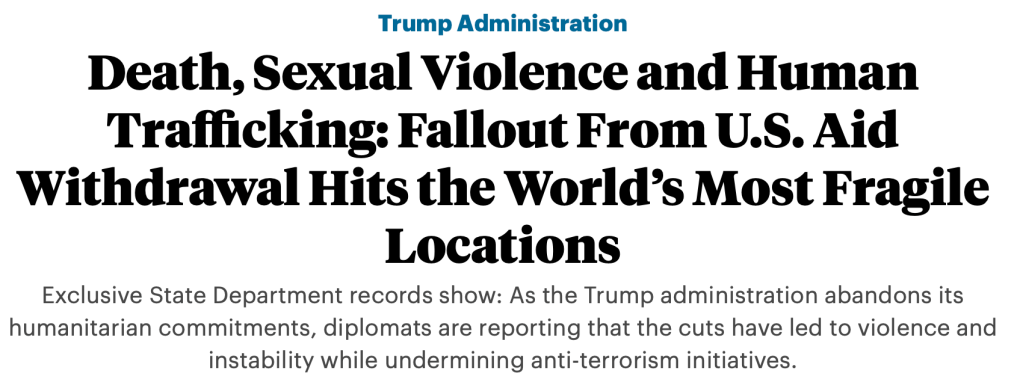
Plus, it hits American businesses, including farmers.
(Rogan’s List) Elon Musk may claim he’s stepping back, but the damage he’s done is just beginning. The White House has sent a “rescissions” bill to Congress to rubber stamp $9.4 billion worth of his thefts from public services. H.R. 4 targets funding for NPR and PBS and legalize the gutting of our foreign aid programs. It passed the House 214-212 on June 12th.
Cuts include:
- $1.1 billion in funding for the Corporation for Public Broadcasting which disburses funds to NPR and PBS, two media organizations commonly targeted by Trump for being “radical, woke propaganda”.
- $1.25 billion in funding to the Clean Technology Fund, which supports the development of low-carbon technologies in middle-income and developing countries.
- $900 million in funding to global health programs like the President’s Emergency Plan for AIDS Relief (PEPFAR), which has been credited for saving millions of lives around the world.
- $200 million in contributions to international organizations like USAID.
- Billions more in U.S. foreign aid for international disasters, migration and refugee assistance, democracy, international peacekeeping, and economic development programs.
We are already seeing horrific costs from the Trump-Musk gutting of the U.S. Agency for International Development, with as many as 300,000 lives already lost and millions of preventable deaths every year ahead of us as people go without relief for severe malnutrition and crucial health care programs aimed at malaria, HIV/AIDS, and Ebola. Furthermore, they are making the world more unstable and less friendly to the United States, with shortages opening the door for conflict and other nations concluding we cannot be counted on. The cuts also put 200,000 American jobs and $23 billion in US exports at risk.
The public broadcasting cuts would be devastating to local PBS and NPR stations, threatening a crucial source of local news. With corporate consolidation and changes in the media environment, many public stations are the primary provider for their region, especially in rural areas, and provide children’s and educational content beloved by so many of us. We’re talking about losing everything from in-depth community coverage to Sesame Street.
(protectmypublicmedia.org) For about $1.60 per person each year, federal funding powers:
- Lifesaving geotargeted emergency alerts and warnings delivered to your cell phones and the airwaves.
- Captivating local programming and community engagement, thought-provoking documentaries and stories, public forums tackling local issues, enriching cultural experiences, and educational workshops supporting children and caregivers.
- Educational content and resources, proven by 100+ studies to boost children’s literacy, math, and science skills.
- PreK-12 classroom tools for educators, children, and families.
Taking back this funding would immediately undermine stations’ ability to serve their communities. Numerous studies confirm there is no replacement for federal support. Stations would face tough choices — cutting programs, reducing outreach, shrinking coverage, or going off-air entirely. Small, rural, and Native American-operated stations, who are often some of their communities’ only local media sources, would be at greatest risk.
They’re even a key part of disaster response systems in many places.
(protectmypublicmedia.org) “Public media isn’t just about educational programs and documentaries. It’s about infrastructure. It’s about having a trusted voice and a signal that reaches nearly every household in America — especially in rural areas where there may be no local news station and where cell coverage is spotty at best.
These stations serve as critical components of our national emergency communications backbone. Many are the primary hubs for the Emergency Alert System in their states. They carry AMBER Alerts. They support severe weather warnings. And they’re part of the technology FEMA and others use to push Wireless Emergency Alerts to your phone. That system doesn’t work without public broadcasting.
And that’s just the national picture.
At the state and local level, public broadcasting stations are stepping up with real innovation:
- In California, they’ve helped cut earthquake alert times from 30 seconds to less than 3.
- In Tennessee, they’ve partnered with the state to build a dedicated emergency communications network.
- In Florida and South Carolina, public media runs round-the-clock storm updates, making sure residents get lifesaving information when it matters most.
This is public safety in action — not theory. These are boots-on-the-ground, people-on-the-air efforts that make the difference between timely evacuations and missed warnings.
And they only happen because Congress has invested in public media through the Corporation for Public Broadcasting.
DC media has suggested it may not be easy for Republicans to find the votes to pull back this funding, and so-called moderates like Don Bacon and Susan Collins are balking. Let’s do our part to make it a little tougher and contact our members of Congress in support of public broadcasting and foreign aid and against legislation destroying them.
(cbpp.org) Detailed explantation of Rescission Rules and the Targets of these proposed cuts.
A Primer on Rescission Proposals Under the Impoundment Control Act
Congress enacted the Impoundment Control Act (ICA) in response to President Nixon’s unilateral impoundment of appropriated funds, which the courts had already ruled unlawful. The ICA created a process by which a President could seek expedited congressional approval to rescind appropriated funding. Under the ICA, the President can request that Congress take back funding that it previously provided as long as the funding has not yet been obligated (typically meaning committed to a particular purpose or recipient). Specifically:
- Presidents may propose funds they desire to be rescinded, and the requested rescission amounts, through a special message to Congress.
- Congress may choose to act on all or some of the funding accounts the President has proposed for rescission and can modify the amounts of funding to be rescinded, but cannot add programs to a rescission package.
- A rescission package proposed in this manner can pass the Senate with a simple majority and cannot be filibustered.
- Congress has 45 consecutive days to take action on a rescission package. The ICA includes special rules to facilitate prompt consideration of a rescission package if a majority of members wish to vote on it.
- The executive branch can temporarily pause the obligation of funds included in a rescission package while Congress considers the request. However, any funds not approved for rescission within 45 days can no longer be paused and must subsequently be obligated, consistent with existing appropriations law. Given that the funds in this rescission request have been impounded for months, there is a strong argument to be made that the ICA’s 45-day standard should apply to an earlier date than when the package was transmitted to Congress on June 3. However, using the date the rescission package was transmitted, the Senate would have until July 18 to take action on it.
Targets of Proposed Cuts
The fiscal impact of the Administration’s rescission package would be quite small; the savings would offset less than 0.3 percent of the cost of the recently enacted Republican reconciliation bill.a The cuts target two areas: public television and radio stations and programs that are intended to support global health, disaster assistance, and development programs in poor countries.
Public television and radio: The federal government is the largest single funding source for public television and radio stations.b Eliminating all federal funding beginning this fall would end a multi-decades-long funding relationship that has long had bipartisan support, in part because this funding plays a particularly important role in smaller, more rural and isolated communities with limited alternatives for local news and public alerts.c For example, Senator Mike Rounds has said that there are Native American radio stations in South Dakota that “will not continue to exist” if their funding is cut without replacement.d
Global assistance: The proposed rescission package would reduce funding for a range of global assistance programs, including global health programs, development assistance, and migration and refugee assistance. For example, the rescission package would cut $400 million from programs to combat HIV/AIDS, including the President’s Emergency Plan for AIDS Relief (PEPFAR), a program started by former President George W. Bush. Senate Appropriations Chair Susan Collins noted that the PEPFAR program “has saved more than 26 million lives” and “remains a bipartisan priority of Congress.” She further noted that, “Cutting funds now — funding that is aimed at preventing disease transmission — would be extraordinarily ill-advised and shortsighted.”e
a Congressional Budget Office, “Information Concerning the Budgetary Effects of H.R. 1, as Passed by the Senate on July 1, 2025,” July 1, 2025, https://www.cbo.gov/publication/61537.
b Corporation for Public Broadcasting, “CPB Financial Information,” accessed on July 1, 2025, https://cpb.org/aboutcpb/financials/. The Corporation for Public Broadcasting’s Community Service Grants are allocated to more than 1,500 local rural and urban public media stations. Corporation for Public Broadcasting, “FY 2026 and FY 2028 Justification to Labor, Health and Human Services, Education Related Agencies Subcommittee,” May 30, 2025, https://cpb.org/sites/default/files/Public-%20FY%202026%20and%20FY%202028%20Justification%20to%20Labor%2C%20Health%20and%20Human%20Services%2C%20Education%20Related%20Agencies%20Subcommittee%20%281%29.pdf.
c Christopher Vondracek and Emmy Martin, “Federal funding cut could silence tribal, rural radio stations many in Minnesota consider vital,” Star Tribune, June 27, 2025, https://www.startribune.com/federal-funding-cut-could-silence-tribal-rural-radio-stations-many-in-minnesota-consider-vital/601372507.
d Aris Foley, “Trump budget director faces bipartisan heat in Senate on DOGE cuts,” The Hill, June 25, 2025, https://thehill.com/business/budget/5370122-vought-bipartisan-heat-senate-doge-cuts/.
e US Senate Committee on Appropriations, Majority News, “Senator Collins’ Opening Statement at Hearing on President’s Rescissions Package Request,” June 25, 2025, https://www.appropriations.senate.gov/news/majority/senator-collins-opening-statement-at-hearing-on-presidents-rescissions-package-request.
 INDIVISIBLE VENTURA