
They are our national parks, national monuments, national forests and national wildlife refuges and the GOP is planning to loot them all for their donors.
UPDATE: As of 3/18/2025, our park rangers have NOT been offered their jobs back!
Part 1 – Support their existence and protection, and the rangers who take care of them.
(Part 2 here)
Watch the video from the fired employees of the Channel Islands National Park here!
Our new Secretary of the Interior Doug Burgum has said: “We will achieve Energy Dominance by sustainably developing our natural resources while championing clean air and clean water, protecting our most beautiful lands, and expanding outdoor recreation!
“We will treat our natural resources as national assets, which are for the benefit and use of the American people.”
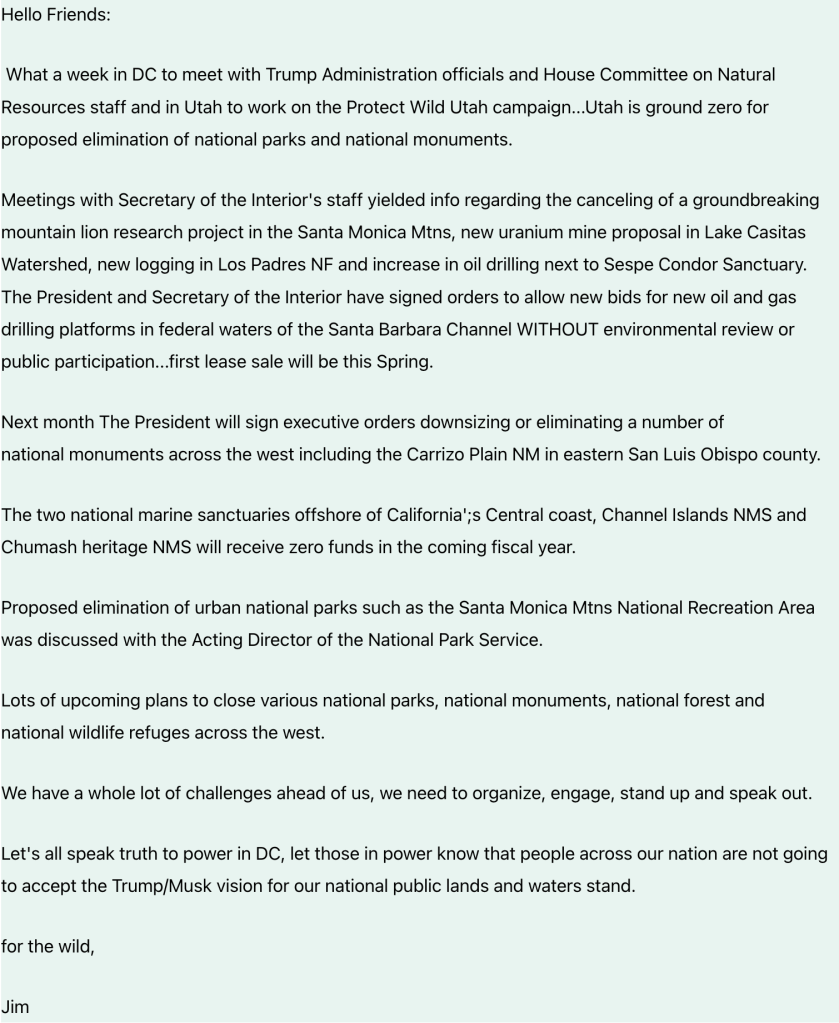
Hmmm. “Resources as assets” What does that mean? And exactly whose “benefit and use?”: Jim Hines of the Sierra Club – Santa Barbara-Ventura Chapter gives us the first of two previews of what’s REALLY going to happen. (Part 2 here)
(Spoiler alert: We don’t think we’re the “American people” who are going to benefit!)
Know the history:
In 2017, coal baron Robert Murray sent a letter to Trump’s first administration with 16 demands to revoke environmental safeguards, including rescinding the Clean Power Plan, in return for generous donations. Most were granted.
In Trump’s second administration, the American Petroleum Industry sent in their deregulation wish list – below are listed the goals of point 3 – “Leverage our Natural Resources” Luckily for them, their list coincides neatly with Project 2025’s plans of decimating our park system for the “benefit and use” of their corporate donors. (expand each point here.)
- Expand Lower oil and gas leasing and support corporate welfare
- Open Alaskan wildlands to drilling and mining
- Roll back protections for nationall monuments
- End protections for birds
- Slash endangered species protections
- Supercharge uranium mining
- Shut the door on wind and solar development
- Increase methane venting and flaring
- Abandon the agency’s conservation mandates.
ACTION – Calls and emails for your legislators:
Instead of just putting in our own script, we’ve collected scripts from others who love and value our national parks as much as we do, along with some inspirational quotes about our park system in yellow boxes. You probably already have some idea of what you want to say, drawing on your own experiences while enjoying our wild spaces and monuments. Use those stories to make your comment personal. We’ve also added more informational resources under “Deeper Dive” below.
Minimal script for ALL legislators: I’m calling from [zip code] and I want [legislator] to know that I’m alarmed and angry at the GOP’s plans to close off ANY of our national parks, monuments, forests and wildlife refuges, and increase polluting and habitat-destroying commercial activities in the wild places that are our national treasures. I expect [him/her/them] to do everything possible to prevent this theft from the American people, and their children and grandchildren, from happening.
CALL: (5calls) Hi, my name is [NAME] and I’m a constituent from [CITY, ZIP].
I’m calling to demand [REP/SEN NAME] to demand oversight hearings to push back on the Trump administration’s efforts to devastate our national parks and public lands under the guise of “cutting costs”. These parks and public lands were already understaffed, and the recent chaotic firings of park workers are dangerous not only to the lands, but the people who enjoy them. It’s inappropriate for the Trump administration to take these dramatic and dangerous actions without any oversight. Thank you for your time and consideration.
“National parks and reserves are an integral aspect of intelligent use of natural resources. It is the course of wisdom to set aside an ample portion of our natural resources as national parks and reserves, thus ensuring that future generations may know the majesty of the earth as we know it today.”
– President John F. Kennedy; 35th president of the United States
– EMAIL: (Sierra Club provides a online submisssion page or you can copy what you want directly to your legislators ) I value America’s unique and precious public lands for what they mean to me, and what they protect. The staff who steward those lands make America’s parks, monuments, and refuges an extraordinary and invaluable resource.
(Add personal message here, especially if you are planning to visit a National Park or other public lands this year or have visited recently, to share how this loss of staff impacts you.)
I ask that you call on Secretary of the Interior Doug Burgum and Secretary of Agriculture Brooke Rollins to stop slashing their workforce and reverse harmful staffing policies that impact land management and environmental protection.
These staff are the heartbeat of public lands, national parks, national monuments, national forests, wildlife refuges, and the health of our air, water, and communities. They are essential to the special places that millions of Americans visit every year. Those visitors drive local economies and support hundreds of thousands of jobs. From guiding hikes to backcountry rescues, trail maintenance to cleaning toilets, protecting endangered species, or helping green nature-deprived communities, staff are already being asked to do more with less. Any further cuts to staffing could forever change our national parks, public lands, and communities. The recent moves by the administration are nothing short of devastating.
In addition to leaving thousands of people without a paycheck, these layoffs will also hinder the implementation of key programs, impact visitor safety, stifle effective public land management, and result in the loss of critical institutional knowledge throughout our government.
Our communities and our economies rely on protected public lands and environmental protections. As your constituent, I want you to do everything in your power to protect the National Park Service, Forest Service and other land management, from these egregious staffing cuts.
“The parks do not belong to one state or to one section…. The Yosemite, the Yellowstone, the Grand Canyon are national properties in which every citizen has a vested interest; they belong as much to the man of Massachusetts, of Michigan, of Florida, as they do to the people of California, of Wyoming, and of Arizona.” – Stephen Mather, First Director of the National Parks
– PHONE OR EMAIL (Channel Islands Protect our Parks) “My name is [______], and I’m a [your city/state] resident. I’m writing to urge [Lawmaker’s Name] to support continued funding to support our public lands, including our national parks and forests.”
Personal Connection (Optional but Encouraged): “Public lands are incredibly important to me because [share a personal experience].”
Examples:
- “I grew up visiting [National Park/National Forest] with my family, and it shaped my love for the outdoors.”
- “As a hiker/camper/kayaker/researcher, I rely on these spaces for recreation and inspiration.”
- “I’ve seen firsthand the incredible work that rangers and public land stewards do to keep these places accessible and protected.”
- “Public lands provide a place for me to connect with nature, de-stress, and spend time with loved ones.”
Why It Matters:
- Option 1: “These lands are an essential part of our national heritage, providing recreational opportunities, protecting wildlife, and supporting local economies.”
- Option 2: “Investing in public lands ensures future generations can enjoy these placeswhile also creating jobs and bolstering tourism.”
- Option 3: “National parks and forests are vital for conservation, climate resilience, and maintaining biodiversity. They need proper funding to be protected.”
Issue of Employee Termination:
- Option 1: “I am also concerned about the recent termination of federal employees who safeguard and maintain these lands. Their work is critical, and they should bereinstated.”
- Option 2: “Without these dedicated employees—scientists, rangers, and stewards—our public lands are at risk of neglect. Please support efforts to reinstate them.”
- Option 3: “Federal workers who protect our national parks and forests provide aninvaluable service. Losing them undermines conservation efforts and public access.”
***consider addition of “Why Channel Islands National Park Matters” (below) here.***
Closing Ask:
- Option 1: “I urge [Legislator’s Name] to support adequate funding for our public lands and advocate for the reinstatement of these essential workers. Can I count on [him/her/them] to take action on this?”
- Option 2: “I urge [Lawmaker’s Name] to ensure that Channel Islands National Park receives the funding and staffing it needs to continue its essential work. Can I count on their support?”
“Thank you for your time and for supporting the protection of our national treasures.”
“If future generations are to remember us with gratitude rather than contempt, we must leave them something more than the miracles of technology. We must leave them a glimpse of the world as it was in the beginning, not just after we got through it.” – President Lyndon B. Johnson; 36th president of the United States
Why Channel Islands National Park Matters
“I’d also like to highlight the importance of Channel Islands National Park. This park is often called ‘North America’s Galápagos’ because of its incredible biodiversity and the unique species that exist nowhere else in the world.”
- “The park protects critical habitats for endangered species like the island fox,which was brought back from the brink of extinction thanks to conservation efforts.”
- “It serves as an important marine environment, protecting kelp forests, seabird nesting sites, and marine mammals like sea lions and whales.”
- “Beyond conservation, Channel Islands National Park provides invaluable recreational opportunities for thousands of visitors each year, boosting the local economy through tourism.”
The Need for Funding and Staff
“Maintaining this special place requires proper funding and the dedicated work of park staff, scientists, and rangers. Without them, the park’s fragile ecosystems, visitor services, and conservation efforts are at risk.”
- “Recent staffing cuts threaten critical research, restoration projects, and visitor education programs.”
- “Investing in Channel Islands National Park isn’t just about protecting the park itself—it’s about preserving a piece of California’s natural and cultural heritage.”
A national park is not a playground. It’s a sanctuary for nature and for humans who will accept nature on nature’s own terms.”
– Michael Frome; writer, educator, and conservationist
Contacts:
- * Rep. Julia Brownley: email, (CA-26): DC (202) 225-5811, Oxnard (805) 379-1779, T.O. (805) 379-1779
- or Rep. Salud Carbajal: email.(CA-24): DC (202) 225-3601, SB & Ventura: (805) 730-1710 SLO (805) 546-8348
- Call Al Green’s office to thank him here: DC (202) 225-7508, Houston (713) 383-9234, Missouri City (713) 383-9234
- Who is my representative/senator?: https://www.usa.gov/elected-officials
Deeper Dive – Resources
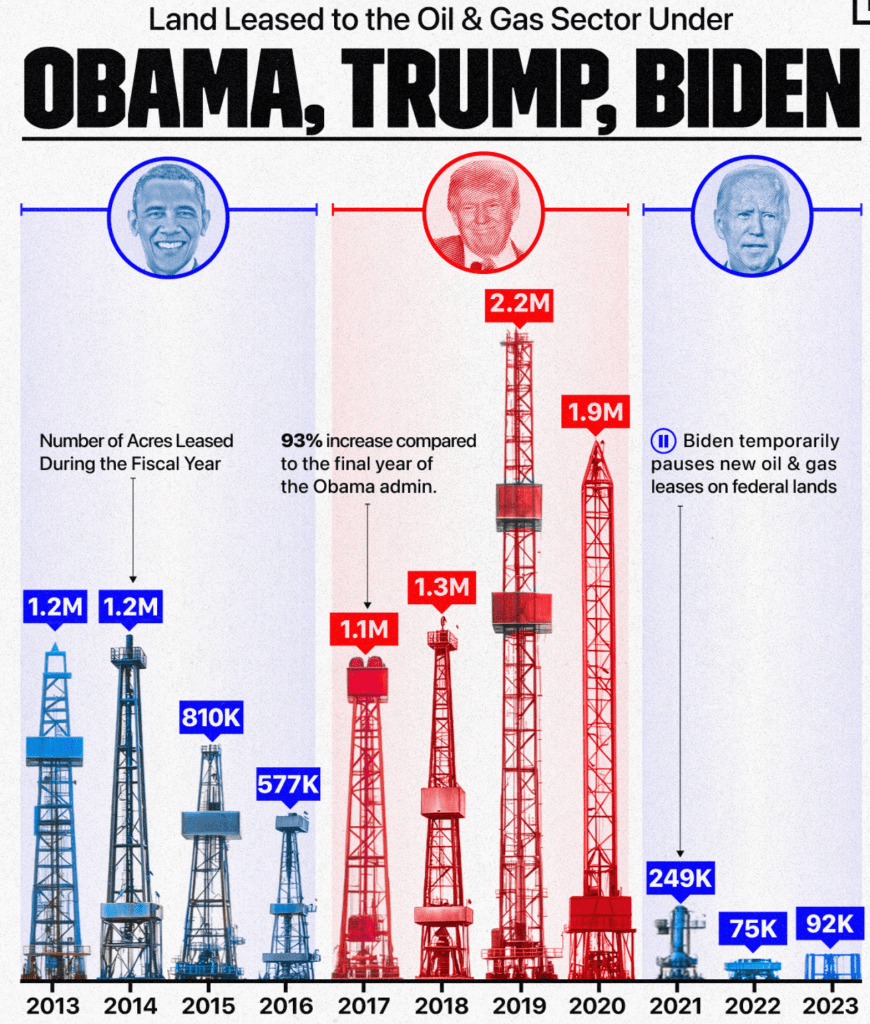
What has happened before…and why opening more public land to development will not bring energy prices down for American consumers and much of the damage will be irreversible.
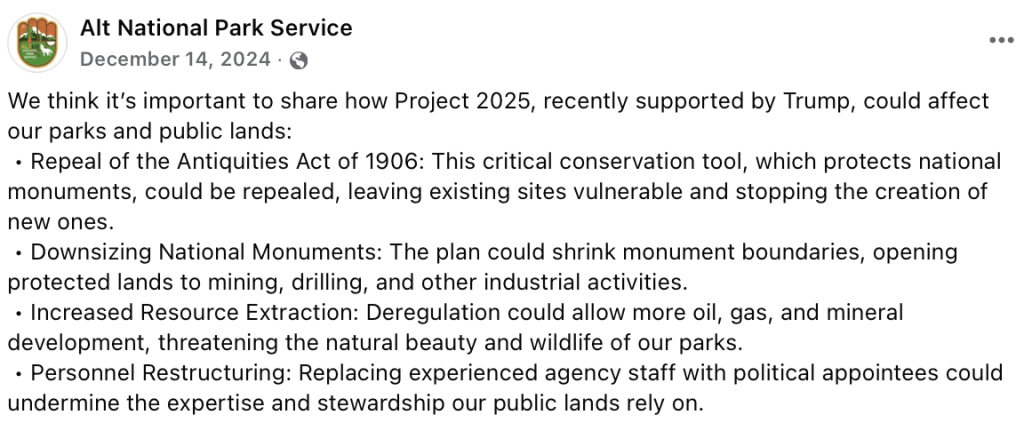
Disappearing Parks: How Project 2025 Would Decrease Protections for Nature
(American Progress) “The Biden-Harris administration has used its executive powers under the Antiquities Act to establish, expand, or restore eight landscape-level national monuments. These new protections—totaling more than 3.7 million acres and including places such as Castner Range National Monument in Texas and Avi Kwa Ame National Monument in Nevada—have benefited communities across the American West. They have played a particular role in serving nature-deprived communities—those experiencing higher-than-average nature loss—and solving for the disproportionate impact that nature deprivation has on communities of color.
A new analysis by Conservation Science Partners (CSP) and the Center for American Progress finds that these monuments have played a significant role in closing the nature gap by providing more protected nature for nearby communities. In fact, more than 88 percent of communities near new, expanded, or restored Biden-Harris monuments are nature deprived, and one-third of these communities have higher proportions of people of color relative to their state.
But Project 2025 threatens to remove protections from these new monuments under a potential conservative administration. The Heritage Foundation’s Project 2025 is an extreme, far-right playbook that seeks to unravel many core American principles and policies, including the conservation of the country’s natural wonders. It explicitly calls for the removal of much of the Biden-Harris administration’s conservation and climate progress, including actions taken through long-established and bipartisan tools such as the Antiquities Act. This conservative agenda could mean rolled back or even expunged protections for national monuments. Project 2025 poses a risk to conserved nature and threatens the families and communities who rely on the benefits of nature.
The Antiquities Act of 1906 grants the president authority to protect public lands of scientific or historic value as national monuments. In more than 118 years, it has been used by 18 presidents—both Democrats and Republicans. Project 2025 threatens this tool by suggesting that “the new Administration must seek repeal of the Antiquities Act of 1906.” This historically popular and bipartisan tool has helped the president respond to community-led calls for increased conservation for more than a century and has been used to protect 164 places of ecological, cultural, historic, or scientific importance across the United States.
The Project 2025 policy mandate promises “review” of Biden-Harris monument designations. In 2017, the Trump administration demonstrated its commitment to downsizing, removing, and selling off protected public lands through its own “review,” which led to the downsizing of the Bears Ears and Grand Staircase-Escalante national monuments. Project 2025 called these actions “courageous,” though Tribes represented by the Native American Rights Fund filed lawsuits questioning their legality.
Project 2025 claims that “the result of that review was insufficient in that only two national monuments in one state (Utah) were adjusted” and proposes revisiting “past monument decrees and new ones by President Biden.” This puts a direct target on rolling back protections for Biden-Harris national monuments. The extent of conservation rollbacks that a conservative administration could undertake could be unimaginably destructive.”
National monuments are a tool to close the nature gap
Since 1906, national monuments have been a critical executive tool for actualizing community-led conservation. Often, advocacy for proposed monuments spans decades prior to their designation. National monument designations are one of few ways that communities can appeal directly to the president for new conservation measures near their homes. The resulting increase in local access to protected natural areas has proved to have positive mental and physical health impacts. Having better access to nature is also increasingly important for helping communities regulate the impacts of climate change. For example, protecting and expanding tree cover can help combat extreme heat, and restoring and safeguarding natural floodplains can provide improved flood risk reduction.
Despite these benefits, many communities across the country are nature deprived, meaning that they experience higher-than-average nature loss. Communities of color are three times more likely to live in nature-deprived places than white communities, and low-income communities are 20 percent more likely to live in nature-deprived places than individuals of other income statuses. The uneven and inequitable distribution of natural places within communities of color and low-income communities is often referred to as the nature gap and is caused by a history of discrimination and dispossession on public lands.
CSP and CAP conducted an analysis identifying the communities most significantly affected by Project 2025’s suggested rollbacks to Biden-Harris national monuments. The analysis identified almost 4,000 census tracts—referred to here as communities—located within 25 miles of the administration’s eight landscape-level monuments. They were then examined for their demographic characteristics including race, ethnicity, socioeconomic status, family status, and nature deprivation.
According to CSP and CAP’s analysis, communities across the West would be negatively affected by Project 2025’s potential reversal of national monument protections. There are approximately 15.6 million people living in the areas surrounding national monuments established or expanded by the Biden-Harris administration. This means that within four years, nearly 5 percent of the U.S. population has gained greater access to protected nature through Biden-Harris monuments, which could be at risk.
Eighty-eight percent of communities living near new national monuments are nature deprived. Many of these people reside in urban areas such as the San Francisco Bay Area; Los Angeles; Las Vegas; and El Paso, Texas.
Race and ethnicity
The disproportionate impact of nature loss by race and ethnicity is prevalent in the communities surrounding the recently designated monuments in this analysis. More than one-third of nearby communities have some of the highest proportions of nonwhite residents compared with other communities in their state. Nonwhite communities near these new monuments are almost 30 percent more likely to be nature deprived than white communities. New monuments have played a critical role in helping provide access to protected nature for thousands of nature-deprived communities of color across the West.
Some of the most racially and ethnically diverse states in the country also contain some of the highest rates of nature deprivation. In Nevada, 100 percent of Black communities within 25 miles of a Biden-Harris national monument are nature deprived. In Texas, in an area where the majority of the population is Latino, 9 in 10 Latinos are nature deprived.
Income
Low-income communities are disproportionately affected by nature deprivation across the country. About 11 percent of communities near new monument protections have average household incomes in the bottom 10 percent of all communities in their state. New monuments in Utah, Arizona, and Texas have benefited the greatest proportions of low-income communities relative to their state, when compared with all new monument protections.
Household composition
There are 1.7 million families with children under age 18 living in the areas surrounding the eight national monuments in this analysis. Nature access is especially important for children because it has proven correlations to improved motor skills, social skills, and cognitive function. When compared with all new designations, monuments in New Mexico, Texas, and California benefit nearby communities with the greatest proportions of families with children.
Recent designations are critical for nature-deprived communities
Previous CAP analyses of specific national monument protections confirm the threat that Project 2025 poses to nature-deprived communities.
San Gabriel Mountains National Monument
The San Gabriel Mountains National Monument expansion in California increased the total number of people within 5 miles of the monument’s boundaries by 90 percent, extending access to nearby protected nature for 757,000 people. A majority of people benefiting from this expansion are nonwhite. This expansion resulted in a significantly decreased drive time to protected nature for nonwhite, low-income, and nature-deprived communities, from more than 1 hour to 30 minutes…
…Conclusion
Across the West, Biden-Harris national monuments have given nature-deprived communities the refuge of nearby nature. Without them, communities stand to lose their right to clean air, water, and land. The threat that Project 2025 poses to American conservation should not be understated. Revoking or downsizing protections for popular public lands sets a dangerous precedent that no iconic landscape is ever truly safe and in the community’s hands.
- (NRDC.org) Trump Interior Secretary’s Orders Make Public Lands Ground Zero for Drilling & Mining – The Trump administration hopes to end protections of cherished places and expand oil, gas, and mining on the country’s public lands.
- (npca.org) Parks Are Being Dismantled Before Our Very Eyes
- (BBC) Cuts to national parks and forests met with backlash
- (guardian) Trump purge raises extinction threat for endangered species, fired workers warn
- (awionline.org) President Trump’s Day-One Actions Will Decimate Wildlife Habitat
- (AP) Environmentalists say Trump’s energy order would subvert the Endangered Species Act
- (guardian) Trump orders swathes of US forests to be cut down for timber – President’s move to expand tree cutting across 280m acres evades rules to protect endangered species
- (endangered.org) Trump Administration Declares A War On Wildlife With Nomination Of Brian Nesvik
- (humaneworld.org) What U.S. President Trump’s initial executive orders could mean for animals
- KCAL/CBS Los Angeles: Former Channel Islands Park Rangers talks about Trump Administration firings
- CBS Los Angeles: Protesters in Channel Islands denounce cuts to National Parks workforce
- CBS Los Angeles: Channel Islands National Park workers rally against federal firings
- KSBY/NBC: Local federal workers speak out after layoffs in the U.S. Forest Service and Channel Islands National Park
- Ventura County Star: Channel Islands National Park loses 10% of its workforce, former officials say
- Ventura County Star: Rain-soaked rally draws hundreds to Channel Islands National Park office in Ventura
- Ojai Valley News & Ventura County Sun: Protesters champion Channel Islands National Park
- Santa Barbara Independent: Fired Channel Islands worker speaks out at protest against cuts to National Parks
- Spectrum News: Federal job cuts could impact national park maintenance
- HuffPost: DOGE Abruptly Cut These National Park And Forest Service Workers’ Jobs. Here’s How It’ll Impact You.Ventura County Star
- (Facebook) Photos from the rally
 INDIVISIBLE VENTURA