
On August 20th, “…the Republican attorney general of Texas sent armed police officers after Hispanic voters—some in their 80s—to intimidate, threaten, and destroy them financially by forcing them to hire lawyers to defend themselves, even though they are perfectly legal voters.
It’s a manifestation of the new unofficial Republican slogan: “If you can’t win on the issues, cheat. And if cheating doesn’t get you over the top, intimidate!”
Write an email to Attorney General Merrick Garland:
Contact Merrick Garland at the Department of Justice here: https://www.justice.gov/doj/webform/your-message-department-justice
Here’s one example: On September 5th, your office published a memo commemorating the 15th anniversary of the Matthew Shepard & James Byrd Jr. Hate Crimes Prevention Act. It listed numerous efforts of the Civil Rights Division to combat crimes targeting Black people. By the time you publish the notice for the 16th anniversary, we hope you will have included invoking the Ku Klux Klan Act of 1871 against Texas AG Ken Paxton, for his egregious violations committed against members of his state’s Latino and civil rights groups under the color of law. His victims were terrorized in their homes and suffered violations of the Fourth Amendment‘s protection against unreasonable search and seizure.
Paxton abused the power of his office to retaliate against voters who spoke out peacefully against his earlier suppression of mail-in ballots. His purpose appears to be the intimidation of a specific group of American citizens in order to prevent them from exercising their right to vote – a crime for which the KKK Act was enacted.
We are sure that League of United Latin American Citizens (LULAC) has already reached out to your office, but we want you to know that the outrage against this lawless official, and those who follow his orders, spreads far beyond the borders of Texas.
Here’s another example to pull from:
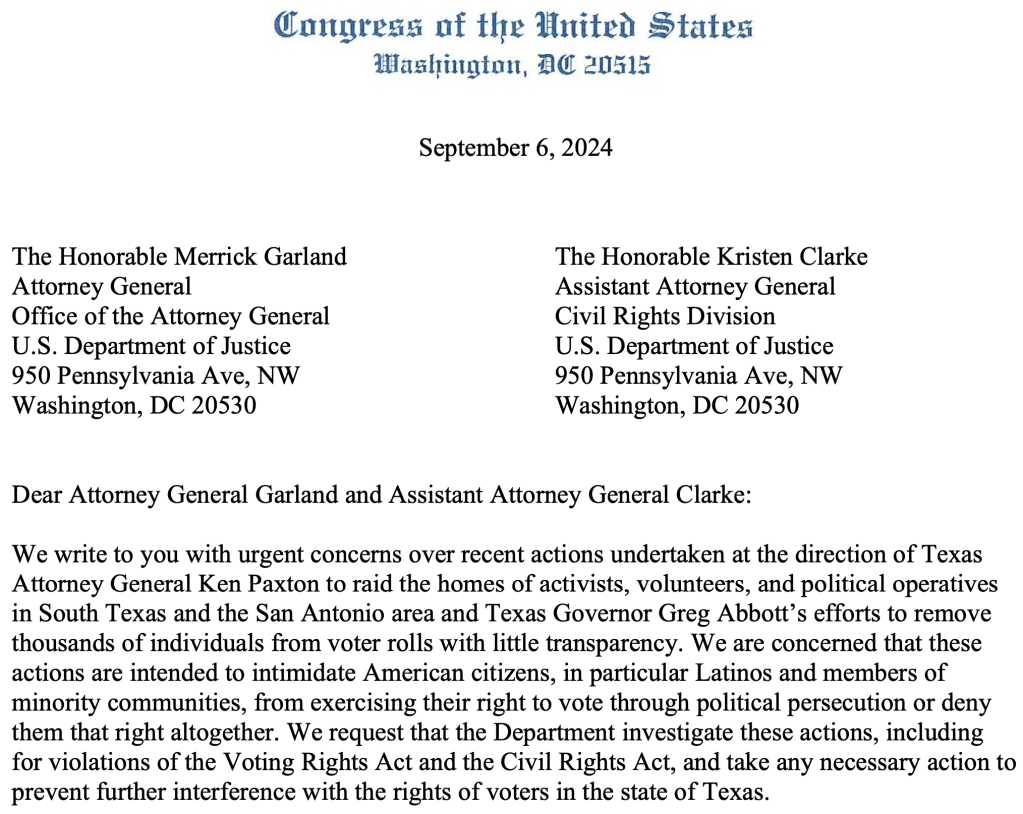
(Read the entire letter here)
Deeper Dive
League of United Latin American Citizens (LULAC) (one of the oldest Latino voting and civil rights groups in the country) is asking the Department of Justice to open an investigation into a series of raids conducted against Latino voting activists and political operatives, as part of a vindictive voter fraud inquiry by the Texas attorney general, Ken Paxton. Gabriel Rosales, the director of the group’s Texas chapter, said that officers conducting the raids took cellphones, computers and documents. He called the raids “alarming” and said they were an effort to suppress Latino voters.
“One of the victims of this violation of the Fourth Amendment‘s protection against unreasonable search and seizure under the color of law was retired schoolteacher 87-year-old Lidia Martinez, who had publicly spoken out against Paxton when he forbade Texans from getting mail-in ballots in 2020. Ms. Martinez, a 35-year member of LULAC who instructed elderly residents and veterans on how to fill out voter registration cards, said that the armed officers who pushed their way into her home before 6 am told her they came because she had filled out a report saying that older residents were not getting mail ballots. Though they said they were looking for the voter cards she’d filled out, they ended up taking her laptop, phone, planner and some documents.
He got his revenge this past week.”
(NYTimes) “She said she heard a knock on her door right before 6 a.m. on Tuesday. She thought that maybe a neighbor needed milk and eggs, she said, and she fastened her sleeping gown and opened the door.
Nine officers, seven of them men, some with guns in their holsters, then pushed open the door and marched past a living room wall decorated with crucifixes, she said.
“I got scared,” she recalled in an interview on Sunday, speaking in both English and Spanish. “They told me, ‘We have a warrant to search your house.’ I said, ‘Why?’ I felt harassed.”
Ms. Martinez said that the officers told her they came because she had filled out a report saying that older residents were not getting mail ballots. “Yes, I did,” she told them. For 35 years, Ms. Martinez has been a member of LULAC, the civil rights group, helping Latino residents stay engaged in politics. Much of her work has included instructing older residents and veterans on how to fill out voter registration cards.
“I go to a lot of senior events; I explain to them what they have to do,” she said. “I’ve been involved in politics all of my life.”
The officers said they were looking for voter cards that residents had filled out, she said.
“I told them, I don’t have them here,” she said.
One of the officers handed her a copy of the search warrant and ordered her to sit at her kitchen table. The warrant states that officers were looking for records, including “applications for ballot by mail, a list of voter banks and documents about elected officials and candidates.”
Two of the agents went to her bedroom and searched everywhere, “my underwear, my nightgown, everything, they went through everything,” Ms. Martinez recalled. They took her laptop, phone, planner and some documents.
Ms. Martinez said officers told her that a woman who lives in Frio County, an hour from her house, was using her return address for mail ballots. “They showed me her picture, and I said, I’ve never seen that person,” she said. “I don’t know who she is.”
The officers questioned her for about three hours, she said.
“They asked me about my entire life,” she said. They also asked her if she knew fellow LULAC members, Mr. Medina and area politicians. “I told them, ‘I haven’t committed any crimes,’” she said. Ms. Martinez has not been arrested or charged. Mr. Paxton’s office did not respond to a request for comment on Sunday.
What is the Ku Klux Klan Act of 1871 and is it still relevant?
Short answer: YES!
The Enforcement Act of 1871 (17 Stat. 13), also known as the Ku Klux Klan Act, Third Enforcement Act, Third Ku Klux Klan Act, Civil Rights Act of 1871, or Force Act of 1871, was intended to combat the paramilitary vigilantism of the Ku Klux Klan…the act also made it illegal to “go in disguise upon the public highway or upon the premises of another” to deprive anyone of equal protection of the law. The act also allowed victims to sue the perpetrators in federal court.
Several of the act’s original provisions still exist today to protect Americans against political intimidation. The most important of these is 42 U.S.C. § 1983: which authorizes monetary and injunctive relief against anyone who, acting under the authority of state law, deprives a person of rights guaranteed by the U.S. Constitution or federal law.” This includes any “threat to prevent any citizen of the United States lawfully entitled to vote from giving his support or advocacy in a lawful manner towards or in favor of the election of any lawfully qualified person as an elector of President or Vice-President of the United States, …or to injure any such citizen in his person or property on account of such support or advocacy, each and every person so offending shall be deemed guilty of a high crime….“
The most common use today is to redress violations of the Fourth Amendment‘s protection against unreasonable search and seizure. Wikipedia has a long paragraph on its use to protect people during and after the presidency of Donald Trump, including, “intimidation and coercion of elected officials and volunteers,” refusing to certify election results, inciting violence against the Capitol, beating up law enforcement there, and retaliation for testifying against Trump.
Recent examples:
- Michigan Welfare Rights Organization: In 2020, the NAACP filed a lawsuit on behalf of the Michigan Welfare Rights Organization and a group of Black Michigan voters, accusing the Trump campaign of trying to decertify elections results only in predominantly Black cities. “These systematic efforts–violations of the VRA and the Ku Klux Klan Act–have largely been directed at major metropolitan areas with large Black voter populations,” the lawsuit reads. “Defendants have not directed these efforts at predominantly white areas.” The lawsuit is ongoing, but in December 2022, a federal court ruled in favor of the NAACP and the Michigan Welfare Rights Organization. The Court’s ruling allowed the plaintiffs to proceed with filing a second amended complaint.
- Lee vs. Trump: “NAACP Celebrates Historic Victory in Lawsuit Against Former President Trump” This suit was filed on behalf of Congressman Bennie Thompson in the U.S. District Court for the District of Columbia on February 16, 2021. It was the first lawsuit filed seeking to hold Trump accountable for his conduct relating to the January 6th insurrection and his attempts to overturn the will of the voters in the 2020 Election. The lawsuit alleges violation of 42 USC sec 1985(1), which was enacted as part of the Ku Klux Klan Act of 1871, which prohibits conspiracies, through use of violence, threats or intimidation, that seek to prevent members of Congress from discharging their official duties.
The Ocoee Massacre – a massacre to prevent Black people from voting
Resources:
- (newrepublic) GOP: If We Can’t Win, We’ll Cheat. If We Can’t Cheat, We’ll Intimidate – Last week in Texas, Attorney General Ken Paxton unleashed police raids of the homes of Hispanic voting activists. Get ready for more of this.
- (NYTimes) Latino Civil Rights Group Demands Inquiry Into Texas Voter Fraud Raids. The organization said many of those targeted by the raids, conducted by a unit created by the Texas attorney general, Ken Paxton, were Democratic leaders and election volunteers.
- (Justice.gov) Justice Department’s Civil Rights Division Highlights Efforts to Combat Hate Crimes Targeting Black People
- (Wapo) The 150-year-old Ku Klux Klan Act being used against Trump in Capitol attack
- (Latintimes.com) LULAC requests DOJ to investigate home raids of Latino activists in Texas as a violation of civil rights. The homes Texas Latino campaign volunteers have been raided amid an election fraud investigation. The baseless accusations have caused fervor among activists.
 INDIVISIBLE VENTURA