Project 2025 source link: DEPARTMENT OF LABOR AND RELATED AGENCIES
WARNING: This is a HUGE chapter – but since the Heritage Foundation’s prime directive is to serve the needs of corporations and oligarchs, this is to be expected. We follow author Jonathon Berry’s “Mr. Toad’s Wild Ride” of wonky and obsurely-written policies to suppress workers, along with sudden banked turns into Christo-fascism. And truly, we marvel at his chutzpah in linking the protection of the American family with impoverishing and disempowering them.
We’ve added in videos and graphics to try to break this monster up, including ones of the author, but our point-by-point breakdown is admittedly still a slog. There is no shame in just looking through the top summaries from Stop the Coup and labor unions that cover the important points.
Who is this Jonathon Berry anyway? – This weasel-worded lickspittle (watch video above), who hides his most horrifying edicts as mere “alternatives,” was the “former acting Assistant Secretary for Policy at the US Department of Labor. At the US Department of Justice, he assisted with the nominations of Justice Neil Gorsuch and dozens of other judges. He previously served as Chief Counsel for the Trump transition and earlier clerked for Associate Justice Samuel Alito and Judge Jerry Smith of the US Court of Appeals for the Fifth Circuit. During his time in Trump’s Department of Labor, he denied “guaranteed overtime pay to millions of people and made it harder for workers to hold companies like McDonald’s liable for actions taken by individual stores, allowing companies to hide behind the protections afforded to franchises.“
What does he want?
Creating a caste system: Berry’s part in Project 2025’s Christian Nationalist plot is to pretend that eviscerating the Department of Labor (DOL) is in support of the traditional nuclear family: “At the heart of The Conservative Promise is the resolve to reclaim the role of each American worker as the protagonist in his or her own life and to restore the family as the centerpiece of American life.” However, the only “traditional” part of his vision is to protect “an employer-dominated economy of low-wage labor and its attendant social order.“
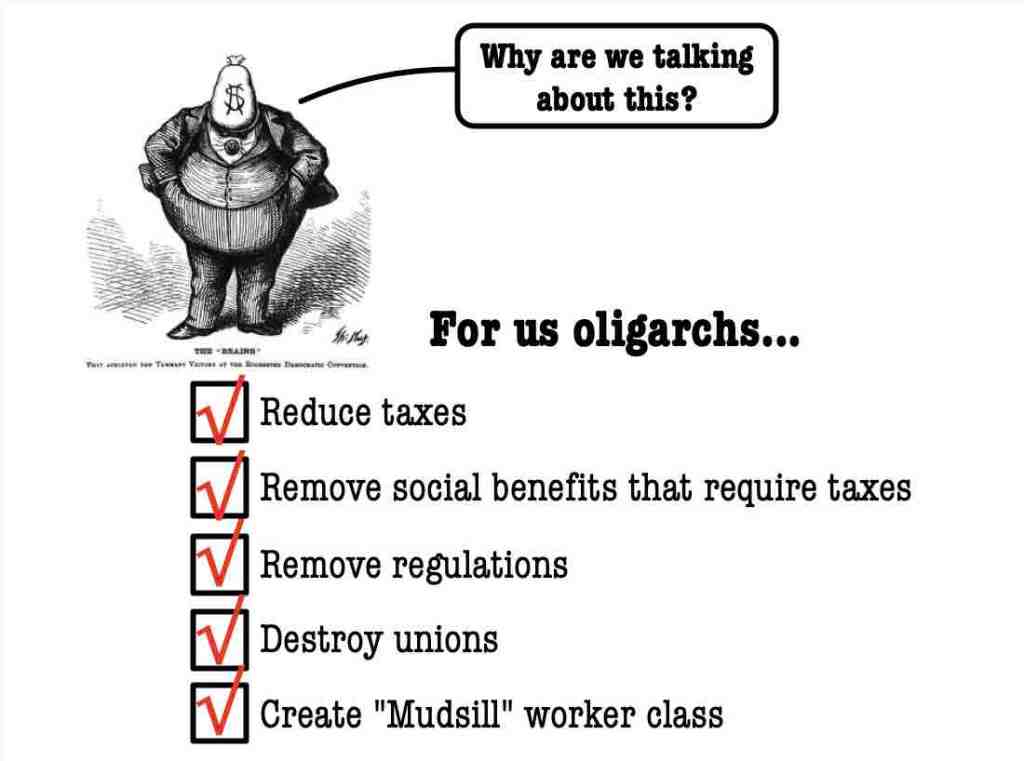
Behind the trappings of Christian nationalism, such as the ability to discriminate against the LGBTQ community, and the desire to force an official Sabbath on us all, we believe that all the parts of Project 2025 are connected in service to creating a permanent economic underclass in America, a caste system reminiscent to the “mudsill” class envisioned by a former slave owner back in 1858. Their vision of “Making America Great Again” is not the “Happy Days” of the fifties – when FDR’s post-crash policies and WWII literally created the middle class, but the dark days of the robber barons, before Teddy Roosevelt slowed their roll.
We believe that these are some of the pieces…
- Destroying worker power: Berry devotes 19 pages to this effort on every oligarch’s wishlist – the outlawing and crushing of the unions that helped create America’s middle class. This includes torching regulations on pay, and safety measures for the health and lives of workers.
- Cutting off migrant labor visas: On the surface, this makes no sense. As American workers age out of the workplace, companies and farmers have increased their use of these visas. Capping and reducing these visas, along with Trump’s promise to deport undocumented workers, promises to create widespread economic upheaval, inflation, and shortages of food and essential workers.
- Removing access to equality: SCOTUS has already gutted affirmative action and GOP-dominated states have legislated against DEI, mechanisms that have attempted to equalize access of opportunities to minority groups.
- Controlling/sidelining women:
- Destroying women’s rights over reproduction: The GOP wants to cut off abortions, and possibly all forms of contraception except their highly fallible rhythm method – “fertility awareness“- as their solution to their odious “Replacement theory” – force American women to start churning out children in great numbers, with proportionately few of them getting a good education to join what is now the middle class.
- Eliminating women from the workplace: Project 2025 wants to force moms to stay home, with vague promises that “funding should go to parents either to offset the cost of staying home with a child or to pay for familial, in-home childcare.” In the meantime, they intend to eliminate Head Start, removing services for a million children and undermining economic progress for low income families, including entrepreneurial endeavors, professional development, and additional educational certifications and degrees.

- Destroying pathways upward:
- Defunding public schools: In our chapter on Project 2025’s destruction of the Department of Education, we laid out the oligarchs’ malignant plans for children of working-class families, most obviously expressed in their push for universal vouchers. “These programs, advocated by right-wing billionaires, are designed to ghettoize red state public schools by subsidizing middle- and upper-class children’s tuition while leaving poorer students—who can’t afford the costs beyond the vouchers—stuck in defunded and thus failing public schools.“
- Utilizing uneducated kids as labor: The children left behind in a purposefully dysfunctional public schools will become the raw material for the Department of Labor’s return to the dark days of child workers. This has already begun. “...eight red states have made it easier for children to get trapped in a cycle of work that often ends their educational progress and consigns them to a lifetime of manual labor. Eight other Republican-controlled states are currently considering legislation to weaken child labor laws…” Guaranteed this kids will get “trainee” wages, far below those of adults.
- Devaluing higher education: When he gets to the section on de-emphasizing bachelor degrees, remember that this guy graduated from Yale College and the Columbia University School of Law, an elite educational career that many of the authors of Project 2025 share. If they can’t control the curriculum, as Gov. Ron DeSantis did to Florida’s New College, they would prefer that us peons just get job training in programs that corporations and oligarch profit from running.
- Celebrating the 13th amendment: Trump promises to imprison his political rivals, just as we’ve seen in other authoritarian regimes. Political prisoners, just like those for criminal offences, will be made available for next to nothing under the auspices of the 13th Amendment. Currently, 1/3 of CA prisoners work, many for less than $1/hr.
- Keeping his promise: “Americans with more education vote at higher rates. In the 2020 presidential election, 77 percent of eligible voters who had attended or graduated from college and 90 percent with post-graduate studies cast a ballot compared to 54 percent of voters with only a high-school diploma and 36 percent of dropouts.” However, Trump has promised that we never need to vote again, and Project 2025 is working very hard to accomplish that. Four years may be too short a span to turn us in something akin to the peasant class of the middle ages, but it’s not at all to short for a fascist to take over the government.
Various summaries, useful vocabulary and a couple of videos!
- This is the article Convergence’s Stephanie Luce references: Trump Loyalists Lay Out Plan for Second Term: Gut Worker Protections
- This is the Project 2025 chapter on the Department of Labor: https://thf_media.s3.amazonaws.com/project2025/2025_MandateForLeadership_CHAPTER-18.pdf
Nice short form from Stopthecoup.org.
- Basics
- All labor regulations would prioritize traditional, Christian families only
- Protections for LGBTQ+ employees would be eliminated
- The impact of race could no longer be considered in discrimination cases ✓ Regulations to protect the environment would be reduced
The proposed changes fall under four headings:
- DEI
- Any requirement for “racial equity” regulations should be rescinded; “racial equity” is a form of discrimination, since it relies on racial classifications and concepts drawn from Critical Race Theory. Thus, any collection of data that could be used in “disparate impact” lawsuits should immediately be halted
- Any regulations based on “novel anti-discrimination theories (such as sexual orientation and gender identity theories)” should be rescinded by eliminating EO 11246
- The legal concept of sex discrimination should no longer cover sexuality, gender identity, transgender status, and sex characteristics in any area other than hiring or firing
- Sex should be reconized as a biological binary category only.
- Family
- “We must replace ‘woke’ nonsense with a healthy vision of the role of labor policy in our society, starting with the American family”
- The DOL should promote regulations that prioritize traditional families by providing accommodations for pregnancy and childcare (but not abortion)
- All regulations that support abortion should be rescinded
- Religion
- Religious employers, employees, and institutions should be exempt from anti- discrimination policies
- “Sabbath Rest. God ordained the Sabbath as a day of rest, and until very recently the Judeo-Christian tradition sought to honor that mandate by moral and legal regulation of work on that day. Moreover, a shared day off makes it possible for families and communities to enjoy time off together, rather than as atomized individuals, and provides a healthier cadence of life for everyone. Unfortunately, that communal day of rest has eroded under the pressures of consumerism and secularism, especially for low-income workers.”
- Business Regulations
- Small businesses in general should be exempt from burdensome bureaucracy, such as environmental regulations
- Congress should be encouraged to pass the “Worker’s Choice” Act (H.R. 8442), which would dilute the power of unions
- Work visas for immigrants should be greatly reduced to prioritize hiring of Americans
- Much of the administration of business regulations and unemployment benefits should be transferred to the states, who could adjust it as necessary
Summary from AFSCME (American Federation of State, County & Municipal Employees)
Donald Trump and his allies want to eliminate AFSCME.
Questioning the need for public service unions is only part of Trump’s plan for a second term. His plan — all 900 pages of it — would take power away from working people and give him unprecedented levels of control over our lives.
Known as “Project 2025,” this radical agenda, designed to be set in motion on Day One of a new Trump administration, was written by top Trump advisers.
AFSCME research shows Project 2025 would hurt working people by:
- Allowing states to ban labor unions in the private sector.
- Making it easier for corporations to fire workers who engage in collective action or organizing.
- Allowing corporations to get rid of unions even when the workers are protected by a signed union contract.
- Forcing workers to hold secret ballot elections to form a union even when their employer has agreed to voluntarily recognize it.
- Eliminating overtime protections for workers.
- Ignoring the federal minimum wage.
- Eliminating the Public Service Loan Forgiveness Program, which has relieved many AFSCME members of an overwhelming student debt burden.
- Ending merit staffing in the federal government so Trump can hire unqualified loyalists for thousands of positions now filled by qualified, trained, nonpartisan career employees — among them AFSCME members.
- Eliminating federal rules that protect children from working in mines, meatpacking plants and other dangerous workplaces.
But Trump’s attacks on workers and our unions are only one front in Project 2025’s attack.
Our research shows the draconian blueprint for Trump’s second term includes hundreds of extreme policy recommendations that would, among other things, transform the entire federal government, gut health care and retirement benefits, destroy public education, wreck the economy, and wreak havoc with reproductive rights and immigration — all designed to crush our freedoms and benefit the wealthy at our expense.
What’s more, Project 2025 would also eviscerate Biden administration programs and policies that AFSCME members overwhelmingly support and fought for:
- If this plan is implemented, Trump would undo the progress we’ve achieved under the Biden administration in reducing prescription drug costs, and he would repeal the $35 per month cap on insulin costs for seniors on Medicare.
- He would also end the government’s ability to negotiate drug prices with Big Pharma and end Medicare’s $2,000 per year cap on out-of-pocket drug costs that begins in 2025.
- Project 2025 would put an end to the Head Start program, which serves more than 833,000 children living in poverty across the country; many AFSCME members also work as Head Start educators.
AFSCME has launched a website to give members and the public the facts about Project 2025 and Trump’s radical MAGA agenda.
The best way to block this roadmap for an imperial presidency is to defeat Trump and his MAGA allies during the upcoming elections. Vote for pro-worker candidates at every level of government in November!
Summary from AFGE (American Federation of Government Employees)
- Eliminate up to a million federal jobs
- Declare public unions illegal and take away union rights
- Gut federal workers’ pay and benefits
- Make it easier to discriminate against people of color, women, and LGBTQIA+ people. They also propose abolishing so-called “disparate impact” – adverse impact of a facially neutral requirement or process – as grounds for challenging the legitimacy of the new civil service exams. They would prohibit DEI (diversity, equity, and inclusion) efforts in most agencies including VA and at the Department of Labor. They would end data collection that showed differences by race and ethnicity and rescind regulations prohibiting discrimination based on sexual orientation and gender identity. They would also use the Department of Justice to police federal hiring government-wide to ensure that race, religion, and sex are not considered.
- Dismantle and privatize federal agencies. The Department of Homeland Security (DHS) would be eliminated, and the Transportation Security Administration (TSA) would be privatized.
- The Department of Education would be eliminated and oversight of education and federal funding for education will be handed over to the states. Also being gutted are regulations prohibiting sex-based discrimination in schools and discrimination based on gender identity and sexual orientation.
- The Federal Emergency Management Agency (FEMA) would be eliminated and moved to the Department of Interior or the Department of Transportation if combined with the Cybersecurity and Infrastructure Security Agency (CISA). The costs of disaster preparedness and response would be shifted to states and local governments.
- The Environmental Protection Agency (EPA)’s many regional labs and entire offices of enforcement and compliance and scientific integrity and risk information would be eliminated. This will endanger public health by giving corporations and big businesses a greenlight to pollute the air we breathe, the water we drink, and the food we eat.
- The Department of Veterans Affairs (VA) is to “privatize as much as possible” and close many hospitals and clinics.
- The Department of Housing and Urban Development (HUD) would be taken apart and send much of its work to states and other agencies – bad news for low income and working-class families who rely on its meagre assistance.
- The Department of Justice (DOJ) would lose its independence and be under control of the President.
- The Centers for Disease Control and Prevention (CDC) would be drastically reduced and split into two entities: one gathering scientific data and one making public health recommendations and policies.
Vocabulary for this chapter
- Fair Labor Standards Act of 1938 (FSLA)
- Set the first minimum wage,
- Banned employment of young children,
- Established standards for teen employment, (states trying to roll this back)
- Set rules on working hours and overtime pay.
- Intentionally excluded industries and occupations with high numbers of women and people of color, consequences still affect those workers today.
- The National Labor Relations Act (NLRA) 1935 – This act states that it is the policy of the United States to encourage collective bargaining by protecting workers’ full freedom of association. The NLRA protects workplace democracy by providing employees at private-sector workplaces the fundamental right to seek better working conditions and designation of representation without fear of retaliation. America established the right of workers to form a union 12 years before that right was included in the 1948 Universal Declaration of Human Rights. It has long been contested by business interests.
- Occupational Safety and Health Act (OSHA) 1971 under President Nixon. The law resulted in dramatic improvements in workplace safety, including a 65 percent decline in the number of worker deaths and a 67 percent decrease in worker injuries and illnesses — even as the working population doubled in size. According to its website, the average number of worker deaths in the United States dropped from 38 a day in 1970 to 13 a day in 2020. Worker injuries and illnesses dropped from 10.9 incidents for every 100 workers to just 2.7 incidents over that same time frame.
- National Labor Relations Board (NLRB)– “Established in 1935, the National Labor Relations Board is an independent federal agency that protects employees from unfair labor practices and protects the right of private sector employees to join together, with or without a union, to improve wages, benefits and working conditions. The NLRB conducts hundreds of workplace elections and investigates thousands of unfair labor practice charges each year.”
- Weaknesses in current law limit the NLRB’s ability to protect worker organizing—and thus must be reformed through policies such as the Protecting the Right to Organize (PRO) Act. Yet the agency still plays a critical role in ensuring that workers have a fair shot at organizing. NLRB rulings govern important aspects of organizing campaigns, such as where and how workers vote; how, where, and when they can discuss union matters or workplace conditions with colleagues; and whether certain corporate actions to undermine organizing campaigns or union actions constitute unfair labor practices.”
- The Act specifically excludes individuals who are: employed by Federal, state, or local government. employed as agricultural laborers. employed in the domestic service of any person or family in a home.
- Minimum wage: The federal minimum wage for covered nonexempt employees is $7.25 per hour. Many states also have minimum wage laws. In cases where an employee is subject to both the state and federal minimum wage laws, the employee is entitled to the higher of the two minimum wages.
Project 2025 is already in 2025 funding bills.
We are adding a note to share with the deluded amongst us who believe Trump’s lies that he has nothing to do with Project 2025, despite his assertion that they are laying the groundwork “for exactly what our movement will do,” and that he followed the majority of Heritage’s plan during his former administration.
The GOP is trying their best to backstop his story by folding Project 2025 goals into their current funding bills, so Trump can claim at least partial deniability.
You will see a header like this, with information compiled by the House Committee on Appropriations Ranking Member Rosa DeLauro, when we get to a point that is already in the works.




Our own page-by-page deep dive – This is where we teach ourselves about labor law, GOP-gibberish and Christian nationalism.
OVERVIEW
Maya Angelou stated “When someone shows you who they are, believe them.”
Republicans try to sound nice on paper by using words like “restore,” “work ethic,” and “protecting,” but their anti-worker record speaks for itself.
- (Pg. 581) OVERVIEW – “At the heart of The Conservative Promise is the resolve to reclaim the role of each American worker as the protagonist in his or her own life and to restore the family as the centerpiece of American life. Give workers the support they need for rewarding, well-paying, and self-driven careers, and restore the family-supporting job as the centerpiece of the American economy. The Judeo-Christian tradition, stretching back to Genesis, has always recognized fruitful work as integral to human dignity, as service to God, neighbor, and family.”
- Translation: It’s every worker for themselves, against huge corporations. Plus, we’re going to inject our favored form of Christianity into everything.
- Project 2025 purports that government agencies and unions have acted against American workers. But no one has hurt American workers more than the Republican party.
- Republicans helped corporations outsource jobs: They provided decades-long support of corporate employers who outsourced (moved out) American jobs from America to China, India, and other foreign countries so they could increase profits by paying less money to foreign workers for the same work and ignoring American workers’ rights and protections at home.
- Republicans had the opportunity to protect workers. Instead, they did this:
- They voted AGAINST the American Rescue Plan in 2022 that aimed to protect the pension plans for millions of American workers and retirees;
- They voted AGAINST the Pregnant Workers Fairness Act in 2021,
- They voted AGAINST the Protect Older Job Applicants Act in 2021; and many more similar bills.
- Republicans had the opportunity to regulate labor markets. Instead, they did this:
- They voted AGAINST the Protecting the Right to Organize Act that aimed to restore fairness to the economy so workers may band together for fair changes in the workplace.
- Republicans had the opportunity to raise wages. Instead, they did this:
- They BLOCKED President Biden’s federal minimum wage increase from $7.25 to $15 in 2021. Jonathon Berry, the author of this section, led the Labor Department’s regulatory office under Trump, and worked to deny guaranteed overtime (the “Obama Overtime Law”) to millions of American workers.
- Republicans had the opportunity to improve conditions so a job can support a family. Instead they did this:
- They voted AGAINST against child care, voting against food and cash aid for those who need it most to support their families, and voting against Medicare for All for you and your family.
The GOP are frightened by CRT and DEI
Project 2025 will widen systemic inequities in the workplace. “The Project 2025 playbook calls for a complete gutting of diversity, equity, and inclusion (DEI) programs in the workplace, stating the need for a reversal of the “DEI Revolution in Labor Policy,” and insisting that the next conservative Administration “eliminate every one of these wrongful and burdensome ideological projects.” Project 2025 also proposes an amendment to Title VII of the Civil Rights Act, the legislation that protects against discrimination based on a set of protected classes that includes race, color, religion, sex, and national origin, suggesting that the collecting of EEO-1 data like race, should be prohibited. Without collecting demographic data about employees, organizations will not be able to recognize disparities in representation (e.g., hiringand promotion rates). What gets measured gets improved and without adequate data collection, systemic inequities in the workplace will persist.”
What is “disparate impact liability?” “Congress recognized that discriminatory motives could also be easily disguised and that our country’s long history of discrimination made it easy to perpetuate inequality without much thought. For these reasons, civil rights laws incorporate disparate-impact liability, which focuses on consequences, not just motives. Ever since, disparate impact liability has been a vital tool in advancing equality. In 2014, Justice Kennedy remarked on the role of disparate impact in Texas DHCA v. Inclusive Communities: “It permits plaintiffs to counteract unconscious prejudices and disguised animus that escape easy classification as disparate treatment. In this way disparate-impact liability may prevent [discrimination] that might otherwise result from covert and illicit stereotyping.”
Republicans want you to forget what America was like without labor laws and civil rights laws that protect every American worker and their families from discrimination in the workplace and a living wage. And because of their wannabe dictator Diaper Don’s dog whistles, they are emboldened in their animosity towards the LGBTQ+ community and anyone who dares disagree with them. Do not allow Republican hypocrites to wrap themselves in the American flag or a perverted idea of the Judeo-Christian tradition to manipulate Americans into voting against their interests as workers and as Americans.
NEEDED REFORMS
(Pg. 582) “NEEDED REFORMS – Reverse the DEI Revolution in Labor Policy”:
- The GOP believes Diversity, Equity, and Inclusion (DEI) is a left-wing ploy to discriminate against conservative and religious and force-birther views (this is in every chapter!)
- On the contrary, DEI has given us the inclusive and diverse society that we enjoy today, where in the last 50 years Americans from underrepresented backgrounds are no longer excluded from the same opportunities in education and careers that used to be reserved only for white men regardless of a white man’s qualifications.
- Republicans want to destroy laws that have helped millions of Americans to accomplish the American Dream regardless of their background, such as: white women (who are the primary beneficiaries of affirmative action), Jewish Americans, Black Americans, Latinx Americans, Indigenous Americans, and Asian Americans.
(Pg. 582) “NEEDED REFORMS – Eliminate Racial Classifications and Critical Race Theory Trainings”.
- (Pg. 582) “Issue an executive order banning, and Congress should pass a law prohibiting the federal government from using taxpayer dollars to fund, all critical race theory training (CRT).”
- The GOP is seriously frightened that people will learn about systemic racism in America.
- (Pg. 582) “Direct DOJ and EEOC to enforce Title VII – to prohibit racial classifications and quotas, including human-resources classifications and DEI trainings that promote critical race theory.”
- For the GOP, the less factual data people have about discrimination, the better it is for them to tell whatever story they want.
- (Pg. 583) “Eliminate EEO-1 data collection“: The Equal Employment Opportunity Commission collects EEO-1 data on employment statistics based on race/ ethnicity, which data can then be used to support a charge of discrimination under a disparate impact theory. This could lead to racial quotas to remedy alleged race discrimination. Crudely categorizing employees by race or ethnicity fails to recognize the diversity of the American workforce and forces individuals into categories that do not fully reflect their racial and ethnic heritage.
- The GOP’s go-to move is removing the ability to gather information, so that racist disparate impact liability is harder or impossible to prove.
- Instead of whining about “crude” methods of categorizing employees, why don’t their resident geniuses figure out how to improve them.
- (Pg. 583)”Eliminate disparate impact liability.“
- Oh, hell, they’ll just get rid of it altogether. They actually had the chutzpah to say that with increasing interracial marriages, people don’t fit into “crude racial categories” and therefore they can ignore this whole thing, rather than to make more and better categories.
- (Pg. 583) “The President should sign an executive order explicitly forbidding the Office of Federal Contract Compliance (OFCCP) from using disparate impact in its analysis.”
- OK, but it might still bubble up…
- (Pg. 583) “Eliminate OFCCP.”
- There! Killed it! This office is just there to enforce Executive Order (EO) 11246, which requires federal contractors and subcontractors to commit to nondiscrimination. Nothing important to see here. Move along.
- (Pg. 584) “Rescind EO 11246“
- There. Those behind Project 2025 have been trying to kill this off since 1965.
Wait! – What? What is EO 11246 and why do corporate lickspittles want to destroy it?
“Executive Order 11246 — Equal Employment Opportunity”: (wiki) Executive Order 11246, signed by President Lyndon B. Johnson on September 24, 1965, established requirements for non-discriminatory practices in hiring and employment on the part of U.S. government contractors. It “prohibits federal contractors and federally assisted construction contractors and subcontractors, who do over $10,000 in Government business in one year from discriminating in employment decisions on the basis of race, color, religion, sex, or national origin.” It also requires contractors to “take affirmative action to ensure that applicants are employed, and that employees are treated during employment, without regard to their race, color, religion, sex or national origin.” The phrase affirmative action had appeared previously in Executive Order 10925 in 1961.
Oh, so no discrimination. Yeah, obviously, this should be eliminated.
What is Bostock v. Clayton County all about?
(Pg. 584) “Sex Discrimination” The GOP’s shorts have been in a tighty-whitie twist since the Supreme Court’s 2020 decision in Bostock v. Clayton County, which holds that “an employer who fires someone simply for being homosexual or transgender” violates Title VII’s prohibition against sex discrimination
- Oh, they HATE Bostock! In the associated bullet points, Project 2025 feels they should be able to pick and choose how this case would affect them, and are counting down the days when they can make this whole workplace issue moot by making talking about, or writing about or simply being LGBTQ illegal, like in some other countries.
- Restrict the application of Bostock: Project 2025 wants to allow employers restrict Bostock’s application of sex discrimination protections to sexual orientation and transgender status in the context of hiring and firing.
- Withdraw unlawful “notices” and “guidances.” Biden extended the Court’s ruling in Bostock beyond Title VII. “Under Bostock‘s reasoning, laws that prohibit sex discrimination — including Title IX of the Education Amendments of 1972, as amended (20 U.S.C. 1681 et seq.), the Fair Housing Act, as amended (42 U.S.C. 3601 et seq.), and section 412 of the Immigration and Nationality Act, as amended (8 U.S.C. 1522), along with their respective implementing regulations — prohibit discrimination on the basis of gender identity or sexual orientation, so long as the laws do not contain sufficient indications to the contrary.” Project 2025 would consider this order unlawful.
- Rescind regulations prohibiting discrimination on the basis of sexual orientation, gender identity, transgender status, and sex characteristics and replace them with “biological binary” definitions of sex. So…more discrimination against the LGBTQ community is OK with Project 2025.
- Direct agencies to refocus enforcement of sex discrimination laws. Project 2025 is only interested in enforcing discrimination laws for those who profess to one of two approved binary genders.
- Speaking of moot…:
- Books referring to LGBTQ subjects will be considered porn and even now in GOP-controlled states, are currently being banned from school and public libraries, accompanied by threats to arrest teachers and librarians as sex offenders.
- A “workplace” under Project 2025 won’t include the military. (Pgs. 103-104) “Reverse policies that allow transgender individuals to serve in the military. Gender dysphoria is incompatible with the demands of military service, and the use of public monies for transgender surgeries or to facilitate abortion for servicemembers should be ended.”
The GOP is frightened by complexity and science.
PRO-LIFE MEASURES
(Pg. 585) Forced-birthers on the job.
- (Pg. 585) “Promote pro-life workplace accommodations for mothers. Federal law should protect life and promote pro-family policies.“
- OK, these sentences are hilarious. They present the following three laws like they love them. It takes about 5 minutes of research to see that they are liars.
- Pregnancy Discrimination Act -This was passed back in 1978, for goodness sakes, and which was a Democrat authored and almost entirely Democrat-cosponsored event. It has made the GOP unhappy ever since. How dare we liberal commies tell businesses how to deal with women?
- The Pregnant Workers Fairness Act (PWFA) -The GOP voted against this, of course, but it passed as part of an appropriations act, also authored by Democrats. BTW, Seventeen anti-abortion Republican attorneys general are suing to overturn this law.
- The Americans with Disabilities Act (ADA) – “SENATE REPUBLICANS ‘HAVE DECLARED WAR’ ON THE ADA, SAYS Sen. Tammy Duckworth” Huh! So maybe not so much. P.S. This law was signed by Republican President George H. Bush.
- No insurance for abortions – They also make sure we know that none of these laws specifically provide health insurance benefits for elective abortions.
- Can we mention here the other crappy Project 2025 bits the GOP wanted to do to women in their 2024 appropriations bill? (Remember the Maya Angelou quote here!) This was a “nearly all-of-government attack on women’s economic security, reproductive care access, and quality health care
- Defund the Department of Labor’s Women’s Bureau, 100-year-old federal agency tasked with improving conditions for women at work, bills targeting the gender pay gap
- Cut $75 million for the Department of Labor’s Wage and Hour Division – the division responsible for outreach and enforcement of key labor laws like the Family and Medical Leave Act, minimum wage and overtime regulations, protections against workplace retaliation, and the right to express breastmilk at work. These laws are critical to women’s participation in the workplace – especially the lowest paid workers.
- Cut $35 million for the Equal Employment Opportunity Commission, which protects Americans from job discrimination and sues companies found to engage in prohibited workplace behavior, like sexual harassment.
- Eliminate funding for multiple programs that support diversity in the health care workforce, including the Health Careers Opportunity Program (HCOP), the Centers of Excellence (COE), and the Nursing Workforce Diversity (NWD). Women are a large share of the health care industry, though women and particularly women of color are underrepresented at the senior levels.
- End all funding for the Agency for Healthcare Research and Quality (AHRQ), which supports research to improve health care quality, address inequities, reduce costs, advance patient safety, decrease medical errors, and broaden access to primary care and maternity care.
- Cut nearly $800 million from government programs that fund maternal and child health and improve women’s health care
- Drastically cut key health equity programs such as a $49 million cut for the Office of Minority Health, and a $24 million cut for the Minority HIV/AIDS Initiative
- Slash funding for the Centers for Medicare & Medicaid Services by $798 million.
- Restrict the federal government’s ability to cover and support abortion care by prohibiting: federal dollars for abortion care for those who receive care or insurance from the U.S. government, allowing service members to travel for care, the VA from providing abortions in cases of rape, incest or the health/life of the mother, and abortion counseling.
- Eliminate funding for Title X Family Planning
- Eliminate all federal funding for Planned Parenthood
- Reinstate medically unnecessary restrictions on and undermining the FDA’s authority over mifepristone
- Reinstate and making permanent the Global Gag Rule
- OK, these sentences are hilarious. They present the following three laws like they love them. It takes about 5 minutes of research to see that they are liars.
- (Pg. 585) “Pass a law requiring equal (or greater) benefits for pro-life support for mothers and clarifying abortion exclusions.“
- This appears to be one of those math problems.
- Question: If an employer offers employees health care benefits for abortion, they must give = or > benefits of pregnancy, childbirth, maternity and adoption. So, what is the minimum pregnancy care would a woman get if her employer provides [zero] benefits for abortion?
- Answer: [zero]
- This appears to be one of those math problems.
- “Keep anti-life “benefits” out of benefit plans.“
- Prevent the Employee Retirement Income Security Act of 1974 (ERISA) from helping individual states to grant coverage for abortion health care.
RELIGION (This should not BE a section in a government plan!)
(Pg. 585) Removing the wall protecting you from the religious beliefs of an employer, some random employee or an organization’s religious beliefs.
Remember that county clerk in Kentucky who refused to issue a marriage license to a gay couple? Although she has been recently ordered to pay a large fine, she is a harbinger of the future under Project 2025. It will privilege people’s random religious beliefs over the civil rights of everybody else – we’ve attached some videos demonstating that this is already happening- in adoptions and at pharmacies against women and transgender customers.
Project 2025 doesn’t have a bottom on this issue – no limit on where they would call a halt to the contest between religious belief and civil rights. Can White hotel or restaurant proprietors return to the days of refusing to serve Black customers, based on the Jim Crow belief that God had ordained the races to remain separate? “In battles over slavery and racial segregation, religion and scripture were often cited as justification for maintaining inequality. Until the civil rights era, refusals to serve African Americans were often cloaked under the guise of religious freedom.”
This may seem ridiculous. But along with LGBTQ families, taxpayer-supported adoption agencies in at least 10 states are turning away couples who are not Christian or not the right kind of Christian.
- (Pg. 585/586) “Provide robust protections for religious employers.”
- Let employers in all kinds of businesses, not just religious ones, burden the civil rights of employees and potential clients and customers, with their personal beliefs about marriage, gender and sexuality.
- “Issue an executive order protecting religious employers and employees.”
- “Religious employers are free to run their businesses according to their religious beliefs, general nondiscrimination laws notwithstanding.” This needs more clarification…Oh, wait…here it is…(See next point.)
- “Congress to make Title VII’s religious organization exemptions to make it more explicit that those employers may make employment decisions based on religion regardless of nondiscrimination laws.”
- “Regardless.” That was the word we were missing. Employees can get reasonable accommodations unless it screws with the employer’s business.
(Pg. 586) “General EEOC Reforms” – We’ve already dismissed CRT and DEI. Why is EEOC still hanging around? Not for long, we bet!
Rep. Pressley talks to smacks the author of this chapter, Jonathon Berry. Her transcript is here.
- (Pg. 586-587) The Equal Employment Opportunity Commission (EEOC) needs to get with the program!
- This boils down to: we don’t like how you’re doing non-discrimination, do it our way instead!
- They must confess that they have no regulatory powers.
- They should disclaim power to enter into consent decrees that require employer actions that it could not require under the laws it enforces.
- Reorient their enforcement against those who fail to accommodate disability, religion, pregnancy (but not abortion.)
- This boils down to: we don’t like how you’re doing non-discrimination, do it our way instead!
(Pg. 587) “Refocusing Labor Regulation on the Good of the Family.” OMG, It actually says that while cheating them!
They stand ready to fight against “woke” nonsense, like respecting your employees’ gender, etc..(except for all those pro-pregnancy bills to Democrats got passed), to “focus on the family.”


- (Pg. 587) “Allow workers to accumulate paid time off.“
- Is this something new? Checked this nifty list and only deep blue California has both statutory policies on vacation pay AND prevents “use-it-or-lose-it” policies set by the employer.
- (Pg. 587) “Congress should enact the Working Families Flexibility Act.“
- THIS IS A SCAM! – one of the misnamed bills the GOP specializes in and is a really bad deal for workers and no Democrat voted for it. Labor advocates oppose because it would let employers provide comp time instead of time-and-a-half overtime pay.
- It would permit employers to demand more hours from their employees without any guarantee that the comp time employees earn will be available to use when they need it.
- Employers can veto employees’ requests to use accrued comp time anytime they feel the employee’s absence will “unduly disrupt” the employer’s business – even if the request is for an urgent need like caring for a sick child or elderly parent!
- It would particularly effect people of color and women, who make up a disproportionate share of the low-wage workforce.
- EPI noted that the legislation does not create employee rights, rather it creates a new employer right – the right to delay paying any wages for overtime work for as long as 13 months.
- ACTUALLY HELPFUL THINGS!
- Biden just put out a new rule that would require employers to pay overtime to so-called white collar workers who make less than $55,000 a year. That’s up from the current threshold of $35,568 which has been in place since 2019 when Trump administration raised it from $23,660. In another significant change, the rule proposes automatic increases to the salary level each year.
- ACTUALLY HELPFUL THINGS!
- THIS IS A SCAM! – one of the misnamed bills the GOP specializes in and is a really bad deal for workers and no Democrat voted for it. Labor advocates oppose because it would let employers provide comp time instead of time-and-a-half overtime pay.
- (Pg. 587) “Congress should incentivize on-site childcare“.
- That’s what WOKE companies like Patagonia do. However, “just 7% of women work for an employer that offers on-site childcare or a childcare subsidy. These estimates are consistently lower for women who work part-time, are self-employed, are low-income, or live in rural areas.” These women are going to more stressed if the GOP wins, because Project 2025 is going to defund Head Start! (See Pg. 482 in the chapter on the Department of Health and Human Services)

- (Pg. 587) “Congress should amend the Fair Labor Standards Act (FLSA) to clarify that an employer’s expenses in providing on-site childcare are not part of an employee’s regular rate of pay.“
- Actually, this seems backwards. If the employee has to contribute to on-site childcare, and they have to work extra hours, they should get more money to pay for the resulting extra child-care required. Especially if they have to work outside the on-site care center’s hours, resulting in a bill from private carers.
- (Pg. 587)”DOL should commit to honest study of the challenges for women in the world of professional work.“
- After trying to defund the Women’s Bureau at the DOL, Project 2025 advocates for an “honest study” of the challenges for women in the world of professional work.” One challenge would be keeping male GOP staffers from defunding the Women’s Bureau, apparently.
- (Pg. 588) “The Bureau should rededicate its research budget towards open inquiry, especially to disentangle the influences on women’s workforce participation and to understand the true causes of earnings gaps between men and women.”
- Here. Let us help. It’s toxic patriarchy, embodied in the Christian Nationalism crap you’re also pushing. You’re welcome.
- (Pg. 588) “Equalize retirement savings access across married households.”
- See next point for comments.
- (Pg. 588) “To equalize access to tax-free retirement savings for married couples, the limit for married couples on 401(k) and similar work- based retirement savings accounts should be double the limit for individuals, regardless of the allocation of work between the couple.”
- Hey, we’re actually OK with this, as long as the parties involved, even one of those “trad wifes,” gets to keep their halves in separate accounts in case of divorce. Why? Because the GOP, in trying to enforce the patriarchal crap of Christian Nationalism, is also trying to eliminate no-fault divorce, even from abusive shitheads (Hi, JD Vance!). We are guessing that getting older, fatter, or less willing to have sex with one’s husband will remain viable “faults” for which men can trade in wives for newer, younger models, just like our former president did. In June 2023, Gov. Ron DeSantis (R-Fla.) signed a law ending permanent alimony in Florida, so women should pay attention to the details of any legislation that can end up enriching one party over the other.
(Pg. 588) “Family Statistics” – Turning the U.S. Bureau of Labor Statistics into a propaganda machine!
- Not sure what this bureau does? The Bureau of Labor Statistics measures labor market activity, working conditions, price changes, and productivity in the U.S. economy to support public and private decision making.
- What is the Consumer Price Index (CPI)? The Consumer Price Index is a measure of the average change overtime in the prices paid by urban consumers for a market basket of consumer goods and services.
- What’s in the CPI market basket? The market basket is developed from detailed expenditure information provided by families and individuals on what they actually bought and is divided into seven major groups, such as food and beverages or housing.
- (Pg. 588) “Congress should establish an Assistant Commissioner for Family Statistics within the Bureau of Labor Statistics.”
- This is simply a ploy to put another Schedule-F Trump-toady into the system to make sure that the reports come out the way they need them to for propaganda purposes.
- (Pg. 588) “Congress should require the Bureau to establish a pilot survey with a sample comparable to the BLS Current Population Survey that would publish monthly estimates for measures of the American family’s wellbeing, and appropriate sufficient funds for that purpose.”
- They want to add metrics like marriage and fertility rates, the share of children living with both biological parents and the cost of middle-class essentials. This also sounds like hyoooge boondoggle for GOP-related consulting firms, similar to how former legislator Ben Sasse channeled millions to GOP allies, and secretive contracts, in his new gig as the University of Florida’s president.
- (Pg. 588) “Congress should require that the Consumer Price Index market basket include measurable family-essential goods.”
- They probably just want to pull out childless cat ladies and teachers, single parents, older people and others who count for nothing in their Christian Nationalist family-first world from the survey pool.
(Pg. 589) “Sabbath Rest” – God ordained the Sabbath as a day of rest”…Seriously, WTH is this doing in a government policy document?
Oh, the suspense! What day would this Sabbath fall on? Sunday for Christians? The far older Jewish tradition of “sundown on Friday until sundown on Saturday? Friday is the day of prayer for Muslims? Just kidding! You know which one it is!
- (Pg. 589) Congress should encourage communal rest by amending the Fair Labor Standards Act (FLSA) to require that workers be paid time and a half for hours worked on the Sabbath.
- Which would default to Sunday. Of course, as this is Christian Nationalism on the hoof. However, a lot of employers are going to be pretty sad about this…
- (Pg. 589) “…the proper role of government in helping to enable individuals to practice their religion is to reduce barriers to work options and to fruitful employer and employee relations.”
- No, really. There is NO PROPER ROLE OF GOVERNMENT IN HELPING TO ENABLE INDIVIDUALS TO PRACTICE THEIR RELIGION. See “First Amendment – Congress shall make no law respecting an establishment of religion, or prohibiting the free exercise thereof…”
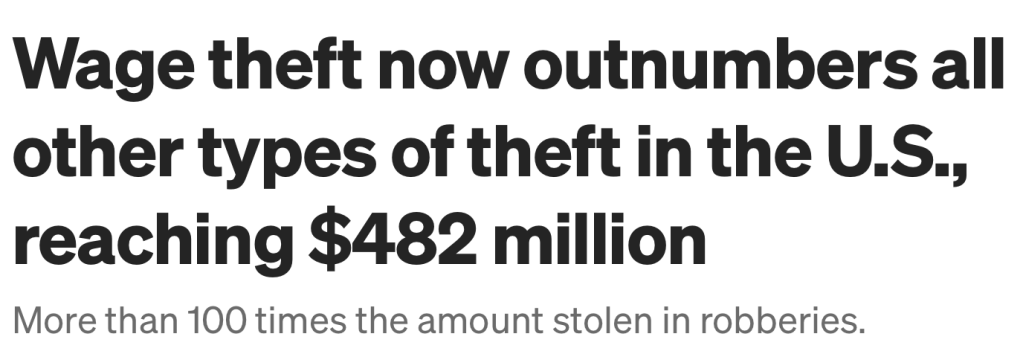
WAGES – Project 2025 wants to change the laws to make wage theft easier to accomplish.
(Pg. 589) “Teleworking” – the GOP is already trying to stop it!
- (Pg. 589) “Congress should clarify that overtime for telework applies only if the employee exceeds 10 hours of work in a specific day (and the total hours for the week exceed 40).”
- This is already covered in the Fair Labor Standards Act (FSLA) Maybe it’s because they so thoroughly intend to undermine the FSLA…
- (Pg. 590) “DOL should clarify that an employee given the option to telework need only record time if the quantity of work assigned for that day exceeds the usual amount of work that employee performs so that the employee need not track every time he logs in and out and the employer need not do so either.”
- OK. Stop keystroke monitoring, while you’re at it.
- (Pg. 590) “DOL should clarify that a home office is not subject to OSHA regulations and that time to set up a home office is not compensable time or eligible for overtime calculations. DOL should likewise clarify that reimbursement for home office expenses is not part of an employee’s regular rate, even if those reimbursements are repetitive (such as for internet or cell phone service).”
- This is in line with the GOP’s current efforts to roll back the telework clock to 2019. They also want to bar the Defense Department from covering teleworking costs and reducing the Social Security Administration’s budget for its capital branch.
- If an employee requires time or expense to setup needed equipment, they should get paid.
- Contrary to GOP claims that there is a lack data on remote work, the White House Office of Personnel Management’s annual report revealed significant advantages to telework in terms of employee retention and engagement, with more than 84 percent of employees and managers acknowledge improvements in work quality and customer satisfaction due to remote work.
(Pg. 590) “Making Family-Sustaining Work Accessible” – the GOP con game behind independent contracting!
This video is ferocious!
The author of this chapter introduced this duplicitous section thusly…
- Jonathon Berry: “Our national work ethic is an American hallmark. As Benjamin Franklin once said, “America is the land of labor.”
- Benjamin Franklin also said: [regarding German immigrants] “Few of their children in the country learn English… The signs in our streets have inscriptions in both languages … Unless the stream of their importation could be turned they will soon so outnumber us that all the advantages we have will not be able to preserve our language, and even our government will become precarious.”
Jonathon should be more careful who he quotes…
- (Pg. 590) Protect flexible work options and worker independence (independent contractors)
- Lyft, Uber, DoorDash, and Instacart were willing to spend over $224 million to convince voters to remove employee benefits from gig workers in California, including medical benefits in a country that uses jobs to determine who has health insurance.
- What did that multi-million dollar media blitz buy them?
- “One survey of California voters founds that 40 percent of “yes” voters thought they were supporting gig workers’ ability to earn a living wage. Other voters said they did not realize they were making a choice between guaranteed rights and protections through employment and “an arbitrary set of supplemental benefits . . . designed by the gig companies.”
Nothing on the gig worker side seems all that “family-sustaining” to us…
| Employees = actual “family-sustaining work“ | Gig workers |
| Sick time | None. Can be penalized for getting sick or taking off for family emergencies. |
| Minimum wage | Piecemeal. After penalties and fees removed, average wage is now $6.20/hour, lower than $7.25 national minimum wage. Economists think the real wage is $5.64/hour after expenses and waiting time are taken into account. |
| Rights to unionize | No. (Corporations align with fascists to destroy unions.) |
| Protection from abuse | None. In fact, may be penalized or cancelled if they refuse obviously risky jobs/clients/sexual harassment |
| Access to equipment/ supplies as required to do work | Equipment, insurance, fuel, maintenance provided by employee, not compensated for wear and tear. |
| Health care benefits | Technically available for a few – app-based workers need to a purchase a covered policy in advance and get enough work hours to qualify for the stipend; if they don’t, they must pay the full cost of the premium. Only 15% have applied under those conditions. |
| Legal protections – Can sue for discrimination or abuse | Arbitrary deactivation of accounts with no redress. App-based companies’ business model now protected from any legal or worker challenge, so the companies could pass all costs onto workers and consumers. |
High Wonk Factor Ahead!!!
- (Pg. 591) NLRB and DOL should return to their 2019 and 2021 independent contractor rules that provided much-needed clarity for workers and employers.
- Project 2025 would cut labor costs by making it easier to classify gig workers like Uber and Lyft drivers as independent contractors and not employees by going back to the older standard.
- “Union-supporters and Democrats are likely to view the new rule [2024] as a victory for workers, as the rule makes it easier for workers to be classified as employees and thus receive the protections afforded by the National Labor Relations Act.
- Small companies with fewer employees who take on large responsibilities are most likely to be affected by the DOL’s new rule.
- Large companies employing gig workers, such as Uber and Instacart, are unlikely to be greatly impacted. The nature of Uber drivers and Instacart drivers’ work will likely still classify them as independent contractors under the FLSA.
Trump’s older version (on the left in the chart below) makes it easier to misclassify a worker as independent contractors. EPI protested this rule when it was released, stating that by placing undue weight on only two of the five factors determining employment status, instead of the equal consideration of all, the proposed rule was in violation of the plain language of the FLSA’s definition of “employ,” and ignore U.S. Supreme Court and federal circuit court authority interpreting the Act. That weighting also would cost misclassified workers billions of dollars annually. “If the true number of workers affected is equivalent to just half of the 4.9 million workers currently estimated above to be misclassified or working off the books, workers would lose on the order of $17 billion annually as a result of this rule …and will cost the social insurance system hundreds of millions of dollars annually. Further, due to things like occupational segregation by race, discrimination, and other labor market disparities rooted in structural racism, Black and Latinx workers are more likely to work in the occupations affected by this rule.“
| NLRB 2019/ DOL 2021 (Trump) – TWO sections weighted more heavily | New 2024 standards – all aspects equally important. (Biden) Employee friendly. |
| (1) CORE IMPORTANCE – nature and degree of control over the work | (1) opportunity for profit or loss – no opportunity = employee a. Can determine or negotiate pay b. Chooses to accept or decline tasks or chooses the order or time the job is performed c. Attempts to expand their business or secure more work d. Makes hiring decisions e. Makes decisions on purchasing materials and equipment, and/or rent spaces |
| (2) CORE IMPORTANT – opportunity for profit or loss | (2) investments by the worker and the potential employer |
| (3) less important – amount of skill required | (3) the degree of permanence of the work relationship. – Independent contractors = sporadic or project-based. – Open-ended = employee. |
| (4) less important – degree of permanence of the working relationship | (4) the nature and degree of control. – Setting schedules/supervising/non-competes = employee |
| (5) less important – whether the work is an integral part of the business | (5) the extent to which the work performed is an integral part of the potential employer’s business. – The more important = employee |
| (6) skill and initiative – If the worker depends on the potential employer to provide training and/or does not use a specialized skill = employee. |
Why it matters – the comparison of pay, benefits and Social Security contributions based on worker classification:


- (Pg. 591) Congress should establish a bright-line test—based on the level of control an individual exercises over his or her work—to determine whether a payee is an employee or an independent contractor, across all relevant laws.
- Hmmm, seems like there are lots of “bright-lines in the chart above. (Experts, chime in. We’re just using the chart above…)
- Any worker who is penalized in any way for refusing to take an unsafe job or a job that returns pay below the minimum wage IS AN EMPLOYEE.
- Any job that a worker must abide by a company schedules, attend their training sessions, and/or wear or use any form of corporate branding, IS AN EMPLOYEE.
- Driving people or things around is not a specialized skill. Putting things in boxes or picking things is not a specialized skill. Any worker who does these types of jobs IS AN EMPLOYEE.
- Hmmm, seems like there are lots of “bright-lines in the chart above. (Experts, chime in. We’re just using the chart above…)
- (Pg. 591) Congress should provide a safe harbor from employer-employee status for companies that offer independent workers access to earned benefits.
- They would have to be equal to that of employees to count. And that is never going to happen.
(Pg. 591) Protect Small Businesses and Entrepreneurship (Joint Employer)
- (Pg. 591) DOL and NLRB should return to the long-standing approach to defining joint employers based on “direct and immediate” control.
- NLRB had issued a new rule that stated that two employers may be considered joint employers of a group of employees if each entity has the ability to share or codetermine one or more of the employees’ term and conditions of employmement including:
- Wages, benefits, and other compensation;
- Hours of work and scheduling;
- The assignment of duties to be performed;
- The supervision of the performance of duties;
- Work rules and directions governing the manner, means, and methods of the performance of duties and the grounds for discipline;
- The tenure of employment, including hiring and discharge; and
- Working conditions related to the safety and health of employees.
- This rule made it easier for an employee to prove “joint employer status.” However in March of 2024, a Texas 2024, federal district court vacated the NLRB’s new rule and return to the more corporate-friendly version.
- NLRB had issued a new rule that stated that two employers may be considered joint employers of a group of employees if each entity has the ability to share or codetermine one or more of the employees’ term and conditions of employmement including:
- (Pg. 591) Congress should enact the Save Local Business Act, which would codify the long-standing definition that has existed outside the Obama-era and Biden-proposed rules
- “While the legislation is cast as a boon for small-business owners, it is actually an effort to unravel 80-year-old worker safeguards, specifically “joint-employer” responsibility requirements that help to hold companies that cheat workers out of earned wages or violate the right of workers to come together in unions accountable for those actions. In tandem with this effort, President Donald Trump is using his executive authority to ensure that his administration does not enforce these long-standing workplace laws.”
(Pg. 592) Overtime Pay Threshold
(American Progress) “Overtime eligibility and access are already among the most common forms of wage theft and other violations of the law by employers. From 2013 to 2023, overtime violations accounted for 82 percent of back wages for Fair Labor Standards Act violations—which cover minimum wage, overtime, retaliation, and tip theft by employers. Most violators of these laws face minimal consequences. A system rife with abuse needs clearer guidance and more enforcement, not additional “flexibility” for employers to decide who gets overtime pay and when.…Overtime pay increases workers’ paychecks and helps protect their time for personal and family obligations. When workers aren’t eligible for overtime, employers can force them to work 60-to-70-hour workweeks without any extra pay.”
What are the rules for overtime pay now?
- Current rules: Covered nonexempt employees must receive overtime pay for hours worked over 40 per workweek (any fixed and regularly recurring period of 168 hours – seven consecutive 24-hour periods) at a rate not less than one and one-half times the regular rate of pay. There is no limit on the number of hours employees 16 years or older may work in any workweek. The FLSA does not require overtime pay for work on weekends, holidays, or regular days of rest, unless overtime is worked on such days.
- Who is exempt? Some workers exempt from the FLSA’s minimum wage and overtime protections:
- 1. An employee is paid a salary,
- 2. The salary is not less than a minimum salary threshold amount, and
- 3. The employee primarily performs executive, administrative or professional duties. (EAP)
- (americanprogress.org) Between 2010 and 2018, there was a 485 percent increase in the use of a managerial title for positions just above the threshold for overtime eligibility, with job titles—such as “front desk manager” in lieu of “receptionist”—fraudulently providing cover for overtime eligibility exclusion. This abuse has been repeatedly exposed by journalists and targeted for enforcement.
- New minimum salary exceptions under Biden: (These adjustments are estimated to help over 4 million workers.)

- Regular Hourly Rate Calculations
- What is included: Overtime premiums are based on the employee’s “regular rate of pay.” The regular rate is not simply an employee’s hourly rate of pay or their take-home pay. The regular rate is based on “all remuneration” earned from employment, including things like non-discretionary bonuses, commissions, payments for undesirable shifts or duties, and some non-cash payments depending on the circumstances.
- What is NOT included: It does NOT include the exception of eight specific exclusions contained in section 7(e) of the FLSA – “payments made for occasional periods when no work is performed due to vacation, holiday, illness, failure of the employer to provide sufficient work, or other similar cause; reasonable payments for traveling expenses, or other expenses… …However, since such payments are not made as compensation for the employee’s hours worked in any workweek, no part of such payments can be credited toward overtime compensation due under the Act.”
- Myths about overtime: Some employers have certain misconceptions about overtime and exemptions. Here are some of the most common myths along with an overview of the FLSA’s requirements.
- (Pg. 592) DOL should maintain an overtime threshold that does not punish businesses in lower-cost regions (e.g., the southeast United States).
- (americanprogress.org) “Tying wage thresholds to regional variations in what businesses prefer to pay their workers is a long-standing conservative approach that codifies preexisting wage inequality. American workers’ wages have consistently been lowest in the South, originating in slavery. This has only been furthered by sharecropping, the development of a tipping system that shifts the burden of paying wages to customers rather than employers, ongoing discrimination, and low union density.“
- (Pg. 592) Congress should clarify that the “regular rate” for overtime pay is based on the salary paid rather than all benefits provided. This would enable employers to offer additional benefits to employees without fear that those benefits would dramatically increase overtime pay.
- HAHAHAHAHAHAHAHAHAHAHAHAHAHAHA!!!!! If they were so all-fired up to give employees MORE benefits, we wouldn’t be here today.
- (Pg. 592) Congress should provide flexibility to employers and employees to calculate the overtime period over a longer number of weeks. Specifically, employers and employees should be able to set a two- or four- week period over which to calculate overtime. This would give workers greater flexibility to work more hours in one week and fewer hours in the next and would not require the employer to pay them more for that same total number of hours of work during the entire period.
- Prone to abuse: (American Progress) “Providing employers with less clarity about their wage obligations introduces more opportunities for fraud, abuse, and even honest mistakes. Currently, overtime is calculated weekly, which allows workers to keep track of their time accurately over a shorter time frame and to have more consistent expectations for their schedule. But Project 2025 proposes allowing the employer to choose the time period, giving employees less control of and visibility into their own paychecks.“
- No compensation for resultant expenses/losses from a fluctuating work week:
- Workers with children or others who need regular care may not be able to manage these obligations without hiring help to cover longer working hours. Project 2025 does not mention adding more pay for this issue. Although it trumpets the FAMILY, they don’t seem to understand how anything but a “trad-wife” family might work.
- What if workers are juggling work with additional education?
- What if workers’ health is dependent on regular rest schedule?
(Pg. 593) Compliance-Assistance Programming

- (Pg. 593) Labor agencies should provide compliance assistance to help businesses and workers better understand the agencies’ position on their own rules and should do so in a way that makes it easier to follow those rules.
- HAHAHAHAHAHAHAHAHAHAHAHAHAHAHA!!!!! Read all about how the GOP treats labor issues here.
- (Pg. 593) Clear and Restricive Rules on Guidance reports.
- (We had to go to labor industry lawyer blogs to figure this one out.) This article headline helps clarify the issue. The GOP does not like government having any control over their donor corporations and oligarchs.

“On January 20, 2021, the Biden Administration revoked the Trump Administration Executive Order (EO) which had restricted agency Guidance. On January 27, 2021, the Department of Labor (DOL) rescinded the “PRO Good Guidance” rule that it had issued pursuant to the Trump EO – a rule that limited the force of informal guidance in DOL enforcement actions.
| Guidances under Trump’s PRO Good Guidance Rule | Guidances after Biden revoked Trump’s rule |
| Issued fewer guidances and “deprive[d] the Department and subordinate agencies of necessary flexibility” and ““unduly restrict[ed] the Department’s ability to provide timely guidance on which the public can confidently rely.” | Employers should expect more Guidance. |
| Trump’s EO gave employers, who already have the upper-hand in all worker/employer issues, more “freedom to interpret federal statutes. | Employers should expect the Department of Labor (and likely other federal agencies) to insist on compliance with each and every issuance of Guidance. |
| Trump’s DOL removed over 3,200 guidance documents, leaving holes in interpretations. | More Guidance may mean more clarity in agency enforcement standards |
| Whether any particular Guidance is legally binding will still depend on court rulings, as it may be inconsistent with governing statutes or the Constitution . |
- (Pg. 593) DOL should reinstitute the PRO Good Guidance rule via notice and comment.
- See chart above. Basically, the GOP-approved guidance rule puts more power in the hands of corporate counsel.
- (Pg. 593) Congress should amend the Administrative Procedure Act to explicitly limit the use of guidance documents.
- “The Biden Executive Order that led to this agency action…states that the Administration intends “to use available tools to confront urgent challenges,” including the pandemic, economic recovery, racial justice and climate change. The Order added that the Administration is relying on “robust agency action” to achieve its goals.”
(Pg. 594) Exemptions from Regulations for Small Business
The Regulatory Flexibility Act: An Overview
Congress enacted the Regulatory Flexibility Act (RFA;5 U.S.C. §§601-612) in 1980 to require federal agencies to consider the effects of their regulations on small businesses and other small entities. If a regulation is expected to have a “significant economic impact on a substantial number of small entities,” the RFAr equires the issuing agency to consider regulatory impacts and alternatives, with the goal of minimizing significant economic impacts on small entities.
- (Pg. 594) The labor agencies should exercise their available discretion and duties under the Regulatory Flexibility Act to exempt small entities from regulations where possible.
- This is already a thing. See light green box above.
- (Pg. 594) Congress should enact legislation increasing the revenue thresholds at which the National Labor Relations Board asserts jurisdiction over employers to match changes in inflation that have occurred since 1935 and better reflect the definition of “small business” used by the federal government.
- This is intended to leave more employees unprotected.
- (Pg. 594) Congress (and DOL, in its enforcement discretion) should exempt small business, first-time, non-willful violators from fines issued by the Occupational Health and Safety (OSHA) Administration.
- Small businesses will be able to kill off workers with inpunity! Article here. Notice that they say nothing about repeat violators in small businesses. Just that small businesses can force employees into dangerous situations without consequences. Oh, wait a minute. This is just a distraction. This is what they really want...
OSHA, charged with protecting worker health, required masks! Kill it! One hundred and thirty one members of the House Republican caucus voted on Nov. 14 [in 2023] to completely defund the Occupational Safety and Health Administration, the federal agency tasked with keeping Americans safe at work. Illinois Republican Rep. Mary Miller, the author of the proposal, framed it as necessary to “rein in OSHA” and punish the agency because, she said on Facebook, “they tried to implement Joe Biden’s illegal and unconstitutional COVID vaccine mandate.”

Let them eat cake” moment! Rep. Garret Graves (R-La.), the former chair of the Louisiana Coastal Protection and Restoration Authority, agreed. He said it was unnecessary for “government to come in and be overly prescriptive” in telling employees when to take breaks in the heat, calling it “a bit of a commonsense thing.” For employees who aren’t given such accommodations, Graves shrugged: “Well, in a case like that, then you go get a different job.”
- From 1992 to 2022, a total of 986 workers across all industry sectors in the United States died from exposure to heat. This represents an average of 34 deaths per year, according to reported data
- In the same period, 334 construction workers lost their lives to heat exposure on the job—meaning that the construction sector accounted for about 34 percent of all occupational heat-related deaths
- Phoenix just recorded over 100 days over 100 degrees.
Lots of proposed investigations (AND FUNDING for them) of unions ahead. Not so much for worker safety.
(nelp.org) “The agencies and programs tasked with protecting the health and safety of workers and enforcing our foundational labor rights—like the DOL’s Wage and Hour Division—have been operating with anemic and flat funding levels for many years. This has resulted in severe understaffing and underfunding of programs at a time of ever-growing need.
- The DOL’s Wage and Hour Division had only 733 investigators at the end of 2023. This is nearly 500 fewer investigators than the Division had at its peak in 1978.
- The Occupational Safety and Health Administration (OSHA), responsible for workplace safety and health, is also starved for resources: in 2019, it would have taken OSHA 162 years to inspect each workplace under its jurisdiction just once.”
(Pg. 595) Education and Vocational Training (putting taxpayer funded Trump Universities everywhere!)
- (Pg. 595) Congress should expand apprenticeship programs outside of the RAP model, re-creating the IRAP system by statute and allowing approved entities such as trade associations and educational institutions to recognize and oversee apprenticeship programs.
- If you read the accreditation issues within our chapter on education, and you remember the debacles over scams like Trump University, and accreditation failures like ITT Tech and Corinthian Colleges, you know that opening up taxpayer-funded education to anyone with a business license is an invitation to steal. Student lose – time, energy, and money. Trump, and now Mr. Berry, want to start up the fake education money-machine again.
- Privatizing America’s apprenticeship programs. “In June 2017, the Trump Administration issued an executive order to develop a parallel unregistered apprenticeship system. These programs, known as IRAPs, would be certified by to-be-determined third-party entities instead of DOL. They wouldn’t be subject to Registered Apprenticeship standards around wages, training structure and quality, and equal opportunity employment.” The order inhibits the Department of Labor (DOL)’s ability to provide proper oversight of federal apprenticeship program standards, which in turn reduces the quality of the program. Seriously. Nothing to see here. Move along.
| RAP apprenticeship model (BIDEN) | IRAP apprenticeship model (TRUMP) |
| Registered Apprenticeship Programs are industry-vetted and approved and validated by the U.S. Department of Labor or a State Apprenticeship Agency. | Pro-employer, non-union apprenticeship programs. Concern that “the creation of a parallel system of Industry Programs may further fragment our national apprenticeship system and introduce programs of widely varying quality.” Opened system up to third-party entities. |
| Industry Led – Programs are industry-vetted and approved to ensure alignment with industry standards and that apprentices are trained for highly skilled, high-demand occupations. | “Employers and industry groups had leeway in designing their federal apprenticeship programs without much oversight from the government.” |
| Paid Job – Apprenticeships are jobs! Apprentices earn progressive wage as their skills and productivity increase. | “IRAP also proposes to exempt apprentices from key labor protections, including increased wages over time, payment of prevailing wages, and equal opportunity employment to underrepresented groups.” |
| Structured On-the-Job Learning/Mentorship – Programs provide structured on-the-job training to prepare for a successful career, which includes instruction from an experienced mentor. | “they [IRAPS] lack the standardized training rigor that ensures employers know they are hiring a worker with high-quality training. |
| Supplemental Education – Apprentices are provided supplemental classroom education based on the employers unique training needs to ensure quality and success. | |
| Diversity – Programs are designed to reflect the communities in which they operate through strong non-discrimination, anti-harassment, and recruitment practices to ensure access, equity, and inclusion. | “The department instead requires sponsors to ensure their outreach and recruitment extends to all “without regard to race, sex, ethnicity, or disability”—a notable shift from the existing rules prohibiting discrimination based on race, sex, or other characteristics. Apprenticeship programs are already highly unequal by gender and race, and this provision would likely make that worse.” |
| Quality & Safety – Apprentices are afforded worker protections while receiving rigorous training to equip them with the skills they need to succeed and the proper training and supervision they need to be safe. | “…the Labor Department would recognize 70 IRAP accreditors and give them authority to determine if a program meets standards that the Labor Department developed. IRAPs would lack specific enforcement mechanisms to assure quality control and crack down on accreditors or programs that have poor outcomes. IRAPs are not unlike the scam perpetuated by for-profit, worthless career and trade schools that left students jobless and broke.” |
| Credentials – Apprentices earn a portable, nationally-recognized credential within their industry. | (SMART union) IRAP was “a bad faith attempt by anti-union contractors and politicians to undermine high-quality union apprenticeship programs and replace them with a watered-down system of certifications.” |
| Statistics on successful job attainment and salaries are published. | “Under the measure, employers and industry groups had leeway in designing their federal apprenticeship programs without much oversight from the government. For example, appointed organizations or SREs weren’t required to report to the DOL information on a program’s success rate, according to Bloomberg Law.” |
- (Pg. 595) Encourage and enable religious organizations to participate in apprenticeship programs, etc. Both DOL and NLRB should facilitate religious organizations helping to strengthen working families via apprenticeship programs, worker organizations, vocational training, benefits networks, etc.
- Hard NO. The Department of Labor does not have an affirmative responsibility to advocate for religious organizations. Not paying another taxpayer dollar to organizations that discriminate against our neighbors, which would become the standard under a Trump/Heritage Foundation administration.
(Pg. 595) “Hazard-order Regulations” – after decimating public schools, this is the next logical step in expanding the “mudsill” caste.
- (Pg. 595) DOL should amend its hazard-order regulations to permit teenage workers access to work in regulated jobs with proper training and parental consent. “Some young adults show an interest in inherently dangerous jobs. Current rules forbid many young people, even if their family is running the business, from working in such jobs. This results in worker shortages in dangerous fields and often discourages otherwise interested young workers from trying the more dangerous jobs. With parental consent and proper training, certain young adults [his recommendation is for sub-adults, i.e. teens] should be allowed to learn and work in more dangerous occupations.”
- What do normal people say? (governing.com) “Corporations have a long history of exploiting every tragedy in front of them for their gain, and to the detriment of many for the wealth of the few,” says Jessie Ulibarri, co-executive director of State Innovation Exchange (SiX), a progressive policy group. “It makes sense that corporations are using their significant financial and legislative power to put kids on the front lines of some of the most dangerous jobs. It will help their bottom line.”
- (NELP) Over the past decade, child labor law violations have tripled by some accounts. Since 2019, the DOL has reported a staggering 88 percent increase in child labor law violations. In FY2023, the Wage and Hour division of DOL was able to close 955 cases with child labor violations and found that 5,800 children were employed in violation of child labor laws in FY2023.
- One such investigation came after a 16-year-old child lost both legs at a construction site in Vancouver, Washington while operating dangerous machinery. That employer was shown to have repeatedly put minors in harm’s way by allowing them to use or work perilously close to heavy machinery. Alarmingly, despite the rise in children being exploited for cheap illegal labor, many state legislatures across the country are taking steps to weaken child labor laws. This makes the DOL’s ability to enforce federal labor laws all the more critical and proposed House Republican cuts all the more dangerous and irresponsible.
What are the regulations now? The United States’ Fair Labor Standards Act (1938) prohibits those under the age of 14 from working in most industries, restricts hours to no more than three on a school day until 16, and prohibits hazardous work until 18 for most industries.
However, these regulations do not apply to agricultural labor because of outdated exemptions based upon an agrarian society. There are approximately 500,000 child farmworkers in the United States. Many of these children start working as young as age 8, and 72-hour work weeks (more than 10 hours per day) are not uncommon. These children are regularly exposed to pesticides. The Environmental Protection Agency has concluded that children are three times more susceptible to the pesticides’ carcinogenic effects than are adults. Environmental conditions (particularly extreme heat) and dangerous farming tools are even more immediate threats. A report by the Government Accountability Office suggests that 100,000 child farmworkers are injured on the job every year and that children account for 20 percent of farming fatalities. The majority of children from migrant families are not able to complete even a high school education.
(Pg. 595) Workforce Training Grant Program – Graft, Grift and Greed
First, let’s check in with the current crop of GOP nihilists in the House and see what they are doing for education and job seekers!
What have they done so far? The House Republican 2025 Labor, Health and Human Services, and Education bill, and its 11 percent cut of $24.6 billion, furthers Republicans’ goal of ending public education in America and eliminates job opportunities for young adults and working families.
What specifically are they trying to do? (See how these proposals would affect your state here!)
- Kick teachers out of classrooms. Under this bill, during a severe nationwide teacher shortage, 72,000 teachers could be removed from classrooms serving low-income students due to House Republican cuts to Title I.
- Eliminate services for English learners. The House Republican bill eliminates federal support for vital academic services for 5,500,000 English learners through the elimination of English Language Acquisition (Title III).
- Slash Federal Work Study in half. The bill cuts Federal Work Studyfor 330,000 students who need it to help finance a postsecondary education, limiting their potential earnings and future success in the job market.
- Slash need-based financial aid in half. The House Republican bill takes away need-based financial aid for 833,000 students through deep cuts to Supplemental Educational Opportunity Grants (SEOG).
- Eliminate youth employment opportunities. The bill eliminates WIOA Youth Job Training, which would deny job training and employment services for 134,000 youth who face barriers to finding a good paying job.
- Slash adult employment opportunities. The bill cuts WIOA Adult Job Training, which would deny job training and employment services for 250,000 adults who face barriers to finding a good paying job.
What do they want to do in Project 2025?
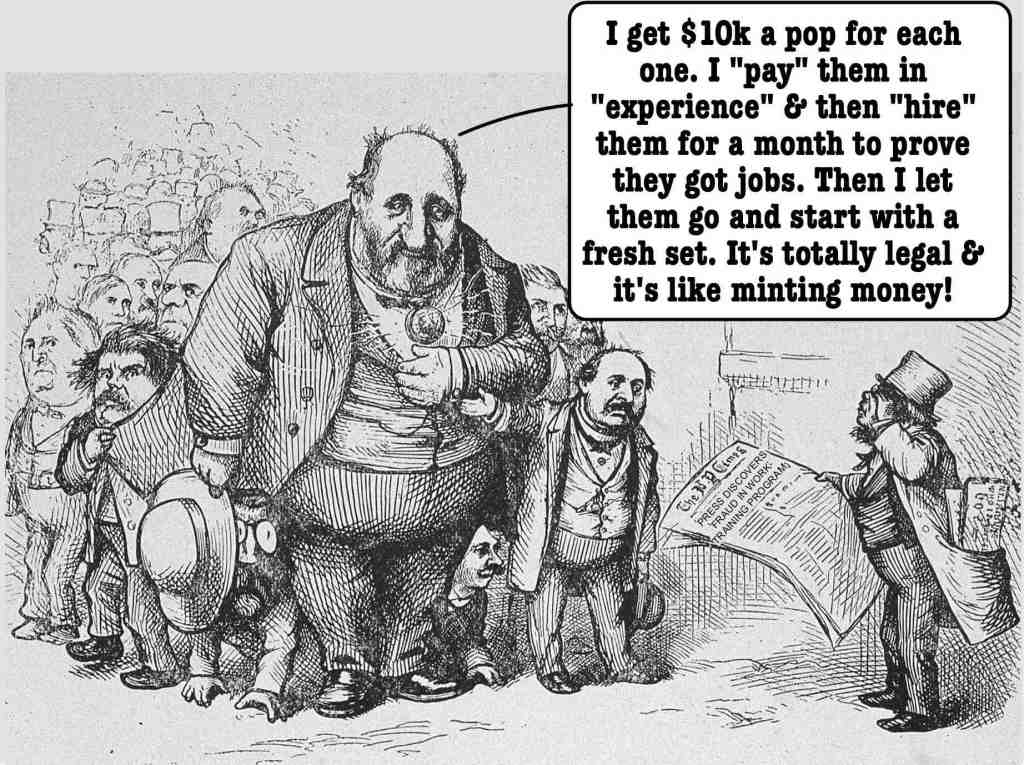
- (Pg. 595) Congress should create an employer grant worth up to $10,000 per year or pro-rated portion thereof for each worker engaged in on-the-job training, defined as some share of paid time spent in a formal training program.
- We created the little illustration above to make this whole scam clearer.
- So much corruption potential here… a private company can get $10k per head, whether or not the students learn anything useful, with the only punishment being that they could get kicked out of the program and have to rename themselves before they head back to the trough. This is basically turning the whole country into ITT Tech, or Corinthian Colleges. Our chapter on the Department of Education covers this whole “relaxing of accreditation” scam.
- We created the little illustration above to make this whole scam clearer.
(Pg. 596) Federal “BA Box”
NOTES ON COLLEGES vs. CONSERVATIVES :
- How did colleges start: (Vox.com) “The Ivies, our very first institutions, like Harvard — which is 150 years older than we are as a nation — were set up privately with charters. The idea was to train white men, usually second, third, fourth sons, and sometimes first sons, for the ministry, sometimes for medicine, sometimes for law, and also for public service…In addition to educating them, there was also a social component. It was about getting elite young men together through social clubs, like supper clubs, dining clubs, and secret societies, many of which are still around today… Christianity was also a really strong component. What we think of as the modern model of colleges didn’t emerge until after the Civil War. Before then, college was really like private high school.“
- When did they change?: “In the 1950s, William F. Buckley Jr., who is widely regarded as the father of the modern conservative movement, pens his first book, God and Man at Yale. The whole premise of the book is that America’s elite institutions have lost their way, deviated from Christianity, and are teaching young men to be more liberal, open-minded, worldly, and more socialist. This is where we see the beginning of a concerted movement of the right being a little bit suspicious about the curriculum in higher ed. They began wondering, “What are they teaching these kids?”
- What do conservatives want? “Conservative activist Christopher Rufo, who played a role in smearing critical race theory and in pushing out Harvard President Claudine Gaylast month, told students at the University of Colorado Boulder recently that America must “lay siege to the institutions” to root out radical liberal policies that were established in the 1960s — an idea he’s been repeating for years. According to Rufo, those policies include diversity and inclusion initiatives that are bringing America down today…But they’re not trying to dismantle public higher education brick by brick, as some commentators have suggested. They want to keep these institutions, but they want them to look like Hillsdale [a small conservative Christian college in Michigan]. They want to do what they’re doing at the New College of Florida. I think they do like these institutions — they just don’t like that they don’t control them.”
- What have they done so far?: “Harvard is an easy target for headlines, but when it comes to practical application, like where the right can really have impact, it’s the large state public universities that are most at risk. Those institutions that don’t make headlines and can slowly be changed behind the scenes, and it’s almost like no one notices. In red states, legislators have direct control over public education budgets. This is why New College in Florida was so easy to tear apart.”
NOTES ON COLLEGE DEGREES AND JOBS: (highereddive.com) “In a new report, Georgetown CEW projects that workers will increasingly need greater levels of education to succeed in the modern economy. By 2031, the report’s authors estimate that 72% of all jobs will require postsecondary education or training — increasing from about 68% in 2021. The 2031 prediction includes that 42% of jobs will require at least a bachelor’s degree.
State policies that reduce bachelor’s requirements won’t affect that trend, Smith said.
“Even though states are removing the B.A. as an entry-level requirement for jobs, they are not removing the B.A. as a promotion requirement or as a requirement for more senior positions,” Smith said.
Research also suggests workers with bachelor’s degrees earn about 75% more in lifetime earnings than those with only a high school diploma.The wage gap occurred because the jobs employers were trying to fill increasingly required advanced education and skills, Wildavsky said.
The wage gap “didn’t occur because of state bureaucrats imposing degree requirements in job descriptions,” he said.
Despite the tight labor market — with low unemployment and high job vacancies — there’s not much reason to believe that the high wage premium associated with college degrees will fall anytime soon, said Wildavsky.”
- (Pg. 596) Adopt the civil service’s skills-based hiring standards for federal contractors. The President should direct the Administrator for Federal Procurement Policy to adopt the civil service’s skills-based hiring standards for federal contractors and issue waivers from degree-based staffing requirements in existing contracts.
- This is already happening in multiple states.
- Pg. 596) Prohibit the use of a BA requirement in job descriptions. Congress should prohibit the inclusion of a BA requirement in job descriptions for all private sector employers, or the use of a BA requirement to screen applicants using algorithms, except where a BA from a particular type of institution or in a particular field is a bona fide requirement of the position.
- This is none of the federal government’s business. Seriously. And is probably a violation of 1st Amendment rights.
(Pg. 597) Federal Workforce Development Programs
Workforce Innovation and Opportunity Act (WIOA) is landmark legislation that is designed to strengthen and improve our nation’s public workforce system and help get Americans, including youth and those with significant barriers to employment, into high-quality jobs and careers and help employers hire and retain skilled workers.
WIOA requires states to strategically align their core workforce development programs to coordinate the needs of both job seekers and employers through combined four-year state plans with greater flexibility than its predecessor program (WIA). Additionally, WIOA promotes accountability and transparency through negotiated performance goals that are publicly available, fosters regional collaboration within states through local workforce areas, and improves the American Job Center system.
- (Pg. 597) Evaluate and streamline workforce development programs, ensuring evidence-based outcomes.
- Nope. Your party has a history of destroying accreditation standards and exposing students to useless programs and debt.
- You will strip DEI language from apprenticeship programs, and balk at DOL efforts to provide more apprenticeship opportunities for underrepresented communities, which consistently have low participation rates in registered apprenticeships.
- You will revert to states having their own standards for training, vs. using national industry standards in apprenticeships, which ensure workers have the same skills no matter where they work, and more flexibility in their job searches. (Example: utility workers who often travel to other states for emergency assistance when storms knock out power.)
- (Pg. 597) Review employment and training programs to ensure outcome- based metrics.
- We’re assuming this means more of your for-profit donors will get their hands in this pie. Companies can create their own apprenticeship programs, but they need DOL approval to tap federal apprenticeship funds.
(Pg. 597) Federal Unemployment Insurance Program
(calmatters.org) There was a huge increase of unemployment fraud during the pandemic, as the Department of Labbor and state agencies struggled to keep up with the massive increase in claims. In California, a switch-over to a completely online system after a shooting at an EDD office in Oxnard, and a slow start on using security features made it much easier to use false IDs and stolen identities. The DOL improving their standards and working better with state agencies is a good thing.
In the meantime, the GOP should seriously investigate the causes of joblessness, instead of repeating their long history of punitive legislation against the unemployed, based on their conviction that being poor and/or jobless is a moral failing. States like Wisconsin are trying to tie the number of weekly benefits someone receives to the state’s unemployment rate to taking away benefits if someone doesn’t show up for a job interview and that people who were fired, for whatever reason, are not worthy of unemployment benefits.
Democrats protest that these bills miss the point. Lack of childcare is a major issue that effects the ability to keep a job, which will be made worse by Project 2025’s destruction of Head Start, to be replaced by it’s hand-wavy fantasy that all businesses will start on-site child care. Lack of reliable public transport is another huge issue, and the GOP has never been big supportive of this kind of infrastructure.
- (Pg. 598) Congress should enact bipartisan commonsense UI program reforms, including statutory authority for the Labor Office of Inspector General (OIG) to access all state UI records for the purposes of investigation and requiring state agencies to crossmatch applicants with the National Directory of New Hires.
- Use recommendations from the GAO report “Unemployment Insurance – DOL Needs to Address Substantial Pandemic UI Fraud and Reduce Persistent Risks“
- (Pg. 598)Congress should also develop a framework (through commission of a congressional report to serve as a blueprint) of technical standards on broader tech topics like usability, state agency cybersecurity postures, data taxonomy standardization, and/or identity verification standards.
- Use recommendations from the GAO report “Unemployment Insurance – DOL Needs to Address Substantial Pandemic UI Fraud and Reduce Persistent Risks“
- (Pg. 598) Congress should provide DOL with more reasonable enforcement tools for the UI system.
- Use recommendations from the GAO report “Unemployment Insurance – DOL Needs to Address Substantial Pandemic UI Fraud and Reduce Persistent Risks“
- (Pg. 598) DOL should review all actual or planned procurements against the $2 billion (under the American Rescue Plan Act) for UI fraud detection, accessibility, and equity investments.
- Why are you jamming “equity investments” in this?
WORKER VOICE AND COLLECTIVE BARGAINING
Where we are now: (americanprogress.org) “According to CAP analysis of NLRB elections data, workers today have a better chance of winning their union representation election than at any point in the past 15 years, with a win rate of more than 70 percent. After a decline in the number of elections under the Trump administration, workers are back to holding more than 1,700 elections for union representation every year, and 115,000 workers voted in union elections in 2023, the largest number in a decade. As workers have pushed to form new unions, the NLRB has pursued a vigorous agenda of going after lawbreakers: It has won 54 percent more reinstatement offers for illegally fired workers since 2021 than during all four years of the previous administration, while instituting new rules that make it easier for workers to exercise their right to join a union.
The trend for the past several decades has been a weakening of labor law, stacking the deck in favor of corporations trying to bust unions. Businesses can use a range of legal tactics to persuade workers to vote against unionizing, and can even resort to illegally firing workers who try to organize their colleagues, since monetary penalties for breaking the law are nonexistent. Corporations are served by a cottage industry of professional “union avoidance” consultants, with law firms and consultants charging top dollar. One boutique consultant offers to potential clients to “show you how not only to win your election but also teach your staff advanced techniques for union avoidance to ensure your company never goes through a union election again.” And the Project 2025 policy playbook offers instructions for future administrations to neuter the NLRB’s enforcement capacity and turn it against unions by firing key agency leaders, making it easier to decertify unions, and closing off established ways of forming unions. However, under the leadership of Biden administration appointees, the NLRB has taken steps to advance, rather than stop, worker organizing. The NLRB is developing new rules that make it easier to form a union and win a contract, while actively protecting workers trying to organize.”
(Pg. 599) Non-Union Worker Voice and Representation.
- (Pg. 599) Congress should reintroduce and pass the Teamwork for Employees and Managers (TEAM) Act of 2022. (TEAM Act). Ummm, NO.
The TEAM ACT is a blind alley to subvert union organizers and channel worker unrest into a front organization for management. Union busting with a friendly face is still union busting.

- Employers can already set up employee participation programs provided they stay within certain parameters. The NLRB is not threatening the existence of these programs.
- The bill would significantly weaken a section of the National Labor Relations Act that bans company-controlled unions. In exchange, workers would get to be part of “employee involvement organizations” (whose recommendations companies would be free to ignore) and gain one non-voting seat on the boards of big companies.
- The non-voting board observer, which a company can choose to have or not have, is completely impotent and pointless.
- This legislation, rather than promoting genuine teamwork, would undermine the system of collective bargaining by allowing employers to establish company unions where no union currently exists and permitting company-dominated unions where employees are in the process of determining whether to be represented by a union.
- “Employee involvement organizations” are not unions and “cannot enter into collective bargaining agreements” or negotiate. These “alternative to employee unionization” are “dissolvable by the employer.”
- The 2022 TEAM Act, where not simply duplicating existing employee participation programs that are already legal, would give employers another union avoidance tool by allowing them to muddy the waters and by allowing them to fend off union organizing drives by setting up their own internal labor organizations, aka company unions.
(Pg. 599) The Worker’s Choice Act and the whole “right-to-work” concept is a scam!

- (Pg. 599) “The Worker’s Choice Act would end exclusive representation so that unions in right-to-work states are no longer forced to represent workers who do not want to join them... Jonathon states that many conservatives interpret the rise in independent and flexible work opportunities, significant expansion in family-friendly policies like paid family leave, and the decline in private sector unionization as indicators of workers’ increasing competency and control.”
- Just to answer the ridiculous claims in this one sentence above:
- “Independent and flexible work opportunities” = gig work = trap without benefits or a safety net for most workers.
- Hey, Jonathon! Bureau of Labor Statistics data show that only about 1 in 4 employees (27 percent) in the private sector workforce have access to paid family leave. Gig workers don’t. No U.S. federal law provides a right to paid family or medical leave.
- Jonathon, you are a liar. Private-sector unionization rose by more than a quarter million in 2023.
- To the GOP, code words like “increasing competency and control” translate to “outside contractor” with no benefits, as shown on the older version of the NLRB 2019/ DOL 2021 (Trump) (See chart above, under pg. 591)
- IV: federal labor law already protects workers who don’t want to join a union or make political contributions.
- Right-to-work issue. “RTW laws—and the phrase “right to work” itself—are intended to deceive and confuse. The misleadingly named policy is designed to make it more difficult for workers to form and sustain unions and negotiate collectively for better wages, benefits, and working conditions.”
- Data show that states with so-called “right-to-work” (RTW) laws have lower unionization rates, wages, and benefits compared with non-RTW states.
- By weakening unions, “right-to-work” laws fuel economic inequality
- On average, workers in RTW states are paid 3.2% less than workers with similar characteristics in non-RTW states, which translates to $1,670 less per year for a full-time worker.
- Claims that weakening unions will lead to state job growth have proven inaccurate. There are no measurable employment advantages between RTW and non-RTW states. These laws actually led to a decrease in employment in certain industries.
- Attacks on worker’s rights to unionize benefit the wealthy.
- Workers in right-to-work states are less likely to have health insurance.
- Higher Poverty and Infant Mortality Rates
- Lower Workers’ Compensation Benefits for Workers Injured on the Job
- More Workplace Deaths and Injuries
- “Right-to-work” Laws erode job quality without creating job growth.
- Just to answer the ridiculous claims in this one sentence above:
(Pg. 599) Union Transparency – They want more policing of workers
What is the Office of Labor Management Standards (OLMS)? (DOL.gov) The OLMS helps ensure that workers have a voice in the workplace and highlights the important role unions play in the modern American economy. OLMS promotes labor-management transparency by making available reports showing unions’ financial condition and employers’ expenditures for their activities in persuading workers during union organizing campaigns. It promotes labor union democracy and financial integrity through adopting and enforcing standards for union officer elections and union trusteeships and safeguards for union assets…
- (Pg. 600) Enact transparency rules. The substance of the Intermediate Bodies Rule should pass into law, either through rulemaking or through legislation. The T-1 Trust Annual Report annual filing requirement should be restored.
- The T-1 Trust Annual Report requirement was removed as duplicative and unnecessary, and that “enforcing the filing of the Form T-1 may actually deprive the department of resources needed to enforce the Labor-Management Reporting and Disclosure Act.…The rescission of this rule will allow OLMS to devote more resources to holding employers and union officials responsible when they violate the Labor-Management Reporting and Disclosure Act.”
- (Pg. 600) Increase funding levels. Congress should expand the funding of the Office of Labor-Management Standards.
- HAHAHAHAHAHAHAHAHAHAHAHAHAHAHA!!!!! Hilarious! But we’re guessing ol’ Jonathon thinks that a well-funded OLMS office with a Trump lackey in charge will be arresting union members for financial violations by the busload. In its current state, the OLMS states that “As illustrated through OLMS’s enforcement data, the vast majority of union officials and employees do their jobs diligently and without incident. When our investigations actually reveal civil and criminal violations, the union is typically the victim.”
Interpreting “Protected Concerted Activity”
(NLRB.gov) “The right of employees to engage in concerted activity to improve their working conditions is central to the National Labor Relations Act. The Board should not artificially constrain the definition of concerted activity, as the Alstate Maintenance decision did. By returning to the Board’s traditional approach, we better protect employees who seek to improve their working conditions,” said Chairman Lauren McFerran.”
- (Pg. 601) Reverse unreasonable interpretations of “protected concerted activity.” The NLRB should return to the 2019 Alstate Maintenance interpretation of what does and does not constitute protected concerted activity, including listing eight instances of lawful actions by employers.
- Trump’s DOL narrowed the definition of “protected Concerted Activity” to 5 factors, placing more power in the hands of employers to prevent organizing among employees. Biden’s NLRB has re-expanded it.
Injunctive Relief and Worker Organizing Activities
What is the 10(j) injunction?: (NLRB) Section 10(j) of the National Labor Relations Act authorizes the National Labor Relations Board to seek temporary injunctions against employers and unions in federal district courts to stop unfair labor practices while the case is being litigated before administrative law judges and the Board. These temporary injunctions are needed to protect the process of collective bargaining and employee rights under the Act, and to ensure that Board decisions will be meaningful.
- (Pg. 601) Increase the use of 10( j) injunctive relief.
Dues-Funded Worker Centers – More policing of workers!
- (Pg. 601) Investigate worker centers and require financial disclosures. DOL should investigate worker centers that look and act like unions and bring enforcement actions to require them to file the same financial disclosures.
Office of Labor-Management Standards Initiative
- (Pg. 602) Revise investigation standards. The Office of Labor-Management Standards should revise its investigation standards to authorize investigations without receiving a formal complaint.
Persuader Rule
(Persuader rule issues starts at 9:35. Read Julia Rock’s article here. )
- (Pg. 602) DOL should rescind the persuader rule once again should the Biden Administration revive it.
- So this is what Biden did: “As the Department stated in its proposed revision, both the public and the employees whose rights are at issue have an interest in understanding the full scope of activities undertaken by employers to persuade employees regarding the exercise of their rights to organize or bargain collectively, to surveil employees, or to commit unfair labor practices. This interest is heightened when the employees’ own tax dollars may be indirectly funding an employer’s reportable activities. The public and employees also have an interest in knowing whether the federal government is paying for goods and services from an employer who would seek to engage in activity that may disrupt the harmonious labor relations that the federal government is bound to protect.“
- Employers to file a report – an LM-10, subject to certain exemptions, covering the following payments and arrangements made in a fiscal year:
- a labor organization or its officers, agents, or employees;
- payments to employees for the purpose of causing them to persuade other employees with respect to their bargaining and representation rights;
- payments for the purpose of interfering with employees in the exercise of their bargaining and representation rights or for obtaining information on employee or labor organization activities in connection with labor disputes involving their employer;
- and arrangements (including related payments) with a labor relations consultant for the purpose of persuading employees with respect to their bargaining and representation rights, or for obtaining information concerning employee activities in connection with a labor dispute involving their employer.
Unionizing the Workplace: Card Check vs. Secret Ballot
Guaranteed that even the smallest details are noted in Project 2025 when they are proven to favor employers.

- (Pg. 603) Discard “card check.”
- CARD CHECKS – LESS PRONE TO EMPLOYER INTERFERENCE: (cepr.net) The process of union certification is a critical area of labor rights, acting as a precursor to collective bargaining. One method, card check, simplifies this process by allowing workers to express their desire for union representation through majority sign-up. Because it reduces opportunities for employer interference and expedites union certification, card check has come under significant fire from those who oppose unions.
- CARD CHECKS – FASTER: Card check is a quick and efficient way for workers to indicate whether they want to be represented by a union. Workers who desire a union simply sign authorization cards indicating their support. If a majority (typically 50 percent plus one) sign cards, the union is recognized as the employees’ representative, and the newly authorized union and its members begin negotiating a collective bargaining agreement. Card check certification allows workers to move quickly from establishing majority support for their union to meeting their employer at the bargaining table.
- SECRET BALLOTS CAN BE IMPOSED BY MANAGEMENT TO SLOW UNION ROLL: While private sector employers can voluntarily recognize their employees’ union based on card check, they are not obligated to do so; employers have the option to petition the National Labor Relations Board (NLRB) even if the majority of workers have signed cards in support of the union. The NLRB adjudicates the matter by running a secret ballot election to determine whether the majority of those eligible for the bargaining unit support the union.The secret ballot election typically involves a prolonged campaign period, which gives employers ample time to interfere. The distinction between card check and secret ballot elections may seem inconsequential, but it makes a significant difference in union certification success rates.
Contract Bar Rule
- (Pg. 603) Eliminate the contract bar rule
- Why we shouldn’t:
- CONTRACT BAR RULE IN EFFECT: On April 21, 2021, the NLBR supports its long-standing contract-bar doctrine, which provides stability in the relationship among the employer, a collective bargaining representative, and its employee-members.
- STOPS OUSTING UNIONS:The contract-bar doctrine prohibits all petitions that could oust an existing union, by employees who are covered by a valid collective-bargaining agreement for three years or the duration of the agreement – whichever is shorter. The doctrine permits an election petition to be filed by representative employees only during a 30-day “window period,” which is typically between the last 60 and 90 days prior to the expiration of the collective bargaining agreement; after the contract expires; or after the third anniversary of any CBA that is longer than three years. The final 60-day period of the agreement is considered an “insulated period,” where no election petition may be filed.
- Why we shouldn’t:
Tailoring National Employment Rules – WARNING! WARNING! WARNING! – Destruction of all labor laws here!
“Davis-Bacon Act“: So what is this evil “Davis-Bacon Act” that has Project 2025’s GOP-issued tightie-whities in a twist? How does their opposition to it square with the GOP’s “longstanding tradition [of creating] policies that promote family-sustaining jobs or with the author’s conclusion that “The good of the American family is at the heart of conservative labor policy recommendations.” (Pg. 616)
Oh, it doesn’t!
- Under the Davis-Bacon and Related Acts 1950, the U.S. Department of Labor is responsible for determining prevailing wages, issuing regulations and standards to be observed by federal agencies that award or fund projects subject to Davis-Bacon labor standards, and overseeing consistent enforcement of the Davis-Bacon labor standards.
- The Davis-Bacon and Related Acts apply to contractors and subcontractors performing on federally funded or assisted contracts in excess of $2,000 for the construction, alteration, or repair (including painting and decorating) of public buildings or public works.
- These contractors and subcontractors must pay their laborers and mechanics employed under the contract no less than the locally prevailing wages and fringe benefits for corresponding work on similar projects in the area.
- It directs the Department of Labor to determine such locally prevailing wage rates. It applies to contractors and subcontractors performing work on federal or District of Columbia contracts.
- For prime contracts in excess of $100,000, contractors and subcontractors must also, under the provisions of the Contract Work Hours and Safety Standards Act, as amended, pay laborers and mechanics, including guards and watchmen, at least one and one-half times their regular rate of pay for all hours worked over 40 in a workweek.
- The overtime provisions of the Fair Labor Standards Act may also apply to DBA-covered contracts.
So, let’s see. It says employers must pay their employees fair wages, and for bigger contracts, more employees need to be paid that same fair wage. And if they work overtime, they get overtime.
SOUNDS PRETTY FAMILY-SUSTAINING RIGHT THERE, DUDES!
WARNING! WARNING! WARNING!
- (Pg. 603) Congress should amend the NLRA to authorize collective bargaining to treat national employment laws and regulations as negotiable defaults. For example, this reform would allow a union to bless a relaxed overtime trigger (e.g., 45 hours a week, or 80 hours over two weeks) in exchange for firm employer commitments on predictable scheduling.
- With just this one item, Berry proposes to dump all worker rights and protections into the toilet. There is no bottom here – they could throw out minimum wage laws, safety laws, child labor laws. Anything. Instead of bargaining to improve their positions above the basic legal minimum, union leaders would be forced to start from zero.
- (Pg. 604) End Project Labor Agreement requirements and repeal the Davis–Bacon Act.
- Explanation of what a Project Labor Agreement is, and why Project 2025 wants it gone.
- A Project Labor Agreement (PLA), also known as a Community Workforce Agreement, is a pre-hire collective bargaining agreement with one or more labor unions that establishes the terms and conditions of employment for a specific construction project. Before any workers are hired on the project, construction unions have bargaining rights to determine the wage rates and benefits of all employees working on the particular project and to agree to the provisions of the agreement.
- Explanation of what a Project Labor Agreement is, and why Project 2025 wants it gone.
- (Pg. 604) End PLA requirements.
- No. Violates Project 2025’s commitment to “family sustaining” work. Asshole-ry afoot.
- (Pg. 604) Repeal Davis–Bacon.
- No. Violates Project 2025’s commitment to “family sustaining” work. Asshole-ry afoot.
THE STATES
Worker-led Benefits Experimentation
- (Pg. 605) Approve non-public worker organizations as UI administrators.
- According to AmericanProgress.org, “Supporting worker organizations to act as unemployment insurance navigators would help increase recipiency rates primarily by improving take-up rates—the share of eligible workers receiving benefits—but also by helping make more workers meet eligibility requirements. Unions and worker centers have a proven track record of representing the interests of workers and have helped many workers navigate through the complex process of receiving benefits—including knowing the law, understanding forms, and working with government websites, systems, and employees—for a range of public programs, such as unemployment insurance, workers’ compensation, and health care. Research finds that when workers are part of a union, they are more likely to receive UI benefits.”
- “Part of the access problem is due to inadequate resources to properly staff the UI administration and update computer systems. Indeed, federal base funding to cover administration of the UI system has declined significantly over recent decades…Capacity problems need to be fixed, such as by providing adequate resources for UI staffing and technology. Similarly, efforts to privatize the administration of UI and related programs should be rejected.
- (Pg. 605) Offer waivers for suitable alternatives. DOL should offer waivers from the standard requirements imposed on unemployment compensation by § 303(a) and § 303(d) of the Social Security Act to states that propose suitable alternatives.
- There is already a lot of room for states to enact their own unemployment compensation systems, and the feds issue guidances, like allowing states to waive recovery of COVID-related insurance benefit overpayments.
- (Pg. 605) Require organizations to comply with restrictions on political spending. DOL should establish as a precondition for receiving any public funds a requirement that an organization comply with restrictions on political spending as applied to 501(c)(3) charitable organizations.
- Ah, here we go! This would muzzle unions and worker organizations from participating in politics if they also assist as UI navigators.
Labor Law WARNING! WARNING! WARNING!
- (Pg. 605) Pass legislation allowing waivers for states and local governments. “To encourage experimentation and reform efforts at the state and local levels, Congress should pass legislation allowing waivers from federal labor laws like the NLRA and FLSA under certain conditions. State and local governments seeking waivers would be required to demonstrate that their reforms would accomplish the purpose of the underlying law, and not take away any current rights held by workers or employers. In addition, waivers would be limited to a five-year period, after which time they could be modified, canceled, or renewed.”
- Seriously, no! Do not give these bastards an inch! “The National Labor Relations Board (NLRB) under Trump administration, with the guidance of the Heritage Foundation’s Mandate for Leadership, systematically rolled back workers’ rights to form unions and engage in collective bargaining with their employers, to the detriment of workers, their communities, and the economy. The Trump board has issued a series of significant decisions weakening worker protections under the National Labor Relations Act (NLRA/Act). Further, the board has engaged in an unprecedented number of rulemakings aimed at overturning existing worker protections. Finally, the Trump NLRB general counsel (GC) has advanced policies that leave fewer workers protected by the NLRA and has advocated for changes in the law that roll back workers’ rights. The Trump board and GC have elevated corporate interests above those of working men and women and have routinely betrayed the statute they are responsible for administering and enforcing.“
- “The Trump administration authorized 13 states’ work requirements, which tied Medicaid to employment, though only Arkansas’ got off the ground. More than 18,000 people were removed from the rolls in that state before a U.S. District Court judge blocked the program in 2019 and the Biden administration revoked states’ approvals, effectively stifling efforts nationwide.”
Excessive Occupational Regulation
- (Pg. 606) Congress should ensure that interstate compacts for occupational license recognition that are federally funded do not require new or additional qualifications (that is, qualifications that do not originate from state governments themselves) for licensed professionals to participate.
- (Pg. 606) Congress should ensure that well-qualified licensees are not locked out of the job market by restrictive government programs funded by the federal government.
Wagner-Peyser Staffing Flexibility
What the heck is the Wagner-Peyser Act?
- (dol.gov) “Enacted in 1933, the Wagner-Peyser Act established the nationwide system to support the nation’s labor markets by bringing together people seeking employment with employers in need of workers. The act requires states to create and maintain Employment Service programs to deliver services to jobseekers and employers, including job placement, counseling, training and labor market information.“
- Trump update – Privatizing the Employment Service: “In 2020, the Department of Labor finalized the Wagner-Peyser Act Staffing Flexibility rule , which removed the longstanding, legally required, merit-based staffing rule for the Employment Service and allow private entities to receive Wagner-Peyser Act funding. …The Department’s changes make it less likely that job seekers get high quality services when they most need them and will likely reduce job quality for those services.”
- Biden update: (dol.gov) They tossed this corruption. “In 2020, the department finalized a rule removing the requirement for states to use state merit staff. The department has since reconsidered its decision and concluded state merit staffing is important for ensuring consistent, high-quality delivery of Employment Service program services by states.”
- (Pg. 606) DOL should repromulgate the Trump-era staffing flexibility rule, and Congress should codify it.
- The Trump version was a cheat to get around using non-partisan, well trained, government staffers, instead of throwing cash to their donor corporations.
WORKER RETIREMENT SAVINGS, ESG, AND PENSION REFORMS
- ESG VOCABULARY:
- ERISA: “The Employee Retirement Income Security Act of 1974 (ERISA) is a federal law that sets minimum standards for most voluntarily established retirement and health plans in private industry to provide protection for individuals in these plans.“
- ESG: “ESG stands for environmental, social, and governance. ESG investing refers to how companies score on these responsibility metrics and standards for potential investments. Environmental criteria gauge how a company safeguards the environment. Social criteria examine how it manages relationships with employees, suppliers, customers, and communities. Governance measures a company’s leadership, executive pay, audits, internal controls, and shareholder rights.”
- Environmental: Investors evaluate corporate climate policies, energy use, waste, pollution, natural resource conservation, and treatment of animals. Considerations may include direct and indirect greenhouse gas emissions, management of toxic waste, and compliance with environmental regulations.
- Social: A company’s relationships with internal and external stakeholders are evaluated. Does the company donate a percentage of profits to the local community or encourage employees to volunteer? Do workplace conditions reflect a high regard for employees’ health and safety?
- Governance: Ensures a company uses accurate and transparent accounting methods, pursues integrity and diversity in selecting its leadership, and is accountable to shareholders. ESG investors may require assurances that companies avoid conflicts of interest in their choice of board members and senior executives, don’t use political contributions to obtain preferential treatment or engage in illegal conduct.
(Pg. 606) Remove ESG considerations from ERISA.
Why does the GOP hate ESG?
- According to Jonathon, the things that make the GOP sad is its implied liberal views on:
- climate change, including greenhouse gas emissions. ESG proponents advocate for divestment from oil and gas companies or the exercise of investor influence to reduce oil and gas production, as climate change is impacting health care, agriculture and property, and wiping out insurance markets. This contradicts Project 2025’s Chapter on the Department of the Interior’s wishlist:
- Reverse the “war on fossil fuels,”
- Re-establishing Trump’s Dominance Agenda,
- Restart coal production,
- Rescind withdrawals of land from drilling,
- racial quotas that tingle every DEI nerve in hard-right Republicans. And what oligarch actually cares about worker safety?
- abortion – and worker requests for coverage – also not acceptable to Project 2025 authors.
- climate change, including greenhouse gas emissions. ESG proponents advocate for divestment from oil and gas companies or the exercise of investor influence to reduce oil and gas production, as climate change is impacting health care, agriculture and property, and wiping out insurance markets. This contradicts Project 2025’s Chapter on the Department of the Interior’s wishlist:
- (Pg. 607) DOL should prohibit investing in ERISA plans on the basis of any factors that are unrelated to investor risks and returns. “Because ESG investing necessarily puts other considerations before the interests of the beneficiary, ESG investing by plan managers is an inappropriate strategy under ERISA.”
- Hey, send this video to Jonathon! STOP INTERFERING WITH CAPITALISM! Beneficiaries appreciate a healthy and livable world, that doesn’t cause lung cancer, dementia, and house-killing fires. We’re sorry you are so sad that the “Social” and “Governance” may use (checks notes…) DEI issues.
- (Pg. 607) DOL should return to the Trump Administration’s approach of permitting only the consideration of pecuniary factors in ERISA. “However, this approach should not preclude the consideration of legitimate non-ESG factors, such as corporate governance, supply chain investment in America, or family-supporting jobs.”
- Maybe Jonathon has been out of the corporate world so long, he doesn’t remember that climate change affects all those things. That worker safety issues = huge lawsuits. That board of director shenanigans = huge lawsuits.
- Unfortunately, fund managers HATE being subpoenaed. “As baseless as the attacks have been, the pressure could still work. Vanguard on Wednesday announced it is withdrawing from the Net Zero Asset Managers coalition, in which companies voluntarily committed to reaching net-zero emissions in their portfolios by 2050. In an apparent nod to the ongoing GOP’s investigations, Vanguard said it withdrew “so that we can provide the clarity our investors desire about the role of index funds and about how we think about material risks, including climate-related risks — and to make clear that Vanguard speaks independently on matters of importance to our investors.”
- (Pg. 607) DOL should consider taking enforcement and/or regulatory action to subject investment in China to greater scrutiny under ERISA.
(Pg. 607) Thrift Savings Plan – same as above – rinse and repeat
BlackRock: (Vox) “One of the defining ideas of ESG is that a company is better off accounting and reporting environmental and social risks to investors and clients, rather than being willfully blind to the world around it. This can include a broad swath of issues, such as a company’s reliance on oil, gas, and coal, or exposure to sea-level rise in coastal operations, human rights violations of the countries it operates in, and lack of board diversity and CEO transparency. A big part of the ESG movement, at least right now, is largely about disclosure of these potential bottom-line risks in the future, not necessarily doing anything differently in the present.…
…ESG isn’t woke, but it is evidence of the free market at work
The backlash began early in 2021 when three events sent the signal that ESG was here to stay. The first was [BlackRock CEO] Larry Fink’s embrace of ESG, noting in his 2021 letter that “No issue ranks higher than climate change on our clients’ lists of priorities. They ask us about it nearly every day.” The second came in March, when the Biden administration proposed a regulation to require climate risk disclosure from publicly traded companies, parallel to rules being adopted by the European Union. The third and final was an unlikely coup staged at the annual Exxon shareholder board meeting.”
- (Pg. 608) DOL should reverse efforts to politicize the TSP by removing “mutual fund” windows that encourage ESG, and should clarify the fiduciary duties of the TSP.
- See green box above “ESG VOCABULARY.”
- (Pg. 608) The federal government should follow the lead of multiple state governments in removing their pension funds from fund managers such as BlackRock and State Street Global Advisers, and contract with a competitive, private-sector manager that will comply with its fiduciary duties.“
- (Vox) “For months, Republicans have been attacking ESG, the financial shorthand for how some companies consider all the ways the environment, social issues, and corporate governance impact their bottom line. One of the GOP’s recent targets is BlackRock, the world’s largest asset manager, which oversees some $8 trillion in assets, as a symbol of the financial community’s growing recognition that climate change is too big to ignore…Republican officials in West Virginia, Texas, Louisiana, Missouri, and now Florida have withdrawn billions of dollars from BlackRock’s management. Proponents are planning to introduce a slew of bills in at least 15 states next year to divest pensions and boycott companies for considering sustainability as an aim. At the federal level, House GOP lawmakers are preparing antitrust investigations.
- (Pg. 608) DOL should also consider bringing enforcement actions against BlackRock and State Street Global Advisers for their violations of fiduciary duty while managing the TSP.
- See Subpoena notice above
- (Pg. 608) Congress should enact legislation authorizing the FRTIB [Federal Retirement Thrift Investment Board] to exercise its independent business judgment in exercising the proxy votes for its holdings of the TSP and provide clear proxy voting guidelines for the FRTIB to follow
- “The FRTIB is charged by law to administer the TSP solely in the interest of the participants and beneficiaries. We seek to improve participant retirement outcomes; provide top-tier defined contribution service to participants; function as a high-performing Agency; and transition successfully to a managed services operating model.”
- People already seem happy with what’s going on now. What exactly is the GOP’s problem?

- (Pg. 609) DOL should exercise its oversight of the FRTIB to prohibit investments in China.
- Why is this in Project 2025? It takes 5 seconds to find this: “TSP Fact Sheet – Investment in China – Among the funds available for investment by individual TSP account holders is the International or I Fund. This fund does not, nor has it ever, include investments in mainland China. In addition, no funds within the TSP are invested in companies that the U.S. government has sanctioned through its Office of Foreign Assets Control (OFAC) in the Department of the Treasury for activities that pose threats to U.S. national security.”
- (Pg. 609) Congress should enact legislation prohibiting investment of the TSP in China.
- See note above. Is this perchance to prevent Trump’s lickspittles from redirecting funds to China? You can’t control them all!
PENSION REFORMS
(Pg. 609) Public Pension Plan Disclosure
- (Pg. 609) Disclose the fair market value of plan assets and liabilities. Congress should require public pension funds to disclose the fair market value of plan assets and liabilities (using the Treasury yield curve as the discount rate) on an annual basis.
(Pg. 609) Multiemployer Plans
- (Pg. 609) Congress should reform multiemployer pensions to give participants in these plans the same protections as those in single-employer plans.
(Pg. 610) Pension Benefit Guaranty Corporation
- (Pg. 610) The PBGC’s annual report must be submitted on time, and with timely data that uses fair-market value principles to calculate the PBGC’s finances.
- (Pg. 610) Congress should increase the variable rate premium on underfunding and eliminate the per-participant cap in order to appropriately take into account risk and limit the degree to which well-funded pension plans must subsidize underfunded plans.
(Pg. 610) Improving Access to Employee Stock Ownership Plans
- (Pg. 611) Provide clear regulations for ESOP valuation and fiduciary conduct.
PUTTING AMERICAN WORKERS FIRST
Putting American workers first means NOT DESTROYING THE ECONOMY! We don’t have multi-million dollars savings accounts stashed away in offshore banks like the oligarchs behind Project 2025! Every bit of their xenophobic agenda – from Trump’s deportation madness, to Project 2025’s ridiculous suggestions for worker visas, is filled with the potential to cause massive shortages, shutdowns and roaring inflation.
(Pg. 611) Immigration
(Niskanencenter) “The H-2A and H-2B visa programs are essential employment programs that fill temporary and seasonal gaps in agricultural and nonagricultural labor markets. The Mandate ultimately intends Congress to wind down the H-2 visa programs over the next 10 to 20 years. In the interim, it instructs the Secretary of Homeland Security not to issue any updates to the list of H-2 eligible countries.
Refusing to update the list would mean that after the expiration of the 2024 list, no countries would be eligible to participate in the program, thus grinding it to a halt. U.S. Citizenship and Immigration Services (USCIS) can still approve individual, case-by-case basis H-2A and H-2B petitions for nationals not included on an eligible countries’ list, but only if doing so is “in the national interest of the United States.” Of course, this significantly increases the burden on petitioning employers, raising the bar from demonstrating their own need for these employees to demonstrating a national interest.
The agricultural industry would be particularly hard hit by such a policy change, losing up to 10 percent of its already stretched-thin workforce or even larger shares on some farms. The construction, forestry, hospitality, and landscaping industries will likely face detrimental labor losses under the Mandate’s direction.“
- H-2A visa program – Temporary Agricultural Workers – allows U.S. employers or U.S. agents who meet specific regulatory requirements to bring foreign nationals to the United States to fill temporary agricultural jobs. The DOL recently finalized additional protections for farmworkers. “This rule ensures farmworkers employed through the H-2A program are treated fairly, have a voice in their workplace and are able to perform their work safely. It also promotes employer accountability, benefitting all farmworkers by upholding labor standards.“
- H-2B visa program – Temporary Non-Agricultural Workers – U.S. employers or U.S. agents who meet specific regulatory requirements to bring foreign nationals to the United States to fill temporary nonagricultural jobs. “Landscapers/groundskeepers account for about 40 percent of all H-2B jobs. The second-largest occupation is forestry workers, at about 8 percent. In fiscal 2014, the top two occupations accounted for nearly half of all H-2B jobs. The other top occupations include amusement and recreation attendants (working at traveling carnivals), maids and housekeepers, meat and fish processors, construction laborers, and restaurant workers such as cooks and waitstaff.“
- (Pg. 611) Cap and phase down the H-2A visa program “Congress should immediately cap this program at its current levels and establish a schedule for its gradual and predictable phase-down over the subsequent 10 to 20 years, producing the necessary incentives for the industry to invest in raising productivity, including through capital investment in agricultural equipment, and increasing employment for Americans in the agricultural sector.”
- “This makes no sense #1″: If a farmer mechanizes, the job opportunity disappears – whether H-2A or U.S. domestic. Mechanization – to the extent it is affordable – eliminates jobs.
- “This makes no sense #2″: Project 2025 says it wants to strengthen agricultural families by eliminating farm jobs and forcing farmers who operate on thin profit margins to buy expensive equipment (assuming farming of the particular crop can be mechanized at all).
- “This makes no sense #3″: Americans don’t want these jobs! U.S. agriculture is hard, dangerous work needing specialized skills. Farmers needs 1.5 to 2 million hired workers each year and have been struggling to fill these positions; in 2019, 56% of California farmers reported being unable to find all the workers they needed over the last five years. Even with perks like 401(k) plans, health insurance, subsidized housing, and profit-sharing bonuses, native-born Americans won’t leave their day jobs for the fields. Nine in 10 agriculture workers in California are still foreign born.
- “This makes no sense #4″: Demand is growing, not lessening, for agriculture labor.
- “Approximately 310,000 H-2A visas were issued by the State Department in 2023, up from 298,000 visas in 2022 and four times more than the 75,000 visas in 2010. Farmers say they have turned to the H-2A program because of the difficulty in recruiting farm labor. Half of farmworkers are believed to be undocumented, and many are reaching retirement age. The 275,000 H-2A guest workers of 2020 accounted for 10% of the average employment on crop farms, according to a USDA report.”
- “This makes no sense #5″: Project 2025 totally missed the actual problem facing farmers!
- “In March, a bipartisan working group [The House Committee on Agriculture’s bipartisan Agriculture Labor Working Group (ALWG)] unanimously recommended that the H-2A visa, now limited to seasonal work, also be available for year-round work on farms and in processing plants. “One thing that has become clear is the need for dairy products, meat processors, sugar processors, forestry, ranchers, and others to have access to a steady and legal workforce,” said the working group, composed of members of the House Agriculture Committee”
- (Pg. 611) Congress should also encourage the establishment of an industry consortium of agricultural equipment producers and other automation and robotics firms interested in entering the sector and match funding invested by the industry, with intellectual property developed within the consortium freely available to all participants.
- “It is amazing that the Heritage Foundation would be proposing a socialized business that would drive out legitimate competition from the private sector because of copious funding from the government (“a trillion here, a trillion there, and soon you are talking about real money.”) What if the “automation and robotics firms” are not interested in entering the sector? If they see it as good opportunity, they would already be there. The Heritage Foundation is supposed to be on the conservative side of the political spectrum so one would not expect yet another socialized public sector boondoggle. One would think that at least one of the prominent people who had a hand in creating the Manifesto would hesitate to replicate Synfuels, Solyndra, windmills, and other boondoggles – especially job destroying boondoggles….While the H-2A Program needs reform, the incoherent proposal advanced by the Manifesto is not it. Shame on the Heritage Foundation for such shoddy work.“
- (Pg. 611) Encourage the establishment of an industry consortium and match funding.
- This will either be a bottomless pit of unaccountable government slush fund going to large industries, or it will never happen, as the GOP slashes all funding.
- (Pg. 612) Phase out the H-2B visa program.
- This are the people that Trump brings in every year, as “Hotels and Motels, Food Services, Janitorial Services and Landscaping Services” are industries with a high need for these workers. (Cato) “As president, he banned many H‑2B workers, but no more U.S. workers applied… U.S. workers simply will not relocate to work in tough manual labor positions when they are temporary. Very few Americans are looking for temporary employment anyway. H‑2B workers not only are not taking U.S. workers’ jobs. They are creating jobs for them. By doing the jobs that U.S. workers turn down, H‑2B workers increase demand for other jobs elsewhere in the economy that Americans want to fill.“
- (Pg. 166-167) (From DHS) cut out lower wage workers from immigration eligibility; Treasury: have IRS share tax info of undocumented people; Intelligence: include immigration enforcement into Intelligence Community
(Pg. 612) Hire American Requirements
- (Pg. 612) Congress should mandate that all new federal contracts require at least 70 percent of the contractor’s employees to be U.S. citizens, with the percentage increasing to at least 95 percent over a 10-year period.
- Good luck finding these workers, boys! U.S. Secretary of Commerce, Gina Raimondo, “warned that America’s aging demographics were poised to hit the country and the economy “like a ton of bricks.” So, of course, the GOP has decided to make immigration of younger adults nearly impossible, and all the kids women are going to forced to bear – well they won’t be ready to work in agriculture or in coal mines for at least a few years..
- (Pg. 613) Congress must amend the law so that employers can again have the freedom to make hiring Americans a priority.
- This probably means that they are creating a level playing ground between competing contractors, because they assume that immigrant workers will be paid far less than citizens.
(Pg. 613) Visa Fraud
- (Pg. 613) To protect the American workforce from unscrupulous immigration lawyers, employers, and labor brokers, the department must follow the recommendations of the OIG and institute more robust investigations for suspected visa fraud and speedier debarments for those found guilty.
- We’re guessing, with their rampant xenophobia, they will retain some money to do this.
INTERNATIONAL LABOR POLICY – (OK, they’re just punking us now!)
(Pg. 613) Leveling the International Playing Field for Workers
- (Pg. 614) Eliminate all forms of forced or compulsory labor.
- Hey! This is great! And we should start with doing this at home! We expect ROBUST support from the GOP on proposed legislation like California’s Prop. 6, which amends the California Constitution to remove current provision that allows jails and prisons to impose involuntary servitude to punish crime
- (Pg. 614) Protect workers’ rights to organize and participate voluntarily in a union without employer interference or discrimination.
- Seriously! There were 19 PAGES on how to restrict unions here in America.
- (Pg. 614) Create a rapid-response mechanism to provide for an independent panel investigation of denial of labor rights at covered facilities.
- It just gets deeper…
- (Pg. 614) Shift the burden of proof by presuming that an alleged violation affects trade and investment, unless otherwise demonstrated.
- and deeper…
(Pg. 614) Investigate Foreign Labor Violations That Undermine American Workers
- (Pg. 614) The next Administration should focus ILAB investigations on foreign labor violations that do the most to damage American workers’ earning power, specifically regimes that engage in child and forced labor, fail to protect workers’ organizing rights, and permit hazardous or otherwise exploitative working conditions.
- You mean like the child labor that is already happening here in the U.S.? The abuses of unions that is happening here in the U.S.? The hazardous conditions this very chapter is trying to let children engage with in the U.S.? Seriously!
ORGANIZATIONAL AGENDA
(Pg. 615) Budget
- (Pg. 615) Reduce the agencies’ budgets to the low end of the historical average. The Trump Administration’s FY 2020 request, $10.9 billion, would provide a workable target for spending reductions for DOL, for example.
- Whatever is necessary for increasing policing of immigrants and union members will be provided.
- (Pg. 615) Spending reductions should occur primarily in the Employment and Training Administration (ETA).
- See above.
- (Pg. 615) Focus health and safety inspections on egregious offenders, as other inspections are often abused and usurp state and local government prerogatives.
- There is no problem here for these oligarch/corporate lickspittles. “OSHA and its state counterparts relying on fewer than 1,850 inspectors to monitor about 8 million workplaces, it would take federal officials 145 years to inspect each job site once, union researchers estimate. The aim of the list is to let OSHA’s limited staff zero in on some of the worst offenders…with about 4,800 workplace fatalities a year nationally, putting every company with a death on the severe violator list would overwhelm OSHA and defeat the goal of tougher enforcement for a subset of the worst offenders. For that reason, the death of a worker will put a company on the list only if the circumstances are particularly flagrant or reflect a pattern of reckless conduct. In 2015 only one out of every roughly 200 employers with an on-the-job fatality landed on the list.”
- Instead of increasing the budget for more inspectors, they want the public to believe that their clients are overwhelmed. “The agency lacks the authority to shut down dangerous workplaces and its fines generally remain modest despite an increase that took effect in August.”
(Pg. 615) Personnel
Update video from Project on Government Oversight (POGO) on “Schedule F” threats.
- (Pg. 615) Maximize hiring of political appointees.
- This is the Schedule F clean-out of merit-based civil servants that Trump tried to effect at the end of his term. At least 50,000 workers with proven expertise would be replaced with political lackeys responsible only to Trump’s whims, a revival of the corrupt spoils system that was replaced with the 1883 Pendletoon Act. “Other former Trump officials’ comments and actions led one professor who studies public administration to conclude that the 50,000 figure “is probably a floor rather than a ceiling.”
- “A recent article published in the journal Public Administration that reviewed 96 different studies on the relationship between meritocracy and government performance found that “Impartiality and professionalism are consistently related to positive performance outcomes, higher public trust and confidence, and lower levels of corruption” whereas “Politicization was negatively related to government performance, employee work attitudes (i.e., job satisfaction, organizational commitment), and impartial administration, and positively related to corruption.”
- This is the Schedule F clean-out of merit-based civil servants that Trump tried to effect at the end of his term. At least 50,000 workers with proven expertise would be replaced with political lackeys responsible only to Trump’s whims, a revival of the corrupt spoils system that was replaced with the 1883 Pendletoon Act. “Other former Trump officials’ comments and actions led one professor who studies public administration to conclude that the 50,000 figure “is probably a floor rather than a ceiling.”
- (Pg. 615) Appoint new EEOC and NLRB general counsels on Day One.
- con’t…
- These are the people that a new Trump administration would put in place.
- Biden replaced Peter Robb the Trump’s NLRB General Counsel on the first day. “Before becoming the GC, Robb had spent his legal career as an aggressive anti-union management lawyer. Among his accomplishments were aiding in the defeat of the Air Traffic Controllers (PATCO) strike under President Reagan. His success in crushing that strike raised the threat of permanent replacement for all striking workers, a threat still felt to this day. Robb was appointed to the position of GC by Donald Trump in 2017. Like most Trump appointees, he set out to undermine (some might say destroy) the agency he was appointed to help lead.“
- Biden then fired fired Sharon Gustafson, general counsel of the Equal Employment Opportunity Commission, who had refused to step down on Inauguration Day, as was traditional. Though the EEOC is charged with defending religious freedom, she “took a narrower view of the issue, focusing on the rights of Christians at the expense of all others. Finally, it is no secret that Gustafson was an ineffective general counsel who sought to curtail her agency’s litigation against both LGBTQ discrimination and systemic racism. Career attorneys at the EEOC told Slate that her removal is a necessary step toward restoring the agency’s mission, badly damaged by Trump appointees, of safeguarding civil rights for all.”
- These are the people that a new Trump administration would put in place.
- (Pg. 615) Implement a hiring freeze for career officials.
- This is a repeat of what Trump did at the beginning of his first term.
(Pg. 615) Office of Compliance Initiatives
(dol.gov) “The Office of Compliance Initiatives promotes greater understanding of federal labor laws and regulations to prevent violations and protect Americans’ wages, workplace safety and health, retirement security, and other rights and benefits. As part of its mission, OCI aims to expand, strengthen, and innovate the U.S. Department of Labor’s outreach to workers, employers, and the regulated community. OCI works with the Department’s agencies to enhance targeted outreach and communication strategies, and ensure their activities are effective.“
- (Pg. 615) DOL should fully staff the Office of Compliance Initiatives (OCI), which was reopened by the Trump Administration after the Obama Administration closed its predecessor down.
- This is an office that “closed up the barn after the horses were gone.” Trump and his minions:
- Rolled back a rule that required employers to keep accurate records of workplace injuries and illnesses
- Delayed a rule requiring employers submit injury and illness records electronically to OSHA
- Delayed a rule protecting workers from exposure to harmful silica dust
- Rolled back protections for workers exposed to beryllium
- Proposed to weaken the inspection rule for metal and nonmetal mines
- Considered a proposal to increase poultry line speeds, endangering workers
- Proposed to weaken protections for farmworkers
- Proposed to make it legal for employers to take workers’ hard-earned tips
- Took money out of workers’ pockets by weakening the overtime rule
- Rolled back rules that made it easier for workers to save for retirement
- Delayed a rule providing protections for retirement savers
- Rolled back a rule ensuring that unemployment workers can access earned benefits
- Put the EEO-1 pay data rule on hold
- Proposed to roll back an SEC rule that requires disclosure of CEO-to-employee pay ratios
- Rolled back a transparency rule that would allow workers to know when their employer has hired outside anti-union consultants during a union election.
- Rolled back rules to modify and streamline union elections
- Rollied back the Fair Pay and Safe Workplaces rule
- What did Obama do that made them so mad?
- He signed EO 13665, “barring any federal contractor from discharging or discriminating against an employee who has discussed, inquired about, or disclosed the compensation of another employer or job applicant. Executive Order 13665 furthers the goal of ensuring pay equality by facilitating wage disclosure and transparency and furnishing workers with the ability to more easily identify and contest unlawful pay and compensation disparities.”
- He signed EO 13672, “prohibiting federal contractors and subcontractors from discriminating on the basis of sexual orientation and gender identity, and adding both to the list of protected categories enumerated in Executive Order 11246. The Obama administration also overhauled the regulations for Section 503 and VEVRAA to add, among other things, a disability utilization goal, a VEVRAA hiring benchmark, and strengthened affirmative action requirements.”
- In 2017, then Equal Employment Opportunity Commission (EEOC) chairwoman Jenny Yang stated that, “Pay discrimination goes undetected because of a lack of accurate information about what people are paid.”
- To address this issue, the Obama administration instructed employers to report information about employees pay, gender, race and ethnicity. But last month, the White House suspended this initiative indefinitely.
- Trump supporters celebrated the decision, saying that it eliminates an undue burden placed on employers. Workers rights groups, on the other hand, said that the Trump administration had “surrendered to corporate special interests” and the National Women’s Law Center said, “Make no mistake — it’s an all-out attack on equal pay.”
- In 2017, then Equal Employment Opportunity Commission (EEOC) chairwoman Jenny Yang stated that, “Pay discrimination goes undetected because of a lack of accurate information about what people are paid.”
- This is an office that “closed up the barn after the horses were gone.” Trump and his minions:
(Pg. 615) Improve Visa-Related Labor-Market Monitoring
- (Pg. 616) OFLC should be moved out of ETA and made directly accountable to the Secretary with a politically accountable Director.
Forget slogans. Here are the actual, awful policy proposals.
HAMILTON NOLAN SEP 10, 2023
Labor policy is probably the single best reason for people on the left to support Joe Biden. He ain’t perfect—he crushed the railroad strike, for example, which was very bad!—but by the standards of modern US presidents, he is by far the best thing unions have seen in my lifetime. It’s been impossible to pass the big labor law reform bill, the PRO Act, through Congress thanks the existence of the filibuster, but Biden’s NLRB has been in overdrive trying to do what it can to make the regulatory environment more conducive to union organizing. If Biden is reelected, you can safely assume that unions will have everything in place at the federal level to make serious gains throughout America. Unless they fuck it up.
What if Biden doesn’t win? No matter who the Republican nominee is, as always happens in Republican administrations, the NLRB will be flipped back into an agency that works to crush worker power, rather than to bolster it. In this election, though, we don’t have to guess about what the Republicans want to do—they have compiled and released a handy plan that tells us. That 920-page plan is “Mandate for Leadership: The Conservative Promise,” a top-to-bottom list of policy priorities for every federal agency published by the Project 2025 Presidential Transition Project, representing a who’s who of right wing establishment groups like the Heritage Foundation, ALEC, the Family Research Council, Turning Point USA, and others.
This is the playbook that the Republican establishment hopes will set the agenda for the first 180 days of the next Republican administration. It is a far right document that has already gotten attention for its plans to purge the civil service and fill it with MAGA drones, to criminalize the existence of trans people, and other horrific things. Fun stuff. This is, again, the guiding document of what is now the mainstream of the Republican Party. They are really proud of this stuff, which is why they release this document publicly.
The labor policy section of their plans has gotten less attention than some of the other more flamboyantly catastrophic sections. So let’s give it a quick examination, shall we? The first thing to note about this entire document is: The right wing policy world are true believers in the culture war. Politicians often just throw out culture war stuff as red meat for the rubes back home, but this document goes to show that the top tier think tank thinkers on the right consider these things to be legitimate policy priorities. The section covering the Department of Labor and related agencies was written by Federalist Society goon Jonathan Berry (Yale, Columbia Law, Supreme Court clerk for Alito), a man whose prestigious resume does not prevent him from writing things like “The Judeo-Christian tradition, stretching back to Genesis, has always recognized fruitful work as integral to human dignity, as service to God, neighbor, and family. And Americans have long been known for their work ethic.” Okay dude.
Because of this, an absurd amount of space is dedicated to the hysterical goals of getting rid of governmental “Critical Race Theory Trainings” and DEI policies, eliminating anti-discrimination language, changing legal standards so that workplaces can be more religious (and anti-abortion), gutting the EEOC, and—my favorite—mandatory time and a half pay on Sundays because “God ordained the Sabbath as a day of rest, and until very recently the Judeo-Christian tradition sought to honor that mandate by moral and legal regulation of work on that day.” Okay. Sure.
I’m all for time and a half on Sundays, but the Christian fundamentalist cast of these proposals actually robs Republicans from their duties to protect the interests of capital, not just be racist religious loons. Those policy prescriptions above, which take center stage, are bad, yes, but anyone with a materialist analysis of labor policy understands that those things are ultimately sideshows. They are not how a smart capitalist would go about gutting the ability of working people to build power in their own interests. The tiny little Christian aphids that eat the brains of the Republican base also appear to be getting to their Supreme Court clerks. Sad.
After the gaudily anti-DEI beginning, though, the chapter does get into the ideas that would do the most damage in the real world. They want to roll back “independent contractor” rules to earlier standards that make it impossible for “gig economy” workers to organize and build power; they want to roll back the improved “joint employer” standard, which would allow corporations that have franchises to escape responsibility for bad labor practices; they want to roll back the recently improved overtime threshold, which would make millions of workers ineligible for overtime pay; they want to exempt small businesses from OSHA and NLRB regulations altogether, which would leave millions more workers with no protection from unsafe, abusive bosses; and, despite that litany of calls for less government supervision of the workplace, the one place they do want to increase supervision is over people receiving unemployment benefits, who must be monitored more closely lest they engage in fraud (unlike upstanding business owners, who need no such oversight).
When it comes to worker organizing and collective bargaining, the document acknowledges that “American workers lack a meaningful voice in today’s workplace.” It proposes to fix that getting more workers into unions, which exist for the purpose of giving workers a meaningful voice in the workplace. I’m kidding. It proposes to “create non-union ‘employee involvement organizations,’” so that workers have the choice of joining a thing that looks vaguely like a union but exercises none of its power. It benevolently proposes that these pseudo-unions could place a worker on their company’s board—though that would, of course, be a “non-voting, supervisory” board seat.
Having dispensed with this show of concern, the document then proposing cracking down on the supervision of unions and their finances, despite the fact that they have extremely high disclosure requirements already. (To understand Republican priorities, consider the fact that the party consistently opposes increasing funding for the NLRB, which makes sure that employers aren’t violating worker rights, but here proposes increasing funding for the OLMS, the agency that supervises unions themselves.) Also included are proposals to limit the scope of “protected concerted activity” at work; to impose burdensome regulations on non-union worker centers, the only groups that can successfully build power for large numbers of workers who can’t join unions; to do away with requirements that companies disclose the professional union-busting firms that they hire; to eliminate any possibility for “card check” union elections (which don’t even exist today, but why chance it?) and to make it easier for disgruntled workers to decertify their existing unions; and, in a favorite idea of right wing reformers who like to cast themselves as pro-worker, to make laws under the Fair Labor Standards Act, as well as safety laws under OSHA, “negotiable” in collective bargaining. This would, for example, grant impoverished workers the ability to negotiate safety and overtime laws in exchange for pay increases. Perhaps if all of those Triangle Shirtwaist Factory workers had had this ability, they would have still burned to death, but at a slightly higher rate of pay.
Then there are a number of proposals that would crush the ability of pensions to do ESG investing, squeeze union pension plans, restrict immigration, and implement protectionist policies. And, in case you are having trouble envisioning who all would be staffing our nation’s regulatory agencies in 2025, the chapter specifically calls to fire NLRB general counsel Jennifer Abruzzo—the most pro-union appointee in the entire government—on day one, to “Implement a hiring freeze for career officials,” and to “Maximize hiring of political appointees.” Goodbye, civil service; Hello, an army of 30 year-old Federalist Society lawyers who don’t know how to turn on the computers but it’s okay because they don’t want the place to function, anyhow.
In recent years some Republicans have found it politically expedient to strike a pose as “populists” who care about the working class but find unions tired old political machines that people must be protected from. Simultaneously, writers like me who cover labor have been forced to write a sickening number of essays explaining why all of these Republicans are full of shit. This work is tedious, like explaining to kindergarteners why the drifter offering them candy is not really their friend, and I do not want to keep writing essays like that for years to come.
Instead of wondering whether Republicans have finally changed their hearts, please just refer to the policies mentioned above. These policies are a fair representation of the substance of the Republican Party’s agenda on labor. They intend to use every regulatory mechanism they can to weaken unions. They intend to make it harder for workers to organize and build power against corporations. They intend to make it easier for employers to flout safety laws and many other types of pro-worker regulations. They intend to make it harder to hold employers responsible for discriminating on the basis of religion or sex or race. They recognize that labor unions are legitimately powerful tools that can build an effective wall against the power of organized capital, and their overarching goal is to make it as difficult as possible for unions to grow or flourish or spread their protections to new workers. There is nothing “populist” or pro-worker about this agenda. Nothing. As on many other issues, the Republican Party waves a flag and a Bible to distract you from the fact that they are picking your pocket.
You do not have to be an expert on the arcane portions of labor regulatory policy to judge what is happening here. Just remember this simple rule: Anyone who truly cares about working people will do whatever they can to strengthen unions. Anyone who claims to care about working people while trying to weaken unions is full of shit. If you are drowning, you need a life raft. You don’t need a Federalist Society member standing on the side of a ship, yelling “Hey I’m very concerned about the fact that you’re drowning, but rather than a life raft, let me offer you this book about breath-holding techniques. By the way, my family owns the publisher.”
Ignore the bullshit and watch the policies. The policies are very, very bad.
- VOTER GUIDE QUICK LINKS: Home page
- PRESIDENT: Here
- FEDERAL: Senators, Representatives,
- STATE: Senators, Assemblymembers
- LOCAL: City Officials, School Boards, Conejo School Board, Special Districts
- PROPOSITIONS: School Bonds, Local Measures, State Propositions
- ONE ISSUE VOTING: Health care,
- Project 2025 CHAPTERS: Education, Labor, Health and Human Services, Centers for Medicare and Medicaid Services, Housing, Immigrants, Media Agencies, Dept. of State, Resources.
 INDIVISIBLE VENTURA